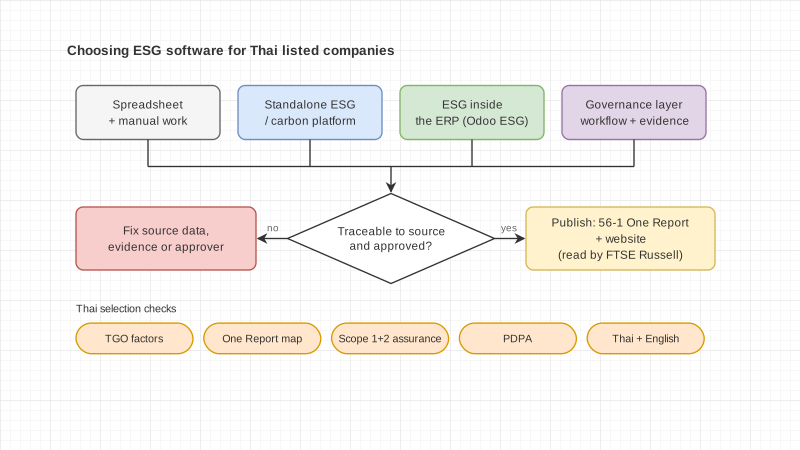
Thai listed companies should choose ESG software on three things: where the source data lives, whether each number can be traced back to evidence, and who approves it. Report layouts come later. There are four options: spreadsheets and manual work, standalone ESG platforms, ESG inside the ERP such as the Odoo ESG app, and a governance layer. Each fits a different situation.
This guide is for sustainability managers, CFOs, company secretaries and investor relations teams building a shortlist. We do not rank any vendor, and we describe Odoo only from what Odoo's own documentation says. We checked every regulatory fact against official pages on 12 October 2026.
Why rethink ESG software in 2026
Because the people reading your ESG data have changed. From 2026 (B.E. 2569), the Stock Exchange of Thailand (SET) uses FTSE Russell ESG Scores in place of the questionnaire-based SET ESG Ratings, which ended with the 2025 round. SET's guideline states that from December 2026 there will be no SET ESG Ratings assessment.
According to SET Sustainability, FTSE Russell assesses companies from what they have already disclosed in public: the annual report, sustainability report, integrated report or company website. Scores run from 0 to 5.0, and on average a company is assessed on about 125 indicators. Data you never published does not count. We cover the preparation work in our guide to moving from SET ESG Ratings to FTSE Russell.
The second push comes from the Thai SEC. Infoquest reported on 28 November 2025 that the SEC is keeping the IFRS S1 and S2 approach. The first phase covers climate only, with Scope 1 and Scope 2 emissions disclosed with assurance, starting with companies that qualify for the SET50 at the December 2026 review and the SET100 at the December 2027 review. The SEC is still revising its notifications, so the first reporting year depends on the final rules. Details are in our Scope 1 and 2 assurance readiness article for SET50 companies.
Together these shift the question from "does the system produce a nice report" to "where did this number come from, who checked it, and where is it published".
How the four options differ
They differ in where the data lives and who keeps the evidence. The table gives the overview.
| Option |
Where the source data lives |
Strengths |
Limits to know |
| Spreadsheets and manual work |
Files sent in by each department |
Start today, no purchase, easy to change forms |
Mixed file versions, formulas that break silently, hard to trace evidence, depends on a few people |
| Standalone ESG or carbon platform |
The vendor's system, fed by imports or forms |
Ready-made indicators and emission factor libraries, framework reports |
Data still has to move in from accounting and other systems. Check how well it handles Thai factors and Thai reports |
| ESG inside the ERP, such as the Odoo ESG app |
Accounting entries, employee records and operations already in the ERP |
Numbers come from real transactions, no double entry |
Covers only data held in the ERP. Governance topics and approvals usually need extra design |
| Governance layer (workflow and evidence) |
Sits above several data sources |
Controls access, task status, evidence and change history in one cycle |
Does not calculate carbon itself. Works alongside a data source or calculator |
Many companies combine them. A common pattern is to use the ERP as the source for energy and purchasing data, then put a governance layer on top to run the monthly collection cycle.
Selection criteria for Thai listed companies
Useful criteria are the ones tied to Thai rules and to the people who read your reports, not a generic feature list. We suggest these seven.
- TGO emission factors. Thailand's Greenhouse Gas Management Organization (TGO) publishes a CFO Emission Factor file dated January 2026. Grid electricity for Scope 2 (grid mix 2022 to 2024) is 0.475 kgCO2eq per kWh. The software should let you import this set, keep versions, and show which factor set each year's figures used.
- 56-1 One Report mapping. Each indicator should map to a disclosure item in Form 56-1 One Report and to the data you submit to SET's ESG Data Platform, which has taken energy, greenhouse gas, employee and board data through SETLink since 3 October 2022. See our SET ESG Data Platform guide.
- Public disclosure. FTSE Russell reads your reports and website. The software should tell you which figures are published, on which page, and whether they match what you sent to the ESG Data Platform.
- Scope 1 and 2 assurance readiness. The SEC says assurance can come from corporate carbon footprint verifiers registered with TGO, or other verifiers working to international standards. A verifier will trace from the total down to the electricity bill, fuel receipt or meter reading. The software must keep that link.
- PDPA. Employee data behind social indicators, such as sex, pay and workplace injuries, is personal data under Section 6 of the Personal Data Protection Act B.E. 2562 (2019). Some of it, such as health, disability and trade union data, falls under the stricter rules of Section 26. The software should separate access to individual records from aggregate figures.
- Thai and English. Form 56-1 One Report is in Thai. If your company also publishes a sustainability report or investor pages in English, indicator names, units and descriptions should come from one source so the figures never differ between versions.
- Evidence and approvals. Every figure should carry a data owner, reviewer, approver, date and attachment. Edits after approval must leave a history.
If part of your data comes from suppliers, such as Scope 3 or labour data in the supply chain, add criteria for collecting external data. We cover that in our article on supplier ESG data collection.
Criteria table
No option meets every criterion without configuration or extra design. This table shows what each type usually needs. It does not score anything, because results depend on the product and the setup.
| Criterion |
Spreadsheets |
Standalone ESG platform |
ESG in the ERP |
Governance layer |
| TGO emission factors |
Typed into the file by hand |
Check for Thai factors or self-import |
The Odoo ESG app needs factors imported by you |
Does not calculate; uses factors from the data source |
| 56-1 One Report mapping |
Build your own mapping sheet |
Check for a Thai template or build your own |
Build your own mapping |
Stores the mapping and its status |
| Public data FTSE Russell reads |
Manual cross-checking |
Depends on whether it records what was published |
Needs extra design |
Can record where each figure is published |
| Scope 1 and 2 assurance |
Attach files by hand, hard to trace |
Check evidence attachment per entry |
Traces to accounting entries; evidence outside the ERP needs design |
Keeps evidence and history |
| PDPA for employee data |
File-level access only |
Check field-level permissions |
Uses ERP access rights; set them to separate individual records |
Role-based access |
| Thai and English |
Two files |
Check report languages |
Depends on system translations |
Depends on configuration |
| Evidence and approvals |
Email and file names |
Check how many approval levels |
Not covered in the Odoo ESG docs |
The core job of this layer |
What the Odoo ESG app covers, and what Thai companies still need
The app calculates carbon well from data already in Odoo, but the parts tied to Thai rules still need design.
According to Odoo's documentation, the app takes activity data from accounting entries, employee commuting from Fleet and Employees, and manual inputs. It splits emissions into Scope 1, 2 and 3 under the GHG Protocol, can import emission factors from the ADEME database, shows sex parity and the pay gap, and tracks reduction work under Initiatives. Odoo's edition comparison lists ESG in Enterprise, not in Community.
The documentation does not mention TGO emission factors, 56-1 One Report mapping, governance topics, or review and approval steps for ESG figures. If you plan to use the app, count those four as design work. We walk through the features in our Odoo ESG app article and the monthly cycle in implementing ESG with PrivacyHub.
Questions to ask vendors in a demo
Ask the vendor to demo with one real indicator from your company, then ask these questions.
- Show us importing TGO's latest CFO Emission Factor file. When TGO releases a new set, do last year's figures change?
- From the company-wide electricity total, how many clicks to reach one branch's electricity bill?
- Who can edit a figure after approval, and how is the change history kept?
- How do you map indicators to 56-1 One Report items and to the data submitted to the ESG Data Platform?
- Can a verifier review the data without seeing individual employees' personal data?
- Where is employee data stored, who sees individual records, and can you delete or mask data when an employee asks?
- If energy data sits in a metering system or plant files, how is it imported, and how often?
- Do the Thai and English reports draw on the same set of figures?
- If we stop using the system, in what format can we export all data and evidence?
- What is the total cost over three years, including setup, data import and extra users, not only the subscription?
When each option fits
Each option has its place. Choose by where your source data lives and when you need assurance.
- Spreadsheets fit companies that are just starting, have few indicators and are not yet in a group that needs Scope 1 and 2 assurance. Use them as a trial period to learn what you need to collect.
- A standalone ESG platform fits companies whose source data is spread over many systems, with a full-time sustainability team that wants report templates for international frameworks.
- ESG in the ERP fits companies whose accounting, purchasing and employee data already sit in one ERP, and who want carbon figures to come from real transactions.
- A governance layer fits companies that already have the data but run an unsteady collection cycle, are not sure who has submitted, and worry about evidence at assurance time.
If you are unsure which layer to start with, read our seven-layer sustainability data foundation first.
Frequently asked questions
What is the best ESG software for a Thai listed company?
There is no single best tool for every company. The right one pulls data from your source systems, keeps evidence a verifier can trace, and produces figures that match your 56-1 One Report and what you publish.
Can we keep using Excel for ESG?
Yes, while you have few indicators and no assurance requirement. Once your company has to disclose Scope 1 and 2 with assurance, tracing numbers back to source documents across many file versions takes a lot of time.
Do we still fill in the SET ESG Ratings questionnaire in 2026?
No. The questionnaire assessment ended with the 2025 round. From 2026, FTSE Russell assesses companies from their public disclosures, so ESG software should help keep published data complete and consistent.
Can a Thai company use the Odoo ESG app as it is?
It can calculate carbon from Odoo data, but it requires the Enterprise edition, and you will need to add TGO emission factors, 56-1 One Report mapping and approval steps, because Odoo's documentation does not cover them.
Does PDPA apply to employee data in ESG reports?
Yes. Data that identifies an employee is personal data, and some types, such as health or disability, are sensitive. Report aggregates and limit who can see individual records.
What Enersys does
Enersys is a Bangkok software house that has built business software since 2012 and is an Official Odoo Silver Partner. This is our second year working with Odoo, and we won Odoo Awards 2026 Best Starter APAC.
For ESG, we build a custom ESG module on Odoo for Thai listed companies, scoped to each company's indicators, source systems, approvals and report format, and we set up the standard Odoo ESG app where the company runs Enterprise. We run monthly ESG data cycles on PrivacyHub's governance base, meaning role-based access, workflow status, evidence and audit history, and build ESG-specific functions per project. KPI dashboards map to 56-1 One Report or GRI with links back to source documents, Genesis AI drafts reports with human review, and employee data is handled under PDPA.
See our ESG page for details. If you want to test the criteria in this guide on one of your own indicators, contact the Enersys team.
Sources
- FTSE Russell ESG Scores, SET Sustainability, The Stock Exchange of Thailand (accessed 12 Oct 2026)
- The Guideline to FTSE Russell ESG Scores (Thai edition), The Stock Exchange of Thailand (accessed 12 Oct 2026)
- ESG Data Platform launch news release, The Stock Exchange of Thailand (accessed 12 Oct 2026)
- SEC revises principles for ISSB sustainability disclosure, Infoquest, 28 Nov 2025 (accessed 12 Oct 2026)
- Emission Factor (CFO), Thailand Greenhouse Gas Management Organization (accessed 12 Oct 2026)
- Personal Data Protection Act B.E. 2562 (2019), Royal Thai Government Gazette (accessed 12 Oct 2026)
- ESG, Odoo saas-19.4 Documentation, Odoo S.A. (accessed 12 Oct 2026)
- Compare Editions, Odoo S.A. (accessed 12 Oct 2026)