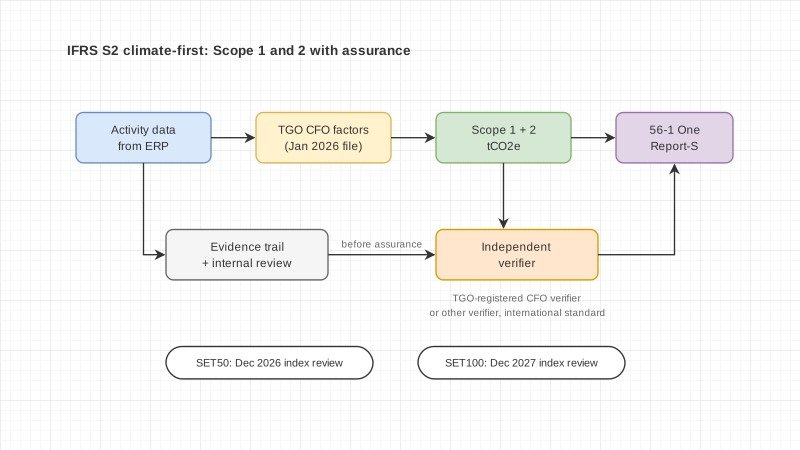
Thailand's SEC has confirmed that listed companies will disclose sustainability information under IFRS S1 and S2. The first phase is climate-first: companies disclose Scope 1 and Scope 2 greenhouse gas emissions, and those figures must be verified. The first group is companies in the SET50 at the December 2026 index review, followed by the SET100 at the December 2027 review.
This guide is for sustainability managers, CFOs, company secretaries, IR teams and internal auditors. On 12 October 2026 we read SEC news release 298/2568, the SEC One Report page, and two pages from Thailand's Greenhouse Gas Management Organization (TGO): its corporate carbon footprint (CFO) emission factors and its list of verification bodies. Below we separate what is confirmed from what is still pending, and what you can prepare now.
Thai dates in SEC documents use the Buddhist Era. 2568 is 2025, 2569 is 2026 and 2570 is 2027.
What has the SEC confirmed?
The principles are confirmed, while the detailed notifications are still being updated. News release 298/2568, dated 28 November 2025, says that after its public consultation the SEC kept the ISSB approach and revised only the start dates, which the Capital Market Supervisory Board approved in November 2025.
| Item | Status under release 298/2568 |
|---|---|
| Standards | IFRS S1 and IFRS S2 from the ISSB |
| First-phase scope | Climate-related reporting first, which the SEC calls "Climate-first reporting" |
| Greenhouse gases | Scope 1 and Scope 2 disclosure |
| Verification | Data must be verified to a credible standard |
| Start | Phased-in, with transition reliefs |
| Where it goes | Form 56-1 One Report-S or related documents |
| Still pending | Notifications and documents the SEC is updating, to be announced when done |
The ISSB issued IFRS S1 and S2 on 26 June 2023. S1 sets general requirements for sustainability disclosure, and S2 sets specific climate-related disclosures used together with S1. If you want a refresher on how ISSB relates to other frameworks, read the difference between sustainability and ESG.
Which companies are covered, and which index list applies?
The SEC groups companies by SET index membership. The SET50 group is companies in the SET50 at the December 2026 review, and the SET100 group is companies in the SET100 at the December 2027 review.
A note in the release lists who is covered: Thai companies and foreign companies with shares traded on the SET, companies making an IPO, REITs, infrastructure trusts, property funds and infrastructure funds. Non-listed companies and companies on the LiVE Exchange are not covered.
The release shows the reporting and filing year for each group as an image table, so we do not restate the years here. Check the table in SEC news release 298/2568 directly and watch for the updated notification. As of this writing (12 Oct 2026), the December 2026 index review has not happened yet, so companies near the SET50 cut-off should prepare as if they are already in scope.
Who can verify?
The SEC allows two routes: a corporate carbon footprint verifier registered with TGO, or another verifier, provided the verification follows international standards.
TGO's list of organisation-level verification bodies showed 24 legal entities on 12 Oct 2026. Each entry gives a registration date, an expiry date and the sectors it may verify, such as general manufacturing, transport or mining. Before you choose a verifier, check three things.
- Its registered sectors match your business.
- Its registration does not expire during your verification period.
- If the verifier is not on the TGO list, ask which international standard it verifies against.
The SEC also publishes a greenhouse gas reporting guide for listed companies on its One Report page. Part one covers disclosure in Form 56-1 One Report. Part two covers preparing, verifying and certifying a corporate carbon footprint. Your team should read it before talking to verifiers.
How should you use the January 2026 TGO emission factors?
Use them as the multiplier for activity data, and record every time which file and which item number you used. TGO's Emission Factor (CFO) page currently shows a file called Emission Factor CFO (January 2026, มกราคม 2569) with 153 items, covering stationary combustion, fuels, electricity and refrigerants.
For electricity, which is the largest part of Scope 2 for many companies, the file has several factors that look alike.
| Item | Description | Factor (kgCO₂e per kWh) |
|---|---|---|
| 137 | Grid mix 2016 to 2018, CFO Scope 2 | 0.4999 |
| 140 | Grid mix 2022 to 2024, CFO Scope 2 | 0.475 |
| 141 | Fuel supply for power generation, 2022 to 2024, Scope 3 | 0.0812 |
| 142 | Grid mix 2022 to 2024, product carbon footprint (CFP) | 0.5562 |
Factors labelled CFP or Scope 3 are not corporate Scope 2 factors. Pick the wrong row and the whole year is off. Picture a company that uses 1,000,000 kWh a year. Item 140 gives about 475 tonnes CO₂e, while item 137 gives about 500 tonnes. That 25-tonne gap comes only from the factor choice; the activity data has not changed.
Agree with your verifier which factor set applies to which reporting year, and write it down as a policy. Never overwrite old factors in the same file. When TGO publishes a new version, you need to show which set last year's figures used.