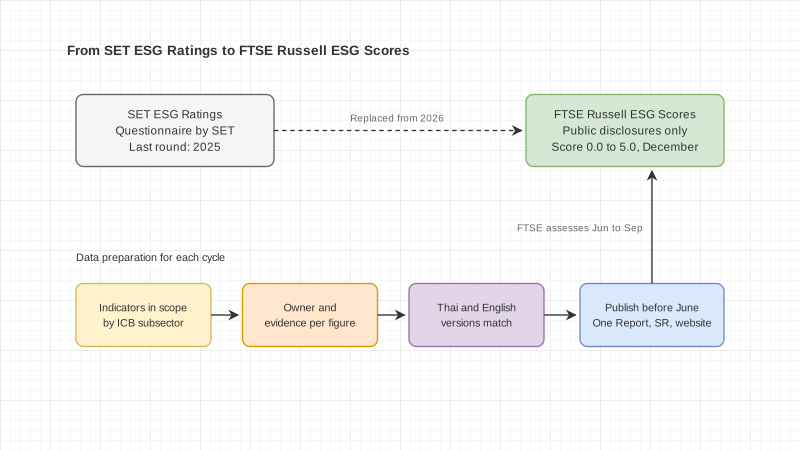
From 2026 there is no SET ESG Ratings questionnaire for listed companies to answer. The 2025 round was the last one. FTSE Russell now gives each company an ESG score from 0.0 to 5.0 based only on what the company has published. Preparing SET ESG Ratings data this year means putting every figure in the annual report, the sustainability report or on the website, with an owner and evidence behind it.
This guide is for sustainability managers, CFOs, company secretaries and investor relations teams who used to prepare the sustainability questionnaire every year. On 12 October 2026 we read the Thai-language FTSE Russell ESG Scores guideline, the 2026 FAQ, the 2025 results deck and the related pages of the Stock Exchange of Thailand (SET), and turned them into steps a team can act on.
Does SET ESG Ratings still exist in 2026?
Not as a questionnaire. SET's 2025 criteria document says "The year 2025 will be the final year" in which SET runs the SET ESG Ratings assessment itself, and the Thai guideline states that from December 2026 SET will not run SET ESG Ratings again.
2024 and 2025 were a two-year transition. FTSE Russell assessed Thai companies as a pilot, the results were not made public, and each company saw only its own score on the FTSE Russell platform. From 2026, SET publishes the scores of every assessed company on set.or.th, setsustainability.com, settrade.com and setsmart.com.
Many people still search for SET ESG Ratings, which makes sense. The name has been used since 2023, and before that the list was called THSI, which started in 2015. What teams need to prepare now, though, is data for FTSE Russell ESG Scores.
SET ESG Ratings compared with FTSE Russell ESG Scores
The biggest difference is that the old system had companies answer a questionnaire, while the new one has an outside assessor read what companies have already disclosed. This table summarises SET's documents.
| Topic |
SET ESG Ratings (to the 2025 round) |
FTSE Russell ESG Scores (from 2026) |
| Assessor |
SET |
FTSE Russell |
| Data source |
Company answers a sustainability questionnaire |
Public disclosures, no questionnaire |
| Participation |
Voluntary application |
Automatic group plus a voluntary group |
| Structure |
3 dimensions, more than 120 indicators, at least 50% needed in each |
3 pillars, 14 themes, more than 300 indicators, about 125 used per company on average |
| Result format |
AAA, AA, A, BBB |
Score from 0.0 to 5.0 |
| Announcement |
Once a year, in December |
Once a year, in December |
| What the company gets back |
Feedback Report |
Score and Feedback Report on the FTSE Russell platform |
| Index using the results |
SETESG Index |
FTSE4Good Thailand Index |
The 2025 SET ESG Ratings are still used for the SETESG Index reviews in December 2025 and June 2026. For the FTSE4Good Thailand Index, the FAQ says interested asset managers may start using it from January 2027.
SET ESG Ratings 2025 results, the final round
SET announced the results on 12 December 2025. 365 listed companies took part and 265 were rated.
| Rating |
Score range |
Companies |
| AAA |
90 to 100 |
102 |
| AA |
80 to 89 |
80 |
| A |
65 to 79 |
67 |
| BBB |
50 to 64 |
16 |
These numbers matter for the new system, because a company rated in any year from 2023 to 2025 is in the group FTSE Russell assesses without an application.
Which companies are assessed automatically, and who has to apply?
Companies in these two groups are assessed every year without applying, and they cannot opt out.
- Companies rated in SET ESG Ratings in any year from 2023 to 2025 and not derated after the announcement
- Companies in the SET100 at any index review from December 2022 to December 2025
Both groups still have to meet SET's qualifying criteria and pass the controversy screening SET runs in May before it sends the list to FTSE Russell. If a company is not on the list SET emails in early June, it is not assessed that year.
Other companies on SET and mai, as well as REITs and infrastructure funds, can apply as volunteers. The 2026 conditions were:
- Fill in at least 85% of SET's ESG Data Platform on SET Link, approved by the ESG-approver, by 30 April 2026
- Download all ESG Data Platform data as a PDF, publish it on the company website in Thai and English, and submit the application by 6 May 2026
- The quota is 50 companies. If more qualify, SET picks those that have filled in the most on the ESG Data Platform
- Assessment is free, but once a company joins it cannot withdraw, and its results are published every year
The 2026 application round has closed. If you plan to apply next year, wait for SET's 2027 criteria, but start filling in the ESG Data Platform now, since it is both the entry gate and the ranking rule. We explain how to fill it in in our SET ESG Data Platform guide.
What does one assessment cycle look like?
A cycle starts with screening in May and ends with scores in December. This table uses the 2026 schedule from SET's guideline, FAQ and results deck.
| When |
What happens |
| 16 Feb |
SET announces the criteria for voluntary applicants |
| 31 Mar to 6 May |
Volunteers receive the invitation, fill in the ESG Data Platform and apply |
| May |
SET screens for controversies before sending the list to FTSE Russell |
| Early Jun |
SET emails the list of companies being assessed; volunteers hear by 5 June |
| Jun to Sep |
FTSE Russell assesses public disclosures |
| Sep to Oct |
Companies review preliminary results and can add information for about 4 weeks |
| Dec |
Scores are announced |
The scores announced in December 2026 are based on performance as at the end of 2025 for companies with a December year end. The reports you publish early in the year are the main input for the score at the end of it. If the 2027 cycle follows the same pattern, your 2026 data needs to be fully public before June 2027.
How to read a score from 0 to 5, and which themes apply
A score of 0.0 means there was nothing to assess, and 5.0 means best practice. SET uses 3.0 as a reference point for good practice, but its FAQ calls this a rough guide and suggests looking at the theme scores too.
SET's results deck lists the 14 themes under 3 pillars.
- Environmental: Biodiversity, Climate Change, Pollution & Resources, Water Security, Supply Chain (Environmental)
- Social: Labour Standards, Human Rights & Community, Health & Safety, Customer Responsibility, Supply Chain (Social)
- Governance: Anti-Corruption, Corporate Governance, Risk Management, Tax Transparency
Not every company is assessed on all 14. FTSE Russell picks themes from the company's ICB subsector, which follows its main source of revenue, and from the countries where it operates. A company earning more than 30% of revenue in another country is also assessed on that country's themes. The exception is Anti-Corruption and Corporate Governance, which every Thai company is assessed on whatever its subsector.
So writing about a topic in detail in the One Report does not bring that theme into scope if your subsector does not cover it. The reverse also holds: a theme that applies but has no data scores low.
How to prepare data when the assessor reads only what you publish
The rule is simple: every indicator in scope needs a public location, an owner and evidence. A figure that lives only in the sustainability team's spreadsheet counts the same as no data.
- List the indicators you will actually be assessed on. Start with the themes for your subsector in the guideline appendix, then go through FTSE Russell's Thai-language indicator list item by item.
- Give each indicator an owner. Energy and greenhouse gases usually sit with engineering or the plant, workforce and safety data with HR and the safety officer, and anti-corruption policy with the company secretary or compliance. A second person should review.
- Keep evidence next to each figure: electricity invoices, board minutes, supplier assessment results, verification reports. The guideline says many indicators expect independently verified data, such as greenhouse gas emissions, energy and health and safety. For Scope 1 and 2 assurance, see our IFRS S2 readiness guide for SET50 companies.
- Decide where each item is published. Annual performance figures go in the 56-1 One Report and the sustainability report. Policies, manuals and supporting evidence go on the company website, on pages that can be linked to and are not behind a login.
- Publish in Thai and English. The guideline requires both languages only for the ESG Data Platform PDF that volunteers post. Still, FTSE Russell is a global rater, and our advice is to make the English version match the Thai figures and boundaries exactly.
- Close the data before assessment starts. The FAQ advises finishing website updates before June and using the review window only to fill gaps.
If you do not yet have an ESG database that keeps figures, owners and evidence together, read our 7-layer ESG data foundation for listed companies first. The steps above get much easier.
How to use the 4-week review window
The window is short, so the indicator register and evidence links need to exist beforehand. After the assessment, FTSE Russell emails login details so the company can see its preliminary results, comment, and point to more sources. FTSE Russell then reprocesses the results before the December announcement.
Anything you point to must be public, and it must be online by 30 September or within the review window. A team with a table showing which indicator sits on which page of the One Report or at which website URL can answer within a day. A team that has to hunt for files each time often runs out of window.
Questions about the assessment go to FTSE Russell at FTSE4GOOD@FTSERussell.com. Questions about applications and criteria go to SET at SETsustainability@set.or.th.
Where SET says Thai companies are still weak
SET's 2025 results deck lists gaps that line up with FTSE Russell's indicators and the ISSB standards.
- Climate governance at board and management level. Many companies only say the board oversees sustainability in general
- Quantified financial impact of climate risk
- Scope 3 greenhouse gas disclosure
- Supply chain analysis that identifies critical suppliers the company does not buy from directly (Critical Non-Tier 1), and results of supplier risk management
- Human rights due diligence (HRDD) that fits the business rather than following a template
Each of these needs months of continuous data. They are hard to write up in the week before a report goes out.
Frequently asked questions
Do we still need to fill in the SET ESG Ratings questionnaire in 2026?
No. SET ran SET ESG Ratings for the last time in 2025. From 2026, FTSE Russell scores companies from their annual report, sustainability report and website, and sends no questionnaire.
We had a SET ESG rating. Will FTSE Russell assess us?
If you were rated in any year from 2023 to 2025 and were not derated, you are in the automatic group. You do not apply and cannot opt out, but you still need to pass SET's qualifying criteria and screening each year.
What counts as a good FTSE Russell ESG score?
SET uses 3.0 as a reference for good practice and 5.0 for best practice. SET's 2025 deck shows a draft entry threshold for the FTSE4Good Thailand Index of an overall score of 2.9 or higher, and notes the information may change.
Do we have to disclose in English?
The guideline requires Thai and English only for the ESG Data Platform PDF posted by voluntary applicants. The documents we read set no language rule for other reports. Because the assessor is a global firm, an English version that matches the Thai one lowers the chance that something is missed.
Can we publish our own score?
Yes. A company can publish its own score in its reports or on its website, but should not compare itself with named companies, and should not use the FTSE Russell logo unless it is a member of an FTSE index.
What Enersys does
Enersys is a Bangkok software company that has built business software since 2012 and is an Official Odoo Silver Partner. This is our second year working with Odoo, and we won the Odoo Awards 2026 Best Starter APAC.
For ESG, we build a custom ESG module on Odoo for Thai listed companies, scoped to each company's indicators, source systems, approvals and report format. Our monthly ESG data cycles run on PrivacyHub's governance base, meaning role-based access, workflow status, evidence and audit history, with ESG-specific functions built for each project. KPI dashboards map indicators to the 56-1 One Report or GRI and link back to source documents, which is what a team needs during the FTSE Russell review. Genesis AI helps draft the report with a person reviewing every step, and employee data is handled under the PDPA.
See our ESG page. If you want to go through your indicators together and find the ones that have no public location or no evidence yet, contact the Enersys team.
Sources
- The Guideline to FTSE Russell ESG Scores (Thai edition), The Stock Exchange of Thailand (accessed 12 Oct 2026)
- FAQs on FTSE Russell ESG Scores and the FTSE4Good Thailand Index (as of March 2026, Thai), The Stock Exchange of Thailand (accessed 12 Oct 2026)
- SET ESG Ratings 2025 results announcement (12 Dec 2025, Thai), The Stock Exchange of Thailand (accessed 12 Oct 2026)
- SET ESG Ratings 2025 results page, SET Sustainability (accessed 12 Oct 2026)
- FTSE Russell ESG Scores assessment process, SET Sustainability (accessed 12 Oct 2026)
- Invitation to apply for FTSE Russell ESG Scores 2026 (voluntary group), SET Sustainability (accessed 12 Oct 2026)
- SET ESG Ratings, SET Sustainability (accessed 12 Oct 2026)
- Criteria and Guideline Corporate Sustainability Assessment 2025, The Stock Exchange of Thailand (accessed 12 Oct 2026)
- SET ESG Ratings: the final year before the move to FTSE Russell ESG Scores in 2026 (Thai), SET Insights (accessed 12 Oct 2026)
- FTSE Russell ESG Data Model Indicators, Thai edition, LSEG (accessed 12 Oct 2026)
- SET launches the ESG Data Platform for listed companies (news release, 4 Oct 2022, Thai), The Stock Exchange of Thailand (accessed 12 Oct 2026)