Say your company installed solar panels on the factory roof last year, cut water use and ran safety training for every employee. Then your lender sends an ESG questionnaire. How many tonnes of greenhouse gas did you emit last year? Where does that figure come from? Who on the board is responsible?
The team did a lot of good work, but cannot fully answer the questionnaire.
That example shows the difference between two words people often use interchangeably. Installing solar panels is sustainability in action. The bank's questionnaire is ESG.
Sustainability is the goal
The most widely used definition comes from Our Common Future, the 1987 report of the UN's Brundtland Commission: meeting the needs of the present without compromising the ability of future generations to meet their own needs.
For a business, sustainability usually looks at three things together: the economy, society and the environment. The core question is what the business does to the world, and whether it can last.
There is no fixed way to measure sustainability. Each organisation sets goals that fit its business.
ESG is measurement and reporting
The term ESG comes from Who Cares Wins, a 2004 UN Global Compact report that asked financial institutions to bring environmental, social and governance factors into investment analysis.
So ESG started on the investor side, and it asks the opposite question. How do environmental, social and governance issues affect the company's risk and value, and how credible is what the company discloses?
Governance is the other difference. Sustainability treats the economy as one of its three areas, while ESG gives governance its own letter, because investors need to know who makes decisions and what checks exist.
Side by side
|
Sustainability |
ESG |
| What it is |
A goal and a way of thinking |
Criteria for measurement and reporting |
| Looks at |
The company's effect on the world |
These issues' effect on the company |
| Main users |
Management, employees, communities, customers |
Investors, banks, stock exchanges, regulators |
| Areas |
Economy, society, environment |
Environment, society, governance |
| How it is measured |
Set by each organisation |
Indicators, standards and ratings |
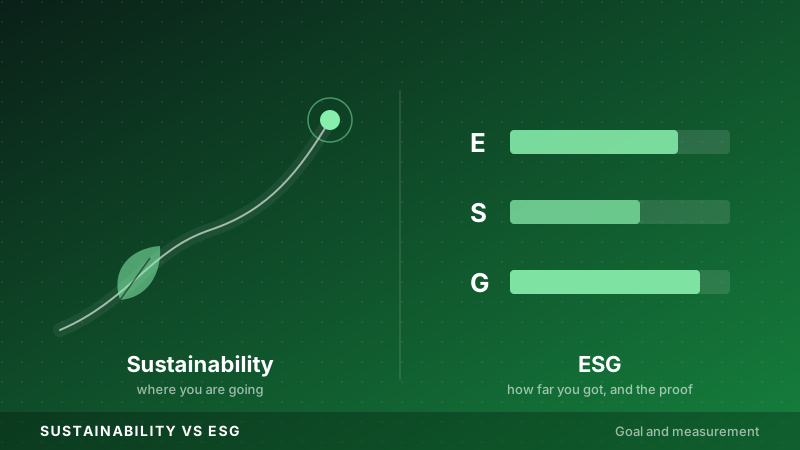
The two are not rivals. Sustainability says where you are going. ESG says how far you have got, and how outsiders can check it.
How ESG is measured in Thailand
Listed companies disclose this information in Form 56-1 One Report, which the SEC applied from fiscal years ending 31 December 2021. It covers greenhouse gas emissions, policies, targets and results, along with human rights and social and environmental impact.
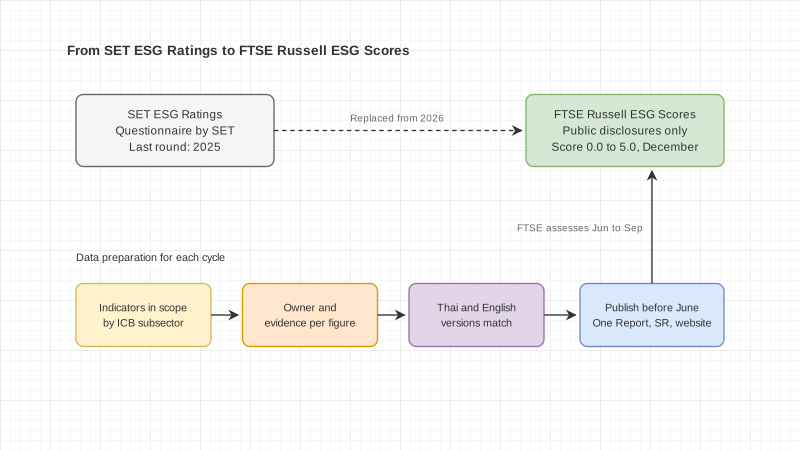
The Stock Exchange of Thailand used to rate companies that took part through SET ESG Ratings, renamed from THSI in 2023, on four levels: AAA, AA, A and BBB. In the first year under the new name, 193 companies were rated. That questionnaire-based assessment ended with the 2025 round. From 2026, SET uses FTSE Russell ESG Scores, which are built from a company's public disclosures such as its annual report, sustainability report and website. See our guide to SET ESG Ratings and FTSE Russell ESG Scores for how to prepare the data.
Internationally, the ISSB issued IFRS S1 on sustainability-related financial disclosures and IFRS S2 on climate-related disclosures in June 2023, and many jurisdictions are moving to adopt them.
Common mistakes
The first is a polished ESG report with no real change behind it: figures with no source, or targets not tied to how the business actually runs. That invites accusations of greenwashing and loses credibility as soon as someone checks.
The second is doing real good with no data to prove it, like the company in the example. Electricity costs sit in accounting, water use in a maintenance spreadsheet, training hours with HR. At reporting time someone gathers it all by hand, and nobody can trace it back.
The second is more common than people expect, and it is fixed by putting data in the right place from the start.
Where to start
- Set sustainability goals tied to the actual business, such as energy per unit produced or fewer factory accidents.
- Choose ESG indicators that track those goals and match what investors and customers actually ask.
- Record which system holds each figure, who owns it and how often it is collected.
- Move data collection into daily work, so the figures are created while people work, not when the report is due.
- Name a board member or executive who is accountable, and review the figures at least once a year.
What Enersys does
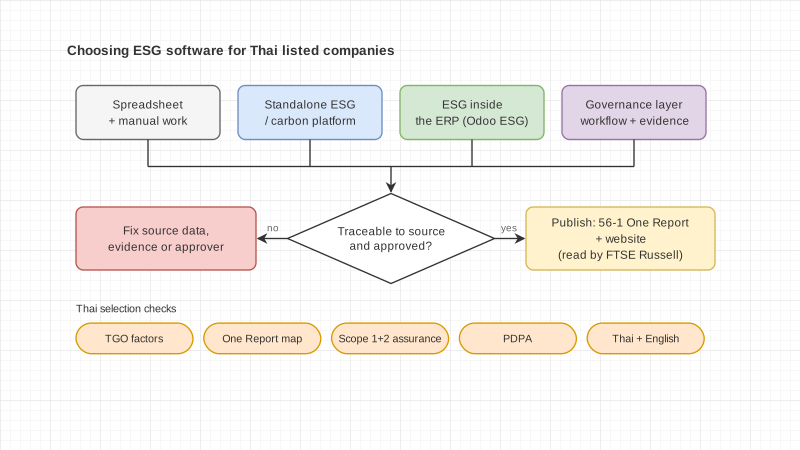
We build the data foundation on Odoo ERP so energy, purchasing, production and HR data sit in one system you can trace back, and use PrivacyHub to manage the personal data behind social indicators in line with PDPA. Read more in our articles on building a data foundation before sustainability reporting and running ESG on Odoo data.
If you already do sustainability work but still assemble ESG data by hand every year, talk to the Enersys team. We start by mapping which system holds each indicator.
Sources
- Sustainability, United Nations Academic Impact (definition from Our Common Future, 1987)
- ESG Turns 20: A Brief History, and Why It's Not Going Away, Morningstar Indexes (21 Jun 2024)
- SET announces SET ESG Ratings for 193 listed companies, Stock Exchange of Thailand (6 Nov 2023)
- FTSE Russell ESG Scores assessment process, Stock Exchange of Thailand, in Thai (accessed 12 Oct 2026)
- ISSB issues inaugural global sustainability disclosure standards, IFRS Foundation (26 Jun 2023)
- SEC requires a single 56-1 One Report and raises ESG disclosure, Mitihoon (1 Sep 2020, Thai)