Why you should read this article
You may have just heard the terms AEO and GEO for the first time — or maybe you’ve spent years reading about SEO but still aren’t clear on how these two differ, and why they matter now.
Here’s the reality: Web Mentions have a 3x stronger correlation with AI Citations than Backlinks do (0.664 vs 0.218) — the rules of the game have changed. What used to help you win on Google may do almost nothing in the world of AI Search.
This article will walk you through AEO and GEO from their origins and core differences to audit methods and website optimization strategies — everything Thai businesses need to understand in 2026.
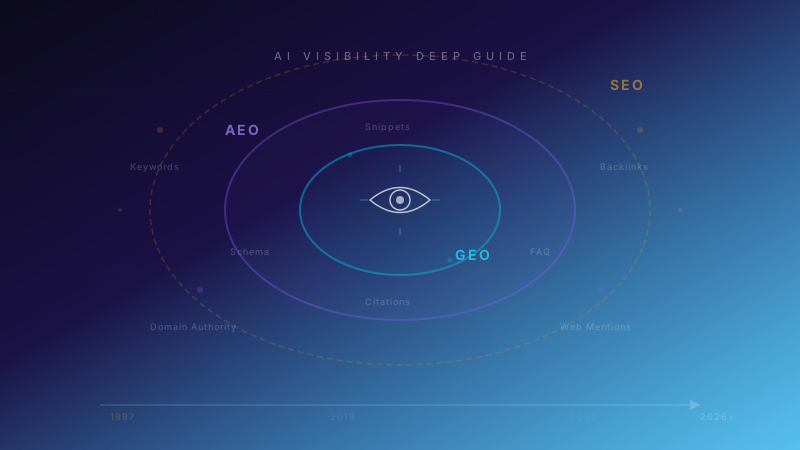
Timeline: From SEO to AEO to GEO
The SEO Era (1997–2022) — The age of 10 blue links
It all started with search engines — you typed in a query, Google showed 10 blue links, and the website ranking #1 won.
Strategy: stuff keywords, build backlinks, optimize technical SEO
What mattered: Domain Authority, Backlinks, Keywords
The AEO Era (2019–Present) — The age of the "single answer"
Google began showing Featured Snippets in 2014, but AEO became a serious discipline around 2019, when Voice Search took off — Siri, Alexa, and Google Assistant needed one clear answer, not 10 links.
Strategy: structure content into clear answers, use FAQ schema, optimize for featured snippets
What mattered: Content Structure, Schema Markup, Direct Answers
The GEO Era (2023–Present) — The age of AI-generated answers
When ChatGPT launched in November 2022, followed by Perplexity, Google AI Overviews, and Claude, information discovery changed permanently. AI no longer just selects answers from websites — it creates new answers by synthesizing information from multiple sources.
Strategy: make AI trust your content enough to cite and recommend it
What matters: Factual Density, Web Mentions, Structured Data, Citation-worthiness
Key timeline
| Year |
Event |
Impact |
| 1997 |
Google is founded |
Beginning of the SEO era |
| 2011 |
Google Panda + Penguin |
SEO shifts from "spam" to "quality" |
| 2014 |
Featured Snippets launch |
Start of the "Position Zero" era |
| 2019 |
BERT model + Voice Search surge |
AEO becomes a serious discipline |
| 2022 |
ChatGPT launches (Nov) |
Starting point of generative search |
| 2023 |
Google SGE (Search Generative Experience) enters testing |
AI Overview begins appearing in Google |
| 2024 |
Google AI Overviews launch globally |
Zero-click rises, GEO becomes essential |
| 2025 |
ChatGPT Search, Perplexity grow, AI referral traffic +527% |
Multi-platform AI search becomes normal |
| 2026 |
Gartner: Search volume -25%, AI drives 12–18% of referral traffic |
Businesses that fail to adapt begin disappearing |
AEO vs GEO — An in-depth comparison across every dimension
Definitions
AEO (Answer Engine Optimization)
Optimizing content so it appears as an "answer" in answer boxes, featured snippets, and voice search — focused on answering questions directly.
GEO (Generative Engine Optimization)
Optimizing content and digital presence so AI can synthesize and cite it in newly generated answers — focused on being "chosen" by LLMs.
Comparison table across 12 dimensions
| Dimension |
SEO |
AEO |
GEO |
| Goal |
Rank in search results |
Become the selected answer |
Be cited in AI output |
| Platforms |
Google, Bing |
Featured Snippets, Voice Assistants |
ChatGPT, Perplexity, Gemini, Claude |
| Core metrics |
Rankings, CTR, Traffic |
Snippet wins, Zero-click share |
AI citation frequency, Brand mentions |
| Content style |
Keyword-optimized |
Concise Q&A format |
Factually dense, quotable |
| Key signals |
Backlinks, Keywords, DA |
Question-answer structure |
Web mentions, Factual density, Freshness |
| Structured Data |
Nice-to-have |
Important |
Absolutely essential |
| E-E-A-T |
Helpful |
Important |
Decisive |
| Content Freshness |
Moderate |
Important |
Very important (7–14 day cycle) |
| Scope |
Search engines |
Answer features in search engines |
Every AI platform that generates answers |
| Web Mentions |
Via backlinks |
Moderate |
Most important (0.664 correlation vs backlinks at 0.218) |
| JavaScript |
Googlebot can render it |
Usually renderable |
Many AI crawlers cannot render it |
| robots.txt |
Googlebot |
Googlebot |
Must manage 9+ user-agents |
The relationship — it’s not either/or
SEO = Foundation
 └─ AEO = Layer 2 (Answer Layer)
     └─ GEO = Layer 3 (Generative Layer)
SEO builds the foundation: Technical SEO, Site Speed, Crawlability, Authority
AEO adds the answer layer: Content Structure, FAQ Schema, Featured Snippet optimization
GEO adds the AI layer: Factual Density, Citation-readiness, Multi-platform visibility, Web Mentions
If your SEO is weak, AEO won’t work — and if your AEO is weak, GEO won’t work. Every layer has to be strong.
Why backlinks are no longer enough in the GEO era
This is one of the most striking findings from the research:
Backlinks — the most powerful SEO signal for decades — show only a 0.218 correlation with AI Citations (low).
But Web Mentions — being mentioned on other websites even without a link — show a 0.664 correlation, which is 3x higher.
What does that mean?
AI doesn’t "count links" the way Google does — AI reads across the internet and decides which brands are talked about frequently in credible contexts.
Businesses with lots of backlinks but little real mention → AI skips them
Businesses that are frequently talked about, even without many backlinks → AI cites them
That’s why PR, content marketing, and brand building have become powerful GEO strategies — this is no longer just about link building.
60 checkpoints — How ready is your website for AI?
Category 1: AI Crawler Access (critical — do this first)
If AI can’t access your site, everything else is irrelevant.
What to check:
- Does
robots.txt allow AI crawlers? (GPTBot, ClaudeBot, PerplexityBot, etc.)
- Is Cloudflare or a WAF automatically blocking AI bots?
- Is server response time under 500ms?
- Does
sitemap.xml exist and is it valid?
- Do important pages have
noindex / nofollow?
- Is content rendered server-side (SSR/SSG), or does it require JavaScript?
Why it matters: AI crawlers like GPTBot and ClaudeBot behave differently from Googlebot — many of them do not render JavaScript. If your site is a fully client-rendered SPA (Single Page Application), AI may see nothing but a blank page.
Recommended strategy: Allow retrieval/search bots (such as OAI-SearchBot, ChatGPT-User) while selectively blocking training bots (such as GPTBot, Google-Extended) if needed — this helps balance AI visibility with content protection.
Category 2: Structured Data (very important)
Schema markup is the "native language" of AI — websites with structured data are 2.5x more likely to be cited by AI.
Schema you need:
- Organization — brand identity + company info + sameAs links
- FAQPage — questions and answers (even though Google has limited rich results, AI still uses this data)
- Article / BlogPosting — article details + author + publication date
- LocalBusiness — address, phone, business hours (for physical businesses)
- Product / Service — product or service details + pricing
- BreadcrumbList — site structure
- Person — author details (for E-E-A-T)
- SpeakableSpecification — indicates which parts can be read aloud (Voice Search)
How to check:
- Open Google Rich Results Test and enter the URL
- See whether schema is detected
- Check for errors or warnings
Category 3: Content Structure (very important)
AI prefers content that is clearly structured, directly answers the question, and is easy to extract from.
What to check:
- Is the H1 > H2 > H3 hierarchy correct?
- Do the first 200 words answer the main question? (Answer-first)
- Are headings phrased as questions?
- Is there a quick answer block above the fold?
- Are bullet points, numbered lists, and tables used?
- Is the content broken into clear sections?
Category 4: Citation Readiness (essential for GEO)
This is what makes GEO different from AEO — the content must be quotable enough for AI to choose it as a source.
What you need:
- Clear statements of 20–150 characters that AI can quote directly
- Numbers, statistics, percentages with cited sources
- Original research not available elsewhere
- Expert quotes or insight from real specialists
- Neutral, trustworthy tone rather than aggressive marketing language
- Avoid vague wording that AI would hesitate to cite
Example:
❌ "We provide the best service in the industry" → AI won’t cite this (opinion, not fact)
✅ "An ERP system can reduce month-end closing time from 15 days to 3 days for companies with 50–200 employees" → AI can cite this (specific, factual claim)
Category 5: E-E-A-T (AI’s deciding factor)
Experience
- Real case studies with numbers
- Portfolio / past work
- Reviews from real clients
Expertise
- Author bylines with real names and job titles
- Author bio pages with credentials
- Content that demonstrates deep subject knowledge
Authoritativeness
- Citations from other websites (Web Mentions)
- Presence in relevant directories and listings
- Backlinks from reputable websites
Trustworthiness
- HTTPS
- Privacy Policy + Terms of Service
- Contact page with a real address
- No spammy behavior or overwhelming pop-ups
Trust is the core — if AI doesn’t trust your site, it won’t cite you, no matter how good your content is.
Category 6: Brand Entity & Web Mentions
This is what many businesses miss — AI doesn’t just read your website, it reads everywhere you are mentioned.
What to do:
- Use your brand name consistently across all platforms
- Have a clear 1–2 sentence brand description
- Add
sameAs links connecting all platforms (website, LinkedIn, Google Business, Facebook)
- Appear in third-party directories and listings
- Get mentioned on other websites (links are not required)
Categories 7–10: Freshness, Performance, FAQ, Monitoring
Content Freshness: Update core content every 7–14 days and clearly display both publish date and updated date. ChatGPT gives strong weight to fresh content.
Technical Performance: Core Web Vitals (LCP < 2.5s, INP < 200ms, CLS < 0.1), HTTPS, mobile responsiveness, SSR/SSG
FAQ Coverage: Every service page should include FAQs that answer real customer questions and align with "People Also Ask"
Monitoring: Ask ChatGPT, Perplexity, and Gemini about your business — if you’re not mentioned, your AI Visibility is effectively zero
How to audit your website yourself (DIY Audit)
Step 1: Test AI Visibility (5 minutes)
Open these 3 platforms and ask questions related to your business:
ChatGPT: "Recommend the best companies for [your service] in Thailand"
Perplexity: "What are the best [your industry] companies in Thailand?"
Google (AI Overview): Search using long-form questions related to your services
Results:
- ✅ Mentioned → You have AI Visibility
- ⚠️ Mentioned but with wrong information → Your content needs to be clearer
- ❌ Not mentioned at all → You need to start GEO immediately
Step 2: Check the technical foundation (10 minutes)
- robots.txt: Visit
yoursite.com/robots.txt — check whether AI bots are disallowed
- Schema: Open Google Rich Results Test → enter URL → see whether schema exists
- PageSpeed: Open Google PageSpeed Insights → enter URL → check Core Web Vitals
- Mobile: Open the site on a phone — is it easy to read?
- SSL: Does the URL start with
https://?
Step 3: Check content quality (15 minutes)
Open 5 important pages on your website and answer these questions:
Step 4: Check web mentions (10 minutes)
Search your brand name on Google using quotation marks:
"your company name" — see how many pages mention you
"your company name" -site:yoursite.com — see only pages outside your own website
If the result count is under 50: your web mentions are low — AI may barely recognize your brand
What each AI platform values most
Each AI system has its own "preferences":
ChatGPT (60–68% market share)
- ❤️ Fresh content — puts weight on publication and update dates
- ❤️ Comprehensive information — prefers complete long-form content
- ❤️ Structured format — likes headings, lists, and tables
Perplexity (6–8% market share, but referral traffic as high as 18–22%)
- ❤️ Source-cited content — the more citations, the better
- ❤️ Numbers and statistics — prefers data-driven content
- ❤️ Comparisons — likes comparative analysis
Google AI Overview
- ❤️ E-E-A-T — heavily weighs credibility
- ❤️ Web Authority — still values domain authority
- ❤️ Answer-first content — wants a clear answer in the first paragraph
Claude
- ❤️ Accuracy — prioritizes factual correctness
- ❤️ Neutral content — prefers a neutral tone over marketing-heavy copy
- ❤️ Primary sources — favors content that serves as an original source
Website optimization strategy — from "invisible to AI" to "recommended by AI"
Level 1: Emergency fixes (week 1)
What you should do immediately, before anything else:
1. Unblock AI crawlers
Check robots.txt to make sure AI bots aren’t blocked — if they are, AI will never see your website.
2. Add Organization Schema
Implement JSON-LD Organization schema on every page — tell AI who you are, what you do, and where you are.
3. Verify HTTPS
If you still don’t have SSL, fix it immediately — AI is unlikely to cite insecure websites.
Level 2: Quick wins (month 1)
4. Add FAQ Schema to every service page
Use clear question-and-answer pairs that match what customers actually ask.
5. Rewrite content in an answer-first format
For every key section, place a 40–60 word answer directly under the heading.
6. Add author bylines
Include the real name and role of the person who wrote or is responsible for the content.
7. Improve your About Us page
Your company information, team, and experience should be complete and clear.
Level 3: Strategic improvements (months 2–4)
8. Build content clusters
Create groups of 5–10 articles around each core topic, covering every question your audience may ask.
9. Add citation-ready content
Include facts, numbers, statistics, and case studies that AI can quote directly.
10. Build web mentions
Use PR, guest posts, directory listings, and industry forums — get your brand talked about across the web.
11. Improve Core Web Vitals
LCP < 2.5s, INP < 200ms, CLS < 0.1 — faster websites perform better for both SEO and GEO.
Level 4: When a full rebuild is the better option
If your website has 4 or more of the issues below, rebuilding may be more cost-effective than trying to patch it:
- ❌ JavaScript-only rendering — AI crawlers see a blank page
- ❌ No CMS — you can’t update content yourself
- ❌ Not responsive — poor mobile usability
- ❌ Messy URL structure — illogical URLs, cluttered parameters
- ❌ No SSL — Google and AI reduce visibility immediately
- ❌ Page Speed under 40 — too slow to recover efficiently
- ❌ Built on outdated technology — Flash, old PHP, old WordPress themes
- ❌ No analytics — you can’t measure anything
Real-world data: Only 1 in 10 website migrations improves rankings — and when migration goes wrong, traffic can drop 50% for as long as 523 days (almost 1.5 years).
That’s why a new website should be built with SEO + AEO + GEO strategy from day one — not treated as an afterthought.
ROI numbers you need to know
SEO + AEO + GEO deliver the strongest long-term returns
- Organic search drives 53% of all traffic
- SEO delivers an average long-term ROI of 700%
- AI traffic has a 14.2% conversion rate vs typical organic at 2.8% — 5x higher
- Brands cited in AI Overviews gain 35% more clicks
- Businesses investing in AEO/GEO see 300% more qualified leads
- AEO ROI in the first quarter: 287–415%
- Customer acquisition costs can drop by 50–60%
The cost of doing nothing
- Zero-click search is already at 65% — and rising
- CTR drops 34–61% when AI Overviews appear
- Gartner predicts organic traffic will fall 50%+ by 2028
- Businesses that fail to adapt will gradually disappear from customer view on both Google and AI platforms
Recommended tools
Free
| Tool |
What it does |
| Google PageSpeed Insights |
Check Core Web Vitals |
| Google Search Console |
See indexing, errors, queries |
| Google Rich Results Test |
Validate Schema Markup |
| HubSpot AEO Grader |
Analyze AI Visibility for free |
Paid (for organizations taking this seriously)
| Tool |
What it does |
| SE Ranking AI Search Toolkit |
Track AI visibility + competitors |
| Profound |
Measure brand performance across AI platforms |
| Otterly.ai |
Monitor AI citations (ChatGPT, Perplexity, Google AIO) |
| Semrush / Ahrefs |
SEO + content analysis |
Conclusion — AEO + GEO are no longer optional, they’re survival strategy
Let’s return to the original question: Will AI "see" or "skip" your website?
The answer depends on 3 things:
- Can AI access your website? (Crawler Access + SSR + robots.txt)
- Can AI understand your content? (Schema + Structure + Answer-first)
- Does AI trust you? (E-E-A-T + Web Mentions + Factual Density)
If the answer is "no" to even one of these — your website is slowly disappearing from the view of customers, both in today’s Google Search environment and in the AI Search era that’s rapidly taking over.
The good news: most Thai businesses still haven’t started — which means those who move first have a huge advantage.
If you want to assess how ready your website is for AI Search or need to build a new website that supports SEO, AEO, and GEO from day one — contact the Enersys team. We analyze, design, and build websites that AI can find, trust, and recommend.
References