When Google Stops Sending Visitors to Your Website
Imagine this: a customer types a question into Google and gets a complete answer from AI Overview without ever clicking through to your website.
This is not the future — this is already happening
Recent data shows that 58–65% of all searches end without a click (zero-click search). When Google shows AI Overview, that number jumps to 83%.
Gartner predicts traditional search volume will decline by 25% by 2026 and 50% by 2028 — as people increasingly ask questions through ChatGPT, Perplexity, and AI assistants instead.
So the real question is: will your business still be discoverable?
This article will help you understand AEO (Answer Engine Optimization) from the ground up, along with advanced strategies and practical steps Thai businesses can take right now.
What Is AEO? — And Why You Need to Understand It Now
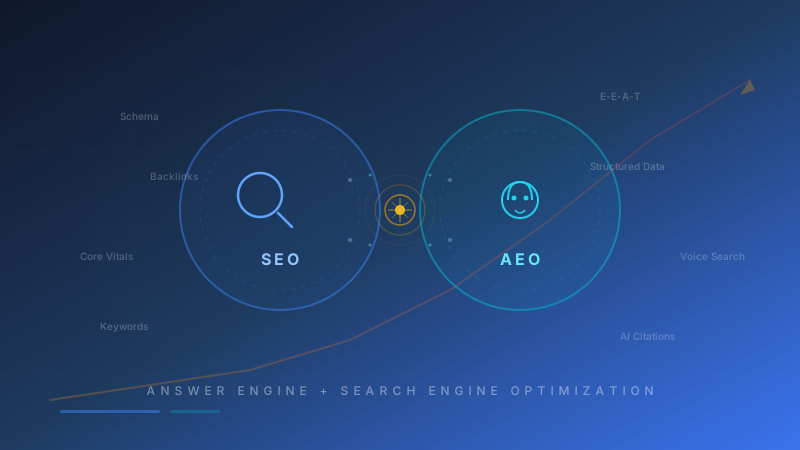
AEO (Answer Engine Optimization) is the process of structuring website content so that AI-powered search tools can extract, cite, and recommend your brand in automatically generated answers.
SEO vs AEO — What’s the Difference?
| Dimension | SEO (Search Engine Optimization) | AEO (Answer Engine Optimization) |
|---|---|---|
| Goal | Rank high in search results | Get cited in AI-generated answers |
| Platforms | Google, Bing | ChatGPT, Perplexity, Google AI Overview, Gemini |
| Methods | Keywords, Backlinks, Technical SEO | Structured Data, Answer-first Content, E-E-A-T |
| Outcome | Website clicks | Brand mentions → trust building → clicks |
| Measurement | Rankings, CTR, Organic Traffic | AI Citations, Brand Mentions, Referral Traffic from AI |
Key point: AEO does not replace SEO — the two work together, like two sides of the same coin.
SEO builds the foundation — AEO makes AI notice you
The Numbers Thai Businesses Need to Know
Search Has Already Changed
- 65% of searches end without a click (zero-click)
- When Google shows AI Overview, zero-click rises to 83%
- AI Overview appears in 25–50% of all searches, depending on query type
- For Education-related queries, AI Overview appears 83% of the time (up from 18%)
- For B2B Tech queries, AI Overview appears 82% of the time (up from 36%)
The Impact on Click-Through Rate (CTR)
- When AI Overview appears, CTR drops by 34–61% (Seer Interactive studied 3,100+ keywords across 42 organizations)
- Average CTR falls from 1.76% to 0.61% — more than half
- However — brands cited inside AI Overview see 35% more organic clicks and 91% more paid clicks
AI Search Is Growing Fast
| Platform | AI Search Market Share | Share of AI Referral Traffic |
|---|---|---|
| ChatGPT | 61-68% | 55-60% |
| Google Gemini | 15-18% | 10-14% |
| Perplexity | 6-8% | 18-22% |
| Microsoft Copilot | 13% | 6-9% |
| Claude | 4% | — |
- ChatGPT processes 1.6 billion queries per day — equal to 12% of total Google search volume
- AI referral traffic is growing 130–150% per year
- Adobe reports AI-driven referrals increased 10x between July 2024 and February 2025
Thailand Context
- Google holds 97–98% of Thailand’s search market
- 37.1% of Thai users discover new brands through search engines (the #1 channel, ahead of social media)
- 90%+ of web traffic in Thailand comes from mobile
- 35% of internet users in Bangkok use voice search every week
- Thai-language “near me” searches are growing 150% per year
Why Older Websites Become “Invisible” in the AI Search Era
Most websites built before 2024 tend to have these problems:
1. No Structured Data (Schema Markup)
AI does not “read” websites the way humans do — it needs clearly structured information. Websites with schema markup are 2.5x more likely to appear in AI answers and can see 20–30% higher CTR
But most Thai websites still have no schema at all.
2. Content Isn’t Structured in an “Answer-First” Format
AI wants a clear answer within the first 40–60 words under each heading, then supporting detail below. Websites with long, unstructured copy and vague sections are often skipped by AI.
3. Slow, Heavy, and Too Late to Load
Google uses Core Web Vitals as a key performance benchmark:
| Metric | What It Measures | “Good” Benchmark |
|---|---|---|
| LCP (Largest Contentful Paint) | Load speed | Under 2.5 seconds |
| INP (Interaction to Next Paint) | Responsiveness | Under 200 milliseconds |
| CLS (Cumulative Layout Shift) | Visual stability | Under 0.1 |
Websites that take longer than 2.5 seconds to load lose rankings — and AI ignores them too. Data shows pages that win in voice search load 52% faster than average
4. Poor Mobile Support
When 90%+ of Thai users browse on mobile, websites that are not mobile-friendly are practically invisible — both to Google and to AI systems.
5. Heavy JavaScript — AI Can’t Read It
Many AI crawlers cannot render JavaScript. If your content is hidden behind JavaScript that must execute first, AI may see only a blank page.
A Beginner’s AEO Guide for Thai Businesses
Step 1: Audit Your Current Position
Before changing anything, you need a clear picture of where you stand today:
Ask AI About Your Business
- Open ChatGPT, Perplexity, and Google Gemini
- Ask the same questions your customers would ask, such as “best website development company in Thailand” or “how to choose an ERP for SMEs”
- Check whether your brand is mentioned — and whether your competitors are
Review Your Technical Foundation
- Test Core Web Vitals using Google PageSpeed Insights
- Check schema markup with Google Rich Results Test
- Review Search Console for crawl errors
- Make sure robots.txt is not blocking AI crawlers
Use AEO Analysis Tools
- HubSpot AEO Grader — see how AI perceives your brand and compare it with competitors
- Google Search Console — identify queries that trigger AI Overviews
Step 2: Restructure Your Content
The “40-Word Rule” (Answer-First Structure)
For every important section on your website, place a direct 40–60 word answer immediately beneath the heading, then expand with more detail below.
Example:
❌ Old style: start with a long three-paragraph introduction before getting to the point
✅ AEO style: put a clear 2–3 sentence answer under the heading first → then explain further
Use Question-Based Headings
AI prefers content that directly answers real questions. Use H2/H3 headings in the form of questions your customers actually ask, such as:
- “Why is ERP useful for SMEs?”
- “How much does website development cost?”
- “Why should you use a CRM system?”
Create Content Blocks That AI Can Easily Pull
- Definition block: “What is X?” + 2–3 sentence answer
- Step-by-step block: “How to do X” + numbered list
- Comparison block: “X vs Y” + table
- FAQ block: question + short answer
Step 3: Add Structured Data (Schema Markup)
Schema markup is the “language” AI understands — without it, you are essentially speaking a different language from AI.
Most important schema types in 2026:
| Schema Type | Best For | Importance |
|---|---|---|
| Article / BlogPosting | Articles, blog posts | Very high — helps AI understand content |
| FAQPage | FAQ pages, common questions | Very high — formats Q&A for AI |
| Organization | About us pages | High — builds brand identity |
| LocalBusiness | Businesses with a physical location | High — essential for local/voice search |
| Product | Products and services | High — useful for AI shopping modules |
| BreadcrumbList | Every page | Medium — shows site structure |
| Person / Author | Articles, reviews | High — supports E-E-A-T attribution |
| SpeakableSpecification | Content intended for voice search | High — marks sections for spoken output |
Step 4: Build Strong E-E-A-T
E-E-A-T (Experience, Expertise, Authoritativeness, Trustworthiness) is the framework Google and AI systems use to judge content quality — and it matters more every day, because the internet is flooded with AI-generated content.
How to strengthen E-E-A-T:
- Experience: show real-world experience — case studies, portfolio work, measurable results
- Expertise: name real authors with titles and bios, not a vague “team” with no identity
- Authoritativeness: earn citations from other sources and backlinks from trusted websites
- Trust: secure site (HTTPS), clear contact details, privacy policy, authentic reviews
Trust is the most important factor — if AI does not trust your website, it will not cite it