One of the core missions of the Stock Exchange of Thailand (SET) is to build a sustainable capital market by helping listed companies grow steadily, stay financially sound and operate responsibly toward society and the environment under good corporate governance. The work began in 1994 with corporate governance (CG) practices and has since grown into tools most companies now know well: the annual Corporate Governance Report (CGR) survey, the SET ESG Ratings assessment and the Sustainability Awards.
The questionnaire-based SET ESG Ratings ran for the last time in 2025. From 2026, SET uses FTSE Russell ESG Scores, which are built from what a company has already published, such as its annual report, sustainability report and website. We cover how to prepare data for the new system in our article on SET ESG Ratings and FTSE Russell ESG Scores.
On its Sustainability at a Glance page, SET states a goal that matters a great deal to anyone who builds systems: companies should put what they learn into practice until it produces results that can be measured and disclosed to stakeholders. Measurable and disclosable means sustainability does not end with a policy or a well-written report. Every figure a company publishes needs data behind it.
This article describes what that data foundation looks like, which building blocks it contains and where to begin.
The report comes first and the data follows
Many organizations start sustainability work by writing the report. As the deadline for the 56-1 One Report or SET's ESG assessment cycle approaches, the team emails other departments for numbers. Accounting sends electricity costs from invoices, HR sends training hours from a spreadsheet, and purchasing sends a supplier list that has not been updated in years. Each department defines its data differently, this year cannot be compared with last year, and when an assessor asks for evidence the team has to dig through documents again.
The result is that every year starts from zero, takes many people and carries a high risk of error. That runs against good governance, the first area SET began developing back in 1994.
What SET expects from company data
SET defines a sustainable business as one that grows economically under good governance, manages risk effectively and delivers profit and returns to shareholders, while acting responsibly toward society and the environment. That responsibility extends across the supply chain, from raw material suppliers, customers and partners to logistics providers and local communities.
The topics SET groups under Know Sustainability cover corporate governance, ESG risk, sustainable supply chains, the environment, human rights, innovation, employees, communities, sustainability disclosure and investor relations. Every one of them needs data with a known source, a named owner, a fixed cadence and a trail back to evidence.
This is not only a concern for listed companies. Suppliers to listed companies are being asked for more ESG data, because their customers must report on their own supply chains.
Seven building blocks of sustainability data
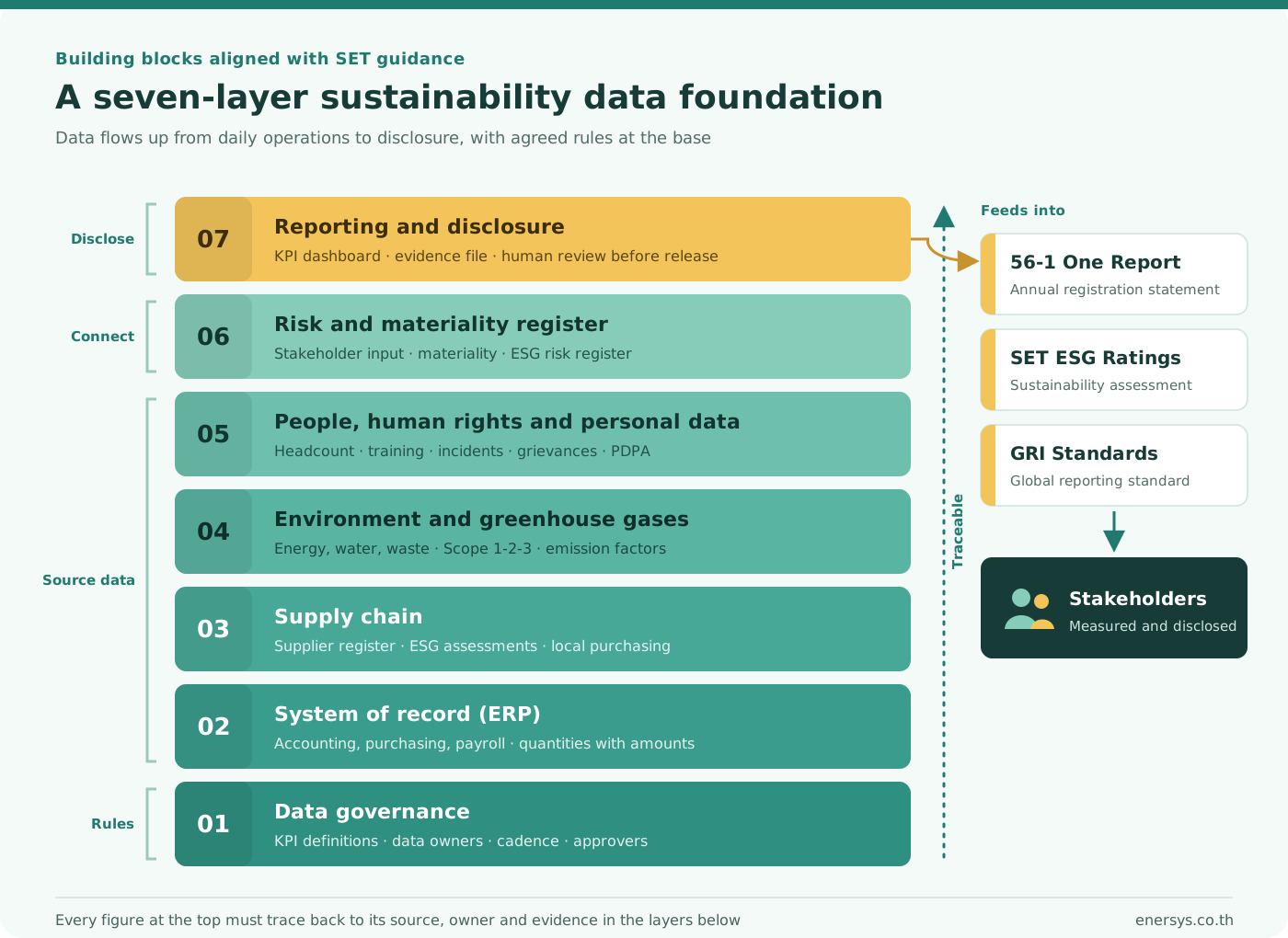
We split the foundation into seven layers, from rules at the bottom to disclosure at the top. This layering is the framework Enersys works with, not a SET requirement. No organization needs all seven in the first year, but it helps to see the whole picture before starting.
1. Data governance
The first layer is a set of rules, not a system. The organization has to agree how each indicator is defined, who owns it, how often it is collected and who approves it. Does "employee" include contract staff? Does energy use cover only head office or every branch? This layer produces a data dictionary and a data ownership table, which are direct evidence of good governance.
2. System of record
Most ESG data is already created in daily operations. Electricity, fuel, raw material purchases, waste disposal and payroll all pass through accounting and purchasing. If these transactions sit in one ERP and are categorised correctly from the start, for example by splitting fuel purchases by type or recording kilowatt-hours alongside the amount paid, environmental data arrives with every month-end close instead of being chased at year end.
3. Supply chain data
SET's definition of sustainability explicitly covers the supply chain, so organizations should keep an up-to-date supplier register, records of supplier code of conduct acknowledgement, supplier ESG assessments and the data needed to calculate the share of purchases from local businesses. This data should be tied to the purchasing system so it is clear whether each purchase came from an assessed supplier.
4. Environment and greenhouse gas data
With activity data from layer 2 in place, the next step is converting it into greenhouse gas emissions using emission factors, such as those published by the Thailand Greenhouse Gas Management Organization (Public Organization), or TGO. Start with Scope 1 and Scope 2 and extend to Scope 3 later. Keep the raw figures, the factors used and the year of each factor so a verifier can repeat the calculation.
5. People, human rights and personal data
Employee and human rights topics need data such as headcount by gender and age band, turnover, average training hours, incident statistics and grievances. The records behind these figures are personal data under Thailand's Personal Data Protection Act B.E. 2562 (2019), or PDPA, so the organization must be able to report in aggregate without exposing individuals and must record a clear lawful basis for processing. Good PDPA practice is therefore both a precondition for collecting ESG data and evidence of respect for human rights.
6. Risk and materiality register
A company has to be able to explain why it chose the issues it manages. This layer holds records of stakeholder engagement, the materiality assessment, the ESG risk register and the link between each issue and the indicators in layers 2 to 5. Once those links exist, the company can answer which numbers track each material issue and how they are performing.
7. Reporting and disclosure
The top layer is a dashboard and indicator set mapped to the frameworks in use: the 56-1 One Report sections, the FTSE Russell ESG Scores indicators SET uses from 2026, and international standards such as GRI, with an evidence file that links back to source documents. AI is useful here for drafting report text and summarizing data, but a person must review everything before it is published, because figures disclosed to investors are the company's responsibility.
SET topics and the data they need
| SET topic |
Example data required |
Main data source |
| Corporate governance |
Approved policies, data owners, meeting minutes |
Data governance, document system |
| ESG risk and materiality |
Risk register, stakeholder engagement results |
Risk register |
| Supply chain |
Supplier register, supplier assessments, local purchasing share |
ERP purchasing module |
| Environment |
Energy, water, waste, greenhouse gases Scope 1 to 3 |
ERP accounting and purchasing, meters |
| Employees and human rights |
Headcount, turnover, training hours, incidents, grievances |
HR system, PDPA system |
| Community and innovation |
Project budgets and outcomes, process improvement projects |
ERP projects, accounting |
| Disclosure |
KPI set mapped to 56-1 One Report, FTSE Russell ESG Scores, GRI |
Dashboard, evidence file |
How to start without overloading the team
First, survey. Take the topics required by the 56-1 One Report and the FTSE Russell ESG Scores indicators and check where each indicator is kept today, who looks after it and what is missing. The result is a gap list that can be prioritized.
Second, set the structure. Begin with the issues most material to the business rather than every topic at once. Define each indicator and its owner, then adjust daily processes so the data is captured at source.
Third, run and improve. Move from collecting data once a year to collecting it monthly with the accounting close, review figures internally before disclosure, and use SET's assessment results to improve the next cycle.
When data flows from daily work into the report on its own, the sustainability team gets time back for work that makes a real difference, such as cutting energy use, developing suppliers or looking after employees, instead of spending months chasing numbers.
How Enersys can help
Enersys works with business owners and operations teams to connect processes and data. Sustainability work usually starts with a data gap assessment against SET guidance. From there we configure Odoo ERP to capture environmental, supply chain and people data from daily operations, use PrivacyHub to manage personal data under PDPA, build indicator dashboards through our Data Analytics service, and use Genesis AI to draft and summarize reports, with a person reviewing every step.
If your organization is preparing a sustainability report, getting your public disclosures ready for FTSE Russell ESG Scores, or being asked for ESG data by a customer, contact the Enersys team to discuss a data foundation that fits the size and stage of your business.
References: The Stock Exchange of Thailand, Sustainability at a Glance and FTSE Russell ESG Scores assessment process (in Thai, accessed 12 Oct 2026)