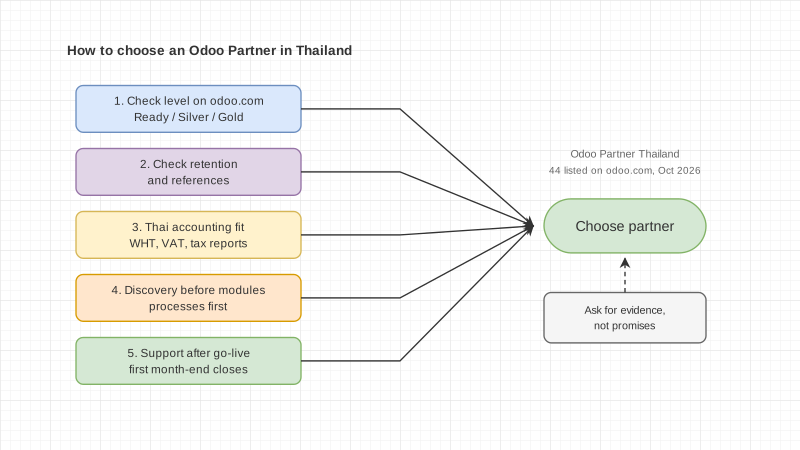
An Odoo Partner is a company Odoo has recognised to implement, customise, train and support customers after go-live. Thailand has 44 partners listed on odoo.com. To pick the right one, open each partner's profile on odoo.com, check its level, customer retention, references and certified people, then ask about Thai accounting, data migration and post-go-live support.
This guide is for business owners, CFOs and IT leads in Thailand who are comparing several Odoo implementers. Every partner level rule and every figure here comes from odoo.com pages we read on 13 October 2026. If you are not yet sure Odoo fits your company, read What is Odoo and who is it for first.
What does an Odoo Partner do, and how is that different from buying from Odoo directly?
An Odoo Partner is an outside company that implements the system for you, while Odoo S.A. owns the software and sells the licences.
Odoo's Become a Partner page lists the partner's work as analysis, configuration, deployment, development, customisation, training and hosting. The same page says Odoo takes no percentage from partner services and that partners are free to set their own service fees. Odoo also asks partners to act as the first level of support for their clients. In practice, when something breaks, the first call you make is to your partner, not to Odoo.
What is the difference between Ready, Silver and Gold?
A level reflects licence sales volume, the number of certified people and the customer retention a partner achieves; it does not tell you who fits your business best.
The Become a Partner page shows four tiers: Learning, Ready, Silver and Gold. The last three sit under the heading Official partners and appear on Odoo's partner search. Learning partners do not get visibility on the website. Odoo's table sets these requirements:
| Requirement | Learning | Ready | Silver | Gold |
|---|---|---|---|---|
| New Odoo Enterprise users per year | None | 10 | 75 | 300 |
| Certified active internal resources | None | 1 | 3 | 6 |
| Minimum retention rate | None | None | 70% | 80% |
| Listed on Find a Partner | No | Yes | Yes | Yes |
On 13 Oct 2026 the Thailand page of Find a Partner listed 44 partners: 2 Gold, 12 Silver and 30 Ready. The numbers can change every quarter.
Keep one thing in mind. Levels are driven mainly by new users sold per year. A firm that runs a few large projects can sit at the same level as a firm that runs many small ones, so read the profile as well.
How can you check a partner yourself on odoo.com?
Go to odoo.com/partners, choose Thailand, and open the profile of the company you are talking to. The data Odoo publishes sits in a side panel, separate from the introduction the partner writes about itself.
The panel has six things worth reading:
- Partner level, such as Ready, Silver or Gold
- Customer retention as a percentage
- Project size, shown as average and largest, counted in users
- Number of references, split by industry
- Certified experts, split by Odoo version
- The named references at the bottom of the page
Here is our own profile as a worked example. On 13 Oct 2026 the panel for Enersys Co., Ltd. showed:
- Level: Silver
- Certified experts: 2 certified on Odoo 19 and 1 on Odoo 18
- Project size: largest 200+ users, average 35 users
- Customer retention: 100%
- References: 6, of which 3 in manufacturing and maintenance, 2 in wholesale and retail, and 1 in health and pharmaceutical
The introduction on the same page still says we were shortlisted for the Odoo Awards 2026. That text is out of date: we won Best Starter APAC. The example makes a point. Text a partner writes can lag behind the facts or run ahead of them. The numbers in the side panel are what you should compare.
When you compare several partners, read three things together: is their average project size close to yours, do they have references in your industry, and are their certified people certified on the version you plan to run?
Which criteria should you use, and how do you verify each one?
A useful criterion is one you can ask to see evidence for before you sign, not a promise made in a meeting.
| Criterion | Why it matters | How to verify |
|---|---|---|
| Thai accounting and tax experience | Withholding tax, VAT and Revenue Department reports must be right from day one | Ask for sample withholding tax certificates and purchase and sales tax reports produced in Odoo. Background in our Thai accounting and tax guide for Odoo |
| Process discovery before module choice | A system configured from a module list rarely matches real work | Ask to see a discovery document or gap list from a past project, with the client name removed |
| Data migration plan | Opening balances and stock that do not match block your first close | Ask what gets migrated, in how many rounds, who signs off, and how balances are reconciled |
| Integration skills | Banks, point-of-sale systems or marketplaces often need connecting | Ask to see integrations running in production, and who maintains them when the other side changes its API |
| Customisation discipline | Heavy code changes make version upgrades harder and more expensive | Ask how many clients they have upgraded across versions, and request the list of custom modules with the reason for each |
| Training and support after go-live | The first month-end closes are when you need help most | Ask for support terms in writing, response times and contact channels |
| Team continuity | If the person who knows your system leaves, the knowledge leaves too | Ask for the names of the people who will run your project and compare with the certified experts on the profile |
| References you can call | A real customer's account is hard to fake | Ask for contact details of 2 references of similar industry or size |
For what a sound implementation process looks like step by step, see How to implement Odoo effectively.