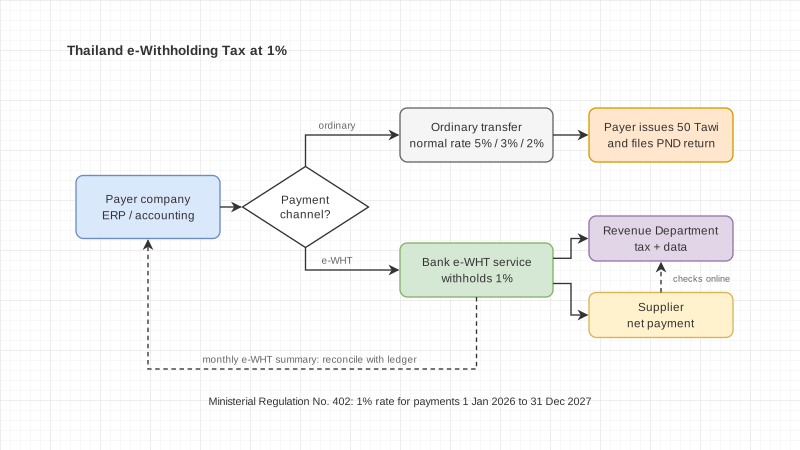
Say your company pays a contractor 100,000 baht a month for services. If the normal withholding rate for that payment is 3%, you hold back 3,000 baht, issue a withholding certificate (the "50 Tawi") and file the return yourself. If you pay through your bank's e-Withholding Tax service instead, the amount withheld falls to 1,000 baht, and most of the paperwork moves to the bank and the Revenue Department.
The 1% rate is not entirely new. What changed last week is that the 2026 to 2027 period now has its full legal basis.
What happened
On 16 June 2026, the Thai Cabinet approved a two-year extension of the tax measures that promote electronic tax systems. The Revenue Department announced the same day that one measure cuts withholding rates of 5%, 3% and 2% down to 1% for payments made through the e-Withholding Tax system, from 1 January 2026 to 31 December 2027.
On 9 October 2026, the Royal Gazette published Ministerial Regulation No. 402 (B.E. 2569), signed by the Minister of Finance on 1 October 2026. It replaces clause (17/5) of Ministerial Regulation No. 144 (B.E. 2522), which had earlier been amended by No. 389 (B.E. 2566). In short:
- Payments made from 1 Jan 2026 to 31 Dec 2027 are subject to 1% withholding.
- The condition is that the payer remits the tax using the method set under section 3 Pannarasa of the Revenue Code, which is electronic remittance.
- The explanatory note says the purpose is to encourage businesses to remit tax electronically.
What it covers
The regulation lists seven groups. In business terms:
- Fees, commissions and other section 40(2) income paid to companies or juristic partnerships
- Goodwill, copyright and other rights under section 40(3) paid to companies or juristic partnerships
- Property rent under section 40(5)(a), except charter of ships used for international transport of goods
- Professional fees and contracting under sections 40(6) and (7)
- Prizes from contests, competitions or lucky draws
- Performance fees paid to public entertainers domiciled in Thailand
- Hire of work, prizes, discounts or benefits from sales promotion, advertising fees and other services, except hotel services, restaurant services and life insurance premiums
Several groups also exclude payments to foundations or associations that run income-generating businesses, and to those designated under section 47(7)(b). Before you change rates in any system, have your accountant read each clause of the regulation itself.