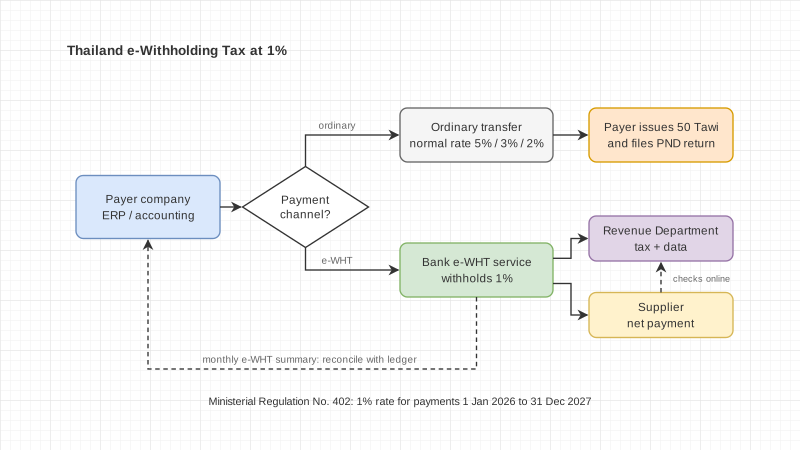
A company can pay THB 100,000 for services through e-Withholding Tax and another THB 100,000 by ordinary bank transfer in the same month. Even with similar corporate suppliers, the tax close may follow two different paths. The first payment may qualify for 1% withholding. The second needs its normal withholding assessment and the payer's filing process. Signing into e-Filing at month-end does not retrospectively turn an ordinary transfer into e-Withholding Tax.
e-Filing is the internet channel for filing tax returns. e-Withholding Tax is a bank-based tax remittance process in which a participating bank sends the tax and transaction data to Thailand's Revenue Department. Shared login credentials for some services do not make the processes equivalent. The Revenue Department says taxpayers can use their e-Filing credentials to access e-Withholding Tax inquiry services. Revenue Department portal guidance
This guide helps CFOs and accounting leads separate transactions and evidence before a mixed-channel monthly close. Sources were checked on 19 October 2026. For the statutory income categories and the wider ERP workflow, read our Ministerial Regulation 402 explainer.
AI-generated editorial illustration of bank remittance and return-filing work. It does not show a real system screen or tax document.
Check 1% eligibility before selecting the payment channel
Start with the transaction facts, rather than the expense-account name in the ERP. Use the following sequence as an internal review procedure.
- Identify the income category under the Revenue Code and whether Regulation 402 covers it. Fees, commissions and certain rights payments have specific recipient conditions. An expense labelled “service fee” is not enough to assign 1% to every line.
- Check the recipient's status: individual, company, juristic partnership, foundation or association. Both the income category and recipient conditions matter, including the domicile condition for public entertainers.
- Check the actual payment date. The qualifying period is 1 January 2026 through 31 December 2027. This refers to income paid, rather than the invoice date or the date the payable was recorded.
- Confirm that tax is actually remitted using the Section 3 quindecim method through e-Withholding Tax. An ordinary transfer, a mobile-banking payment or online return filing alone does not establish this condition.
Only after the conditions are met should the team apply the 1% provision in Regulation 402, which amends clause (17/5) of Regulation 144. The regulation was signed on 1 October 2026 and published in the Royal Gazette on 9 October 2026. Those dates are distinct from the qualifying payment period stated in the text.
Excluded items, such as hotel services, restaurant services, life-insurance premiums and the specified international cargo-vessel rental, do not automatically become free of ordinary withholding obligations. Assess the normal rules for the actual transaction. Where the income classification or recipient status is unresolved, hold approval of the preferential rate until the accounting team reaches a supported conclusion.
Separate the two routes within one monthly close
| Checkpoint |
Ordinary transfer with the payer filing through e-Filing |
Payment and remittance through e-Withholding Tax |
| Rate assessment |
Normal rate and the transaction's conditions |
1% eligibility based on income, recipient, payment date and remittance method |
| Who sends the tax and data |
The payer handles its return and payment |
The payer supplies money and data to the bank, which remits to the Revenue Department |
| Evidence to follow |
Applicable certificate, filed return and payment evidence |
Bank electronic evidence, remittance information and Revenue Department receipt |
| Month-end work |
Include transactions still requiring the payer's own filing |
Reconcile bank-remitted transactions and resolve exceptions |
This is a work-allocation guide, not a claim that every return or payer receives identical relief. Read Regulation 364, clauses 4 to 7 and Director-General Notification 20, alongside the scope of the bank's actual service.
Before submitting the monthly return, the accounting lead should distinguish bank-remittance transactions, transactions the payer must still remit itself, and unresolved items. Do not file bank-remitted tax again merely because the payment remains in the payables report. Do not remove ordinary transfers from the payer's filing work merely because the company has enrolled in e-Withholding Tax. Enrollment is company-level; tax treatment must be checked transaction by transaction.
Track evidence after the cash leaves the account
The internal register should distinguish at least these stages. Bank status names can differ; these are proposed control stages, not universal bank labels.
| Internal stage |
Evidence to check |
Owner |
| Approved and instructed |
Payment date, recipient, income type, tax base and withholding agree with the documents |
Payables and payment approver |
| Bank has received money and data |
Bank evidence identifies the e-Withholding Tax transaction and reference, rather than only an ordinary transfer slip |
Treasury |
| Bank has remitted |
Data and tax sent to the Revenue Department, including rejected or pending items |
Treasury with the bank |
| Revenue Department evidence received and reconciled |
Electronic receipt, inquiry records and ledger agree |
Tax accounting and reviewer |
Regulation 364 addresses bank evidence and remittance. The bank must remit the tax and details within the agreed period, no later than four working days counted from the day after it receives the money and details. Clause 7 treats tax payment as complete upon receipt of the Revenue Department's electronic receipt. “Cash debited” is therefore an inadequate final status for the tax close.
The Revenue Department portal says inquiry records can be found within six working days from payment through a participating bank, provided the bank's submitted data is correct and complete. This inquiry timeframe is distinct from the bank's remittance deadline. It does not promise the same visibility for incorrect data. If a record is missing, check working days, tax IDs, user access rights and the bank status before concluding that remittance failed.
Payer and payee evidence serve different checks
Notification 20, clause 5 provides for bank electronic evidence for the remitter and recipient or person subject to withholding. It serves as withholding evidence, with relief from issuing the certificate under Section 50 bis, paragraph three, within this method's scope. It does not abolish withholding certificates for every company payment.
The payer should connect the payable, approval, bank evidence, remittance details and Revenue Department receipt to the same ledger transaction. The payee should check income, withholding, payment date and its tax ID against bank evidence and inquiry records. If something differs, it should give the payer the transaction reference and correct details for investigation. Receiving the expected net cash does not prove that the tax-credit data is correct.
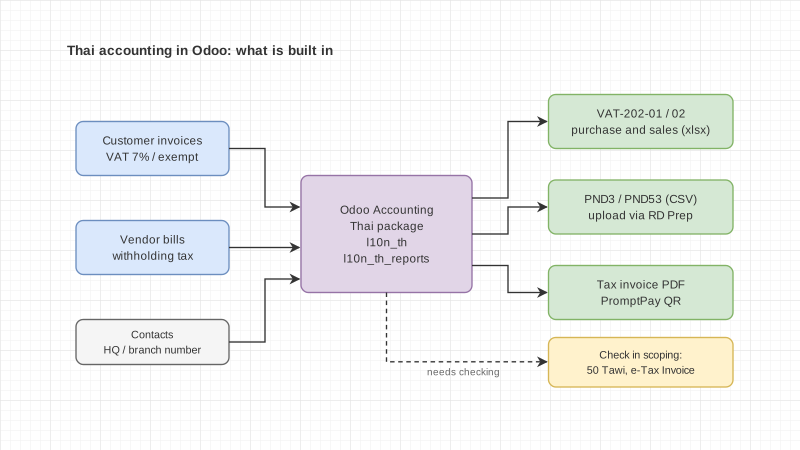
An ERP register can connect its internal transaction ID with the bank reference and receipt, with separate download and review responsibilities. This is a proposed control design. It does not assert that Odoo or every bank supplies a ready-made automated connector. Our Odoo Accounting and Thai tax guide explains related data preparation.
A worked mixed-channel month-end example
Assume Company A pays two Thai corporate service suppliers in October 2026. Its accountant has established a normal 3% rate for both transactions and confirmed that the first qualifies for 1% under Regulation 402. The figures below use a service-fee base excluding VAT. They are hypothetical, not a tax conclusion for every service contract.
| Hypothetical transaction |
Supplier B through e-Withholding Tax |
Supplier C by ordinary transfer |
| Service-fee base |
THB 100,000 |
THB 100,000 |
| Tax withheld |
THB 1,000 (1%) |
THB 3,000 (assumed verified normal rate) |
| Net service fee before considering VAT |
THB 99,000 |
THB 97,000 |
| Follow-up work |
Bank remittance of THB 1,000 and supporting evidence |
Payer's own filing and remittance of THB 3,000 |
Before payment, payables documents the rate decision and validates supplier details. Treasury routes B through the e-Withholding Tax service and marks C as an ordinary transfer. The approver checks the net payment and tax separately.
After payment, treasury retains B's bank evidence and follows its remittance status. Tax accounting checks the Revenue Department receipt and inquiry records before closing the item. C remains in the payer's certificate and tax-return work. The reviewer must explain the THB 4,000 total withholding as THB 1,000 on the bank route and THB 3,000 on the company's own remittance route, rather than filing the full THB 4,000 again.
If the bank rejects B before completion, treasury sends the issue to the accounting lead before changing channels. If the team chooses an ordinary transfer, reassess the rate, net payment, documents and filing duties using the actual facts. Do not retain 1% solely because e-Withholding Tax was originally intended. If the bank has already processed part of the transaction, confirm its status before resubmitting or changing routes to avoid duplicate supplier payments or tax remittances.
Incorrect data and insufficient tax need different remedies
For an incorrect tax ID, income category or recipient details, preserve the original evidence and reference. The payer should coordinate with the bank and Revenue Department using the correction procedure appropriate to the transaction's status. The payee supplies the correct information to the payer. Editing an internal supplier record does not automatically correct data already transmitted. The Revenue Department's e-Withholding Tax guidance distinguishes data-correction procedures; confirm the applicable request form and authorised applicant with the responsible office.
Where an incorrect tax amount causes under-remittance, Notification 20, clause 7, consolidated with the amendment by Notification 31 provides an additional-remittance process linked to the original transaction. The remitter selects that transaction, enters the additional amount and pays through the prescribed channel. The extension to within 15 days after the end of the month in which tax and data were sent to the bank belongs to this additional-remittance provision. It is not a universal 15-day remedy for every error or a refund procedure for overpaid tax.
For excess tax, duplicates, wrong-person records or cases outside the applicable timeframe, the accounting lead should open an exception case and confirm the procedure with the Revenue Department. Do not simply offset it against next month's withholding. Assign an owner, next follow-up date and missing evidence so the issue survives the monthly close.
Questions before submitting the return
Does using e-Filing already qualify a payment for 1%?
No conclusion follows from that alone. Check income, recipient, payment date and actual e-Withholding Tax remittance under Regulation 402. Online filing alone does not meet the remittance-method condition.
Can 1% and 3% appear in the same month?
Yes, where the facts and conditions of the individual transactions support those rates, as in the hypothetical example. Keep a transaction-level reason. The example's 3% is not a universal service-fee rate.
Must the payee always request a paper withholding certificate?
For qualifying e-Withholding Tax transactions, consider bank electronic evidence and the certificate relief in Notification 20, clause 5. Ordinary transfers still require assessment of the certificate obligations applicable to them.
Should the payer file immediately if the inquiry record is missing?
First check bank status, data correctness and access rights. Filing while the bank is remitting can create duplication. Escalate urgent cases to the accounting lead, bank and Revenue Department with the evidence.
Source and date ledger
All sources below were accessed on 19 October 2026. This is an accounting-workflow explanation rather than an individual tax ruling. Recheck later legal and service changes before use. The linked legal documents and guidance are in Thai.
| Document |
Document or event dates |
Use in this guide |
| Regulation 402 |
Signed 1 October 2026; Royal Gazette 9 October 2026; qualifying payments 1 January 2026 to 31 December 2027 |
1% rate, income and recipient scope, exclusions and remittance condition |
| Regulation 364 |
Signed 10 June 2020; Royal Gazette 19 June 2020 |
Bank evidence, maximum four-working-day remittance period and electronic receipt |
| Notification 20, consolidated |
Original notification 17 July 2020; clause 7 notes Notification 31 effective from 25 February 2021 |
Clause 5 evidence and Section 50 bis relief; clause 7 additional remittance; clause 10 data access |
| Revenue Department e-Filing service |
No service-page publication date identified |
Internet return-filing channel |
| Revenue Department e-Withholding Tax portal |
No publication date shown for the inspected inquiry text |
Six-working-day inquiry guidance for correct and complete data, and e-Filing credentials |
| Revenue Department e-Withholding Tax guidance |
First page dated 8 February 2022; publication date unverified |
Data-correction guidance and authority contact; not evidence of the current preferential rate |