When ERP Is No Longer Just About "Recording Data"
If you still think of ERP as software used to "record" transactions, track inventory, or issue invoices — you are looking at a system that has already changed completely.
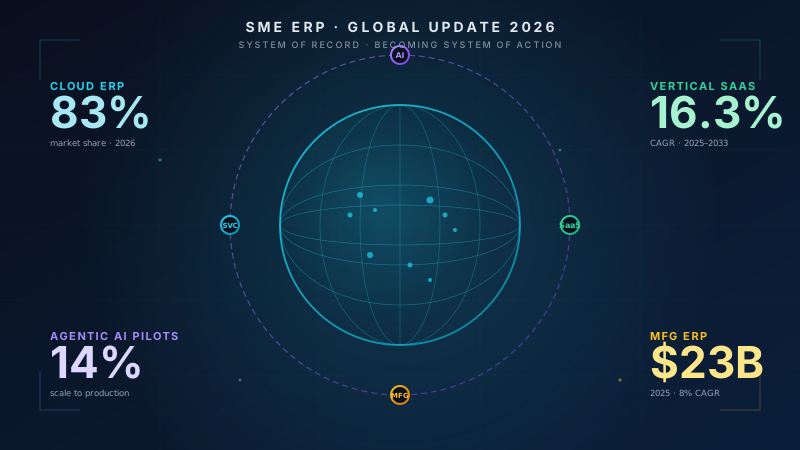
In 2026, ERP has become the "brain" of the organization — a system that not only stores data, but can also analyze, decide, and take action on behalf of people, from predicting which products will run out of stock in the next two weeks to drafting customer response emails and automatically creating purchase orders.
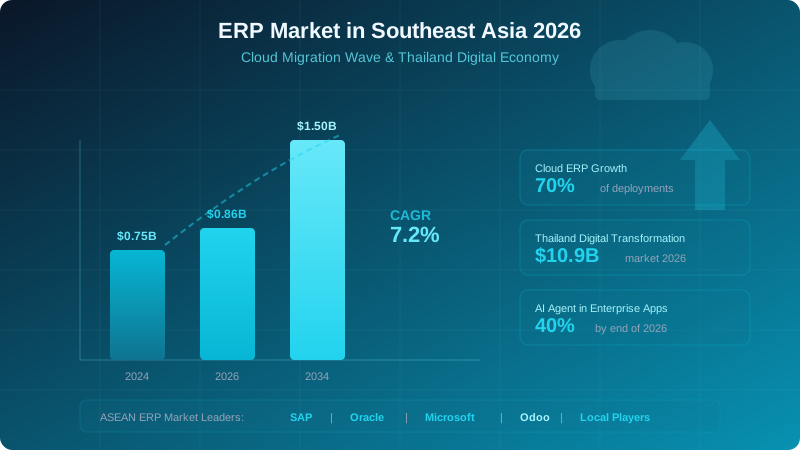
Gartner predicts that 40% of enterprise applications will include built-in AI agents by the end of 2026, up from less than 5% in 2025. Spending on AI-enabled Cloud ERP is also expected to rise to 62% of total Cloud ERP spending by 2027.
This article takes a closer look at the AI mega-trends shaping ERP in 2026, what Odoo can already do with AI, why Odoo + AI is a strong fit for Thai businesses, and a roadmap for organizations ready to get started.
Part 1: AI ERP Mega-Trends 2026 — 4 Waves Changing Everything
Trend 1: AI as the "Intelligence Layer" in ERP
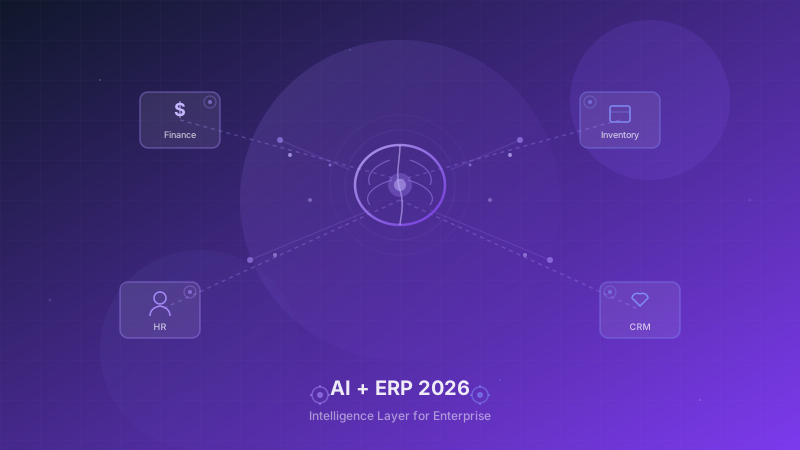
What changed in 2026 is that AI is no longer an "extra feature" that must be purchased separately or integrated later — it has become the intelligence layer embedded in every ERP workflow from the start.
SAP introduced Joule, with more than 2,100 AI skills embedded across S/4HANA, SuccessFactors, Concur, and Ariba. Users can ask business questions in natural language, have AI trigger actions, and pull insights directly from enterprise data without manually opening reports. SAP expects more than 400 AI-assisted use cases by the end of 2025.
Oracle has launched more than 600 AI agents across the Fusion Cloud Suite — covering ERP, EPM, HCM, SCM, and CX — at no additional cost. Fusion Applications are increasingly becoming systems that can "operate themselves," with AI copilots recommending next actions, detecting anomalies, analyzing financial patterns, and presenting insights in human-readable language.
NetSuite is preparing to launch NetSuite Next, an AI-first ERP version where users can work through Conversational AI, from retrieving data and triggering actions to managing multi-step processes.
Odoo is aligning with this trend by embedding AI into every module starting in version 19 — including Sales, Accounting, Inventory, and HR — with support for ChatGPT, Claude, and Odoo’s own AI.
What this means for Thai businesses: If you are selecting a new ERP or upgrading an existing system, AI is no longer a "nice to have" — it is a foundational capability that should be part of your ERP selection criteria from day one.
Trend 2: Agentic AI Has Arrived — It Really Can Work on Behalf of People
Agentic AI is AI that does not just "recommend" — it takes action. It reads data, makes decisions, updates records, creates documents, and triggers workflows automatically within rules defined by the organization.
SAP introduced Joule Agents for Production Planning that can automatically validate and release orders when required conditions are met, significantly reducing order-to-delivery time. SAP also launched Joule Studio, allowing organizations to create custom AI agents starting in December 2025.
Oracle is developing Agentic AI specifically for Finance — an Autonomous Close system where AI continuously works to detect, decide, and act within the financial close process, shifting from "oversight" to "foresight."
Odoo offers configurable AI Agents in version 19 that can both answer questions and perform actions inside Odoo, including updating records, triggering workflows, generating reports, and interacting with live data through a chat interface.
Why this matters for Thai businesses: Many Thai organizations still rely heavily on manual processes in Finance, Procurement, and Supply Chain. Adopting Agentic AI does not just save time — it reduces errors and increases responsiveness to market changes, which is critical for businesses competing regionally.
Trend 3: Predictive Analytics — Know What Will Happen, Not Just What Happened
Older ERP systems could tell you "what already happened." ERP in 2026 can tell you "what is going to happen next."
Inventory Forecasting: AI analyzes sales patterns, seasonality, and external factors to predict which products will go out of stock — weeks in advance, not after inventory is already depleted.
Supply Chain Intelligence: SAP Supply Chain Orchestration, expected in the first half of 2026, uses AI to forecast shortfalls and fulfillment risks, helping planners simulate scenarios and respond quickly.
Production Planning: AI analyzes capacity, lead times, and demand forecasts to create production plans that optimize resources efficiently.
Sourcing Intelligence: AI predicts raw material prices, market trends, and supplier risks before problems occur.
Gartner states that Embedded AI in Cloud ERP will help organizations close financial periods 30% faster by 2028, driven directly by Predictive Analytics that reduces manual reconciliation work.
Impact on Thai businesses: For manufacturing and retail businesses in Thailand, more accurate inventory forecasting means lower carrying costs, fewer lost sales, and higher profitability, especially during festival and peak-demand periods.
Trend 4: Cloud ERP = AI-First — No Cloud, No AI
By 2026, the equation is clear: Cloud ERP is the platform where AI performs best — because AI needs centralized data, scalable computing power, and continuously updated models.
Every major ERP vendor is pushing customers toward the cloud:
- SAP aims to move all customers to S/4HANA Cloud and make AI a core cloud capability
- Oracle has launched AI Database 26ai, combining AI vector search and autonomous management on the cloud
- NetSuite has positioned itself as an AI-native cloud ERP from the beginning
- Odoo offers Odoo Online (SaaS) and Odoo.sh (PaaS), where AI features can operate at full capability on the cloud
Forrester reports that 91% of global technology leaders plan to increase IT budgets, with more than half expecting growth of over 5% — largely driven by AI.
For Thai businesses: Organizations still using on-premise ERP will face increasing disadvantages, because new AI features will always arrive on the cloud first. A Cloud Migration Roadmap is therefore becoming an urgent priority.
Part 2: Odoo AI Capabilities — A Closer Look at Every Module Ready for Use
Many people may still think of Odoo as an "ERP for SMEs," but versions 18 and 19 have changed that perception completely by systematically embedding AI into every module.
Module 1: Odoo AI Chatbot — Ask Business Questions in Natural Language
Problem it solves: Executives and staff waste time opening multiple reports, filtering data, and exporting Excel files just to answer simple questions such as "What are sales this month?" or "Which product is selling best?"
What Odoo AI Chatbot can do: It converts the user’s natural language into query commands that work directly with the Odoo schema. There is no need to know field names or write queries manually.
Real-world examples:
- A procurement manager asks "What is our purchase volume this month?" → gets the number immediately, with a supplier breakdown
- The CEO asks "Compare Q1 sales this year versus last year" → gets a comparison with growth rate
- The HR team asks "How many employees have taken more than 15 days of leave this year?" → gets the list instantly
- Accounting asks "What is the total value of invoices overdue by more than 30 days?" → gets the figure along with details
Why this is a big deal for Thai SMEs: Most SMEs do not have a Data Analyst team. If every employee can "ask the business" for information as if talking to a colleague, it means everyone has data to support decisions without waiting for reports from IT.
Module 2: Odoo AI Engine — Generate Content Automatically
Problem it solves: Repetitive writing tasks across the organization — from product descriptions and marketing emails to meeting summaries and task notes — consume enormous time and often produce inconsistent quality.
What Odoo AI Engine can do:
- Auto-draft Product Descriptions: Enter the product name and basic information → AI generates sales-ready descriptions in both Thai and English
- Marketing Email Generation: Define the target audience and objective → AI drafts emails with adjustable tone
- Meeting Summaries: Meeting notes are automatically summarized into action items
- AI Fields: Missing information in records is automatically filled in, making system data more complete and consistent
Example use case: An e-commerce business with 5,000 SKUs — instead of hiring people to write descriptions one by one, AI Engine can draft descriptions for all 5,000 SKUs, then let the content team review and refine them. This cuts the timeline from months to days, reducing average time per item from 14 minutes to under 2 minutes including review.