In 2026, ERP Is No Longer a "Back-Office System" — It's the Heart of Competition
In an era where Thai businesses compete both domestically and regionally, Enterprise Resource Planning (ERP) is no longer just accounting software or a warehouse system — it has become the central platform connecting every part of an organization, from finance, procurement, and manufacturing to sales and HR.
The global ERP market grew to $66 billion in 2024 (up 11.3%) and is projected to reach $81 billion by 2026. Cloud ERP is the primary growth driver, expanding 7 times faster than On-premise solutions.
This article examines the ASEAN ERP landscape with a focus on Thailand, analyzes why many businesses are choosing Odoo over SAP or Oracle, and explains how Enersys can help.
Part 1: ASEAN ERP Market Overview 2026
Key Numbers
The Southeast Asian ERP market is growing steadily:
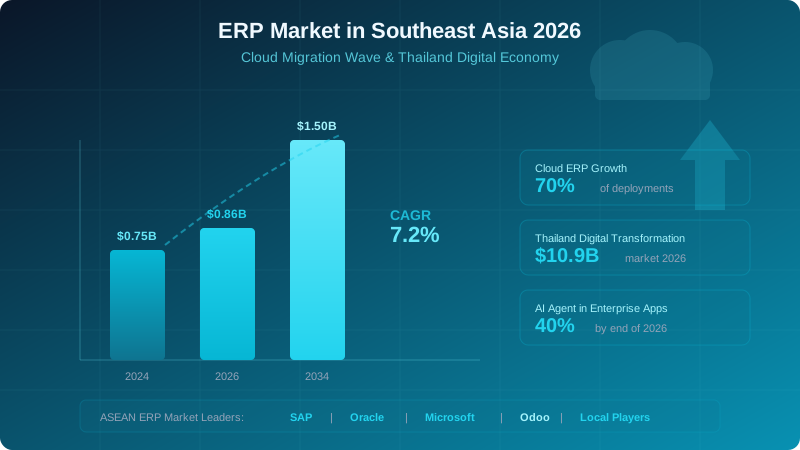
- ASEAN ERP market value: From $0.75 billion in 2024, projected to grow to $0.80 billion in 2025 and $1.50 billion by 2034, at a CAGR of 7.2%
- Asia-Pacific ERP market: Valued at $16,286 million in 2023, projected to reach $36,078 million by 2033, growing at a CAGR of 8.2%
- Cloud ERP globally: Accounts for 70% of all deployments in 2025, growing at a CAGR of 14.5% compared to On-premise at just 2%
Growth Drivers in ASEAN
- Industrial expansion — ASEAN is a major global manufacturing hub, with rising ERP demand in manufacturing and retail sectors
- National digital economy policies — Singapore, Malaysia, Indonesia, Vietnam, and Thailand all promote digital transformation as national priorities
- Cloud infrastructure investment — AWS, Google Cloud, Microsoft Azure, and Huawei continue building data centers across the region, improving Cloud ERP performance and reducing latency
- SME digitization — Over 70 million SMEs in ASEAN are accelerating their digital transition, with ERP among the first systems receiving investment
Part 2: Thailand's ERP Market — Real Numbers from Research Reports
Market Size and Trends
Thailand's ERP market shows strong growth potential:
- Thailand ERP market is expected to reach $161.48 million by 2032
- Thailand Digital Transformation market was valued at $10.06 billion in 2025, projected to grow to $10.94 billion in 2026 and $16.64 billion by 2031, at a CAGR of 8.75%
- Cloud deployment accounts for 55.05% of Thailand's Digital Transformation market in 2025, growing at a CAGR of 19.95% through 2031
Thailand 4.0 and the Cloud First Policy
The Thai government is a major catalyst for ERP adoption:
Thailand 4.0 is a national strategy aimed at transforming the country from a manufacturing-based economy to an innovation-driven one, promoting digital creativity, new technology development, and the transition to a digital economy.
The Ministry of Digital Economy and Society (DES) is driving the Cloud First policy, accelerating the shift to digital government. Meanwhile, hyperscalers like AWS, Google, and Huawei are establishing data centers in Thailand.
Thailand's digital economy is forecast to grow 4.2% in 2026 — twice the pace of national GDP — driven by AI adoption, data centers, and technology investment.
Why Now Is the "Golden Window" for ERP Investment
- BOI supports Digital Transformation — businesses investing in ERP and cloud systems can apply for tax incentives
- Nationwide 5G coverage — enables Cloud ERP to function smoothly even in remote areas
- Growing digital workforce — investment in human capital development means more ERP-ready professionals
Part 3: Cloud ERP vs On-premise — The Migration Wave
Why Businesses Are Leaving On-premise Behind
The shift from On-premise ERP to Cloud ERP is not a temporary trend — it's a structural shift driven by multiple factors:
| Category | On-premise | Cloud ERP |
|---|---|---|
| Upfront cost | Very high (servers, licenses, IT team) | Low (subscription-based) |
| Deployment time | 12-24 months | 3-6 months |
| Scaling | Buy more hardware | Instant adjustment |
| Updates | Manual IT updates | Automatic updates |
| Access | Office-only | Anywhere, anytime |
| Disaster Recovery | Build your own DR site | Built-in |
Statistics That Tell the Story
- Cloud ERP grows at a 14.5% CAGR vs. On-premise at just 2% per year
- By 2025, 70% of new ERP deployments are cloud-based
- Mid-sized and large enterprises in ASEAN are steadily migrating legacy systems to cloud, especially after COVID-19 proved that On-premise couldn't adequately support remote work
Key Considerations Before Migrating
While Cloud ERP offers clear advantages, migration requires careful planning:
- Data Migration: Legacy data may not be compatible with the new system's format
- Customization: Features customized on On-premise may need to be rebuilt or adapted
- Change Management: Staff need to change their work habits, requiring proper training
- Compliance: Ensure the Cloud Provider offers data residency that meets regulatory requirements
Part 4: Major ERP Players in ASEAN
SAP — The Giant Dominating Large Enterprises
SAP has the strongest large-enterprise customer base in ASEAN, with over 42,000 customers worldwide (more than 4x the next competitor). SAP S/4HANA Cloud is the top choice for large enterprises, featuring the Joule AI Agent with over 2,100 AI Skills.
Strengths: Large ecosystem, industry-specific solutions, global support Challenges: High cost, complex implementation, long deployment time
Oracle — The Challenger That Became #1 in Revenue
Oracle overtook SAP to become the revenue leader in ERP for the first time in 2024, with $8.7 billion in revenue. Oracle Fusion Cloud Suite comes with more than 600 AI Agents at no additional cost.
Strengths: Cloud-native architecture, AI integration, Autonomous Database Challenges: Still expensive for SMEs, steep learning curve
Microsoft Dynamics 365
Benefits from seamless integration with the Microsoft 365 ecosystem that many organizations already use. Ideal for businesses using Azure as their primary cloud.
Strengths: Microsoft ecosystem integration, familiar UI Challenges: Module-based pricing can add up quickly when using multiple modules
Odoo — The Rising Star Changing the Game for SMEs
Odoo has become the top choice for SMEs worldwide, with impressive growth:
- Over 170,000 customers across 5 continents
- Adding 13,000+ new customers per month as of late 2025
- Revenue grew 42% in 2025, expected to reach EUR 1 billion by 2027
- Holds 15% of the global SME ERP market, projected to reach 25% by 2027
Strengths: Open-source, 3-10x cheaper than SAP/Oracle, highly flexible, large community Challenges: Requires an experienced partner for effective implementation