Quick summary
In early April 2026, Bloomberg dropped a number that made the entire industry stop and do a double-take:
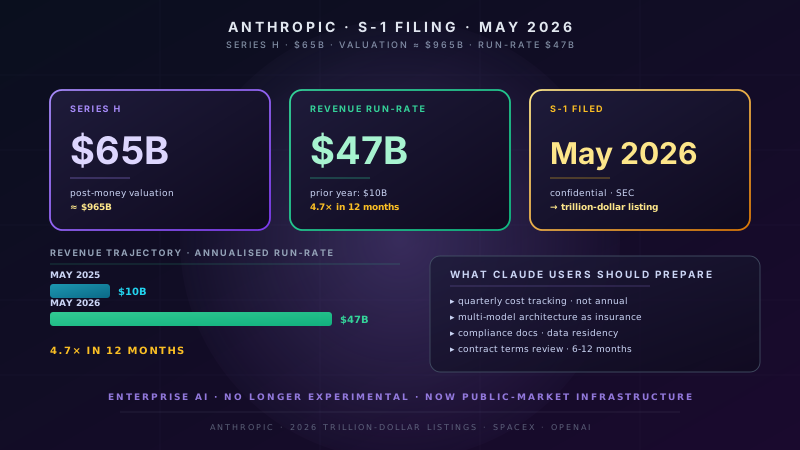
Anthropic — the maker of Claude — has reached an annualized revenue run rate of $30 billion.
What is even more striking is the path it took to get there:
- End of 2025: ~$9B run rate
- February 2026: ~$15B run rate
- Early April 2026: $30B run rate (3x growth in ~4 months)
- Enterprise customers paying more than $1 million/year: over 1,000 (up from ~500 just two months earlier)
- Revenue mix: roughly 80% enterprise
- Ahead of OpenAI's ~$24B run rate
- Announced alongside a 3.5 GW compute deal with Google/Broadcom for TPUs
At the same time, OpenAI disclosed that enterprise now accounts for over 40% of their revenue, on track to match consumer by the end of 2026.
If you still think "AI is a trend we should wait and see on," these numbers are telling you that you may have waited too long.
This article is not here to promote Anthropic or OpenAI. It is here to unpack what these numbers actually mean for Thai businesses — and what to do (and not do) over the next 12 months.
Why $30B matters more than any other AI headline this year
In 2023-2024 we kept hearing one question from clients:
"Is AI actually good, or is it just hype?"
In 2025 the question shifted to:
"If we deploy it, does it pay for itself?"
In early 2026 the question has changed again:
"How do we integrate this fast — before our competitors do?"
Why did the mood shift so quickly? Because Anthropic's numbers quietly answered two questions that had been hanging over the market for years:
1. "Does enterprise AI actually produce ROI?"
One thousand enterprise customers each paying $1M+ per year is not a tire-kicking population. These are companies with CFOs who have to sign off on budgets and finance teams who need to see the payback before renewing contracts.
One thousand companies do not keep paying $1M/year because the product is "cool." They pay because the value back exceeds the cost — and that math has now been validated a thousand times over.
2. "Is enterprise AI a niche or the main market?"
Anthropic's revenue mix is 80% enterprise, not consumer. This is a reversal of the ChatGPT-craze mental model from 2023 where everyone assumed AI was primarily a consumer product.
80% enterprise means B2B AI is the main game now, not a side bet.
And this is not just Anthropic — OpenAI itself confirmed that enterprise is closing in on parity with consumer revenue this year.
What the numbers do NOT tell you (and why it matters more)
Reading the headline at surface level is dangerous. It could push you into thinking "we need to rush into Claude" or "we need to sign an enterprise contract with OpenAI."
Here are three things the headline does not tell you that should shape your decision:
Point 1: $1M+/year is a Fortune 500 contract, not an SME contract
The 1,000 companies paying $1M+/year are Fortune 500s, bulge-bracket banks, global pharma, tech giants. They already have AI strategies, in-house AI teams, and budgets that were pre-allocated for experimentation.
Benchmarking a Thai SME with a 3-person IT team and an annual AI budget below a million baht against those companies is a category error.
That does not mean Thai SMEs should not use AI. It means your adoption model cannot look like JPMorgan's.
Point 2: "Rip and replace" is not how those enterprises are winning
Companies paying $1M+/year are not tearing out their existing systems to replace them with AI. They are using AI to augment the workflows they already have.
Claude is not replacing their ERP, CRM, or financial systems. It is a new layer on top of existing systems that makes those systems more effective.
This is the most important pattern in the whole story, and almost nobody talks about it.
Point 3: Compute is still a real constraint
The 3.5 GW deal with Google/Broadcom tells you Anthropic still needs more compute, constantly. That means inference cost is not going to drop to zero.
If your AI strategy assumes "API prices will halve every year," you could be in for a surprise — especially if your business is growing and your token usage is growing with it.
What Thai businesses should (and should not) do in the next 12 months
Five points, each translated into concrete action:
1. Stop asking "is AI valuable?" — start asking "which of our workflows can AI unblock?"
The first question is a time sink. The second creates value.
How to start: open the list of processes in your company that are actually documented (in your ERP, SOPs, or manuals — not just in someone's head). Flag the ones that:
- Consume more than 4 hours/week of repetitive human effort
- Are dominated by reading, summarizing, or comparing documents
- Have clear rules but lots of exceptions
- Have bottlenecks caused by headcount limits
Three out of four of those boxes ticked = candidate for an AI use case that can show ROI within 90 days.