AI & Technology

Is It Worth It? Analyze ROI Before Deciding to Switch to ERP

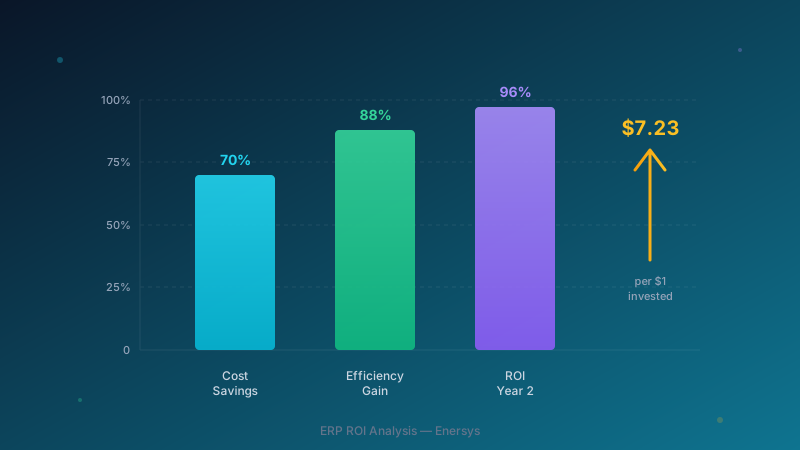
Nucleus Research reports that ERP delivers $7.23 in return for every $1 invested — but 55% of projects fail because readiness was not assessed in advance. This article helps you calculate real ROI, with a free value assessment tool included.

21 Mar 202612 min
ERPROIDigital TransformationOdooSMECloud ERPCost Analysis

Every year, thousands of Thai businesses ask the same question — "If we switch from our current system to ERP, will it really be worth it?"

The short answer is yes — but only if you do your homework first.

According to Nucleus Research, ERP delivers an average return of $7.23 for every $1 invested, while Gartner predicts that organizations using Cloud ERP with AI will close their books 30% faster by 2028.

But these impressive numbers do not come for free — 55–75% of ERP projects fail to meet their goals, mostly because organizations do not thoroughly assess readiness and business value before getting started.

This article will help you analyze ROI systematically before making the investment decision — with a free value assessment tool at the end.


1. The hidden costs you pay every day — without realizing it

Before thinking about the "cost of switching systems," ask yourself this first: how much money is your current system costing you right now?

Hidden costs of legacy systems

People-related costs:

  • 2–3 employees re-enter the same data every day — quotes go into Excel first, then into accounting software again
  • The IT team has to maintain multiple disconnected systems — instead of working on higher-value initiatives
  • Time spent by executives waiting for reports — instead of making decisions immediately

Data-related costs:

  • Customer data is scattered across Excel, Line, and notebooks — when customers call, staff have to ask for the same information again
  • Inventory records do not match actual stock — leading to frequent over-ordering or stockouts
  • Month-end close takes 2–3 weeks because data must be consolidated from multiple sources

Lost opportunity costs:

  • No real-time visibility into sales — decisions are slower than competitors'
  • No data for forecasting — inventory is ordered based on "gut feeling" instead of data
  • Opening new branches is difficult because the old system does not support multi-branch operations

Try calculating it: if 3 employees spend 2 hours per day re-entering data, at an average salary of 25,000 THB/month, that means an opportunity cost of approximately 562,500 THB per year from just one issue alone.


2. A simple ERP ROI calculation framework

ERP ROI should not be measured only by "how much money you save." You need to evaluate it across 4 dimensions:

Dimension 1: Cost Savings — direct cost reduction

Category Example Average savings
Labor costs Less manual work, less duplicate data entry 15–25%
Inventory costs More accurate stock, less excess inventory 20–30%
Operating costs Less paper, fewer process steps 10–20%
IT costs Consolidating systems into one platform 25–40%

Dimension 2: Revenue Growth — opportunities to increase revenue

  • Faster sales closure — quotations can be issued instantly
  • Cross-sell/Up-sell — complete customer history helps recommend the right products
  • Reduced customer loss — automated follow-up ensures no leads fall through the cracks

Dimension 3: Time Savings — time gained back

Activity Before ERP After ERP
Monthly closing 10–15 days 3–5 days
Report generation 1–2 days Real-time
Inventory checking 1 day Immediate
Quotation creation 30–60 minutes 5–10 minutes
Document approval 2–3 days Within hours

Dimension 4: Strategic Value — long-term business value

  • Data-driven decisions — make decisions based on real data, not intuition
  • Scalability — ready to expand branches, add teams, or open new channels
  • Compliance — supports e-Tax Invoice, PDPA, and Thai accounting standards
  • AI-ready — prepared to extend with AI in the future

3. The real cost of switching systems — numbers you need to know

Once you know what you gain, the next question is what you need to pay for:

The 4 main cost components

1. System license costs
Modern ERP platforms such as Cloud ERP offer options suitable for every business size:

  • Small businesses (1–10 users): starting from a few hundred baht/user/month — some platforms offer a free Community Edition
  • Mid-sized businesses (10–50 users): around a few thousand baht/user/month — with full functionality
  • Large businesses (50+ users): based on scale and complexity — pricing can be negotiated

Compared with SAP or Oracle, which often start in the millions of baht, Cloud ERP solutions such as Odoo can be 3–10 times more affordable for SMEs.

2. Implementation costs (setup and customization)
This depends on business complexity:

  • Basic: standard system with minimal changes — tens of thousands to low six figures
  • Standard: moderate customization and data migration — hundreds of thousands up to around 500,000 THB
  • Advanced: extensive customization and multiple integrations — from 500,000 THB upward

3. Training costs
Often overlooked, but critically important:

  • General user training: 1–2 days
  • Super User / Admin training: 3–5 days
  • Usually around 10–15% of implementation cost

4. Monthly/annual subscription costs
Cloud ERP is paid as a subscription — no upfront server investment required:

  • No server maintenance costs
  • Automatic feature updates
  • Easy to scale up or down based on employee count

4. A simple ROI formula

ROI (%) = [(Annual benefits - Annual costs) / Total costs] × 100
Real example: a 30-person SME

Current costs (per year):

Item Amount (THB/year)
Salaries for repetitive manual work 450,000
3–4 separate software tools 180,000
IT support for the legacy system 240,000
Opportunity loss from non-real-time data 300,000
Waste from inaccurate inventory 360,000
Total 1,530,000

ERP costs (Year 1):

Item Amount (THB)
License (30 users × 12 months) 176,400
Implementation 250,000
Training 30,000
Year 1 total 456,400

Year 1 savings:

  • Cost reduction of approximately 25% = 382,500 THB
  • From Year 2 onward, savings can increase to 35–40% once the team becomes familiar with the system

Year 1 ROI: (382,500 - 456,400) / 456,400 = -16% (not yet worthwhile in the first year, which is normal)

Year 2 ROI: (612,000 - 176,400) / 456,400 = +96% (investment recovered and profit begins)

Payback Period: approximately 10–14 months — after that, it becomes monthly gain

Important: The figures above are examples only. Actual results depend on your business size, complexity, and current system landscape.


5. Real outcomes from switching systems — research-backed data

Figures from leading research organizations

Nucleus Research (2024):

  • Average return of $7.23 for every $1 invested in ERP
  • Up 36% from the study five years earlier — because Cloud ERP has lowered implementation costs

Gartner (2026):

  • Organizations using Cloud ERP + AI will close their books 30% faster by 2028
  • Spending on AI-enabled Cloud ERP will rise from 14% to 62% by 2027
  • 40% of enterprise applications will have built-in AI agents by 2026

Deloitte (2025):

  • Digital Transformation could create $1.25 trillion in market value for the Fortune 500
  • Companies with clear technology strategies achieve 2x higher valuation

Panorama Consulting (2025):

  • 33% of ERP projects exceed budget
  • Main cause: requirements were not clearly assessed before starting
  • Key takeaway: good preparation cuts risk in half

Figures from real case studies

From successful projects:

  • Maintenance costs reduced from 3.5 million to under 1.5 million THB/year
  • Data integrity reached 100% after migration
  • Implementation timeline of 22 weeks for an organization with 350 users

6. Bonus: 200% tax deduction for Thai SMEs

What many people do not know — the Thai government offers a 200% tax deduction for SMEs investing in digital technology:

Details

  • Benefit: deduct 2x the actual expense
  • Maximum amount: 300,000 THB
  • Period: 24 June 2025 — 31 December 2027
  • Agency: Digital Economy Promotion Agency (DEPA)

Eligible SME criteria

  • Registered capital ≤ 5 million THB
  • Revenue ≤ 30 million THB/year
  • Eligible expenses: software, SaaS, Cloud, Cybersecurity
  • The service provider must be registered with DEPA

Savings example

If you invest 300,000 THB in ERP:

  • You can deduct 600,000 THB in expenses (2x)
  • Actual tax savings = 600,000 × tax rate
  • For an SME with a 20% tax rate = 120,000 THB in tax savings
  • Equivalent to an immediate 40% discount

Note: This cannot be combined with BOI, EEC, or Competitiveness Enhancement Act incentives. Check eligibility with DEPA before applying.


7. Checklist: is your business ready to switch systems?

If you answer "yes" to 5 or more of the following, it is time to seriously consider ERP:

  • You use Excel or Google Sheets as the main system for managing the business
  • The same data must be entered into multiple systems
  • You cannot view real-time sales or profit
  • Monthly closing takes more than 5 days
  • Inventory often does not match the system
  • You do not have a CRM — customer information is scattered
  • Document approvals require printing paper for signatures
  • You are planning to expand branches or add more staff
  • Your competitors have started using digital systems
  • You want to use AI to support operations, but your current system cannot support it

8. Next step — assess your own business case

Deciding to switch to ERP is not a small matter — but it is not something to fear either, if you have the right information.

Try the free assessment tool

We created the ERP Fit Assessment Tool so you can answer just a few questions and get an evaluation of:

  • ✅ What type of ERP is right for your business
  • ✅ An initial cost estimate
  • ✅ Recommended package options
  • ✅ A preliminary ROI calculation

No email required, no sales follow-up calls — try it for free, 100%

👉 Assess your ERP business case →


Need more advice?

Enersys is an official Odoo Silver Partner in Thailand with more than 14 years of experience and 20+ successful projects — we can help you analyze requirements and plan your ERP journey at no cost.

📧 contact@enersys.co.th | 📞 02-258-5419

👉 Explore Odoo by Enersys services →


Sources

Continue with guides on related topics.

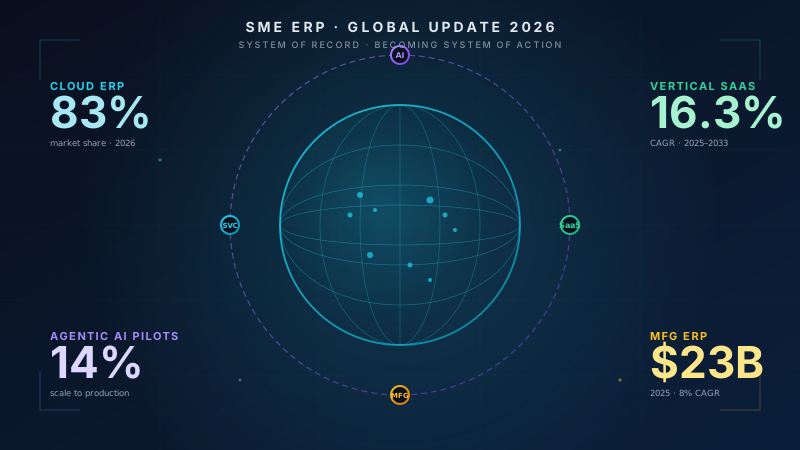
Where SME ERP Stands Globally in 2026: From System of Record to System of Action, Across Services, Manufacturing, and Vertical SaaS

The global ERP market for SMEs is worth around $37.6 billion in 2026. Cloud ERP holds 70 to 83 percent of new deployments. SMEs are the fastest-growing segment, with a CAGR above 14 percent. The clearest shift this year is the move from ERP as a system of record to ERP as a system of action, with agentic AI now making purchase, production, and maintenance decisions inside the system. This piece reviews the state of SME ERP worldwide across services, manufacturing, and vertical SaaS, and what it means for Thai SMEs.

Read article

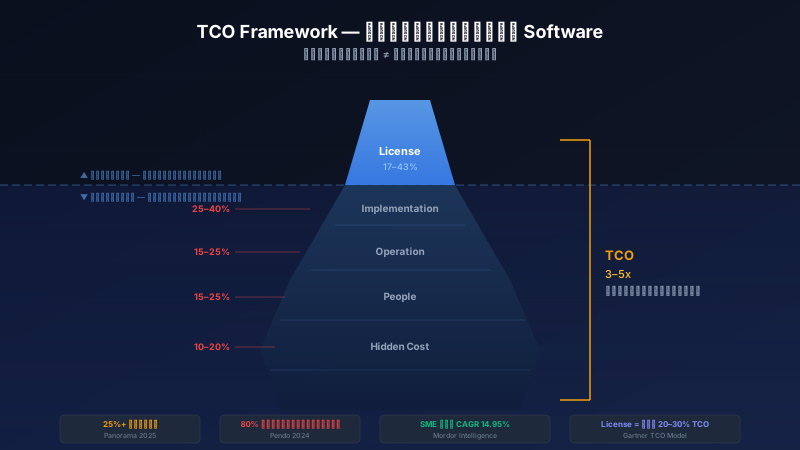
How to Calculate TCO Before Buying Software — The Framework Every Executive Needs to Know Before Wasting Millions

Panorama Consulting reports that more than 25% of organizations go over budget, with actual costs averaging 3–5x higher than the quoted price. This article provides a 5-layer TCO framework, a 3-year comparison table, and a 20+ point checklist of questions to ask vendors before signing.

Read article

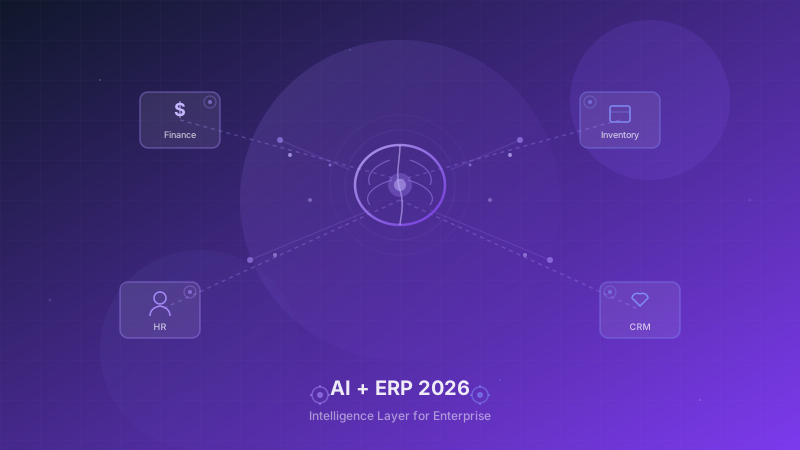
AI + ERP in 2026 — When ERP Can Think for Itself, and Odoo Is Already There

In 2026, AI is no longer an add-on for ERP — SAP Joule has 2,100 AI skills, Oracle has released 600+ AI agents, NetSuite is preparing Autonomous Close, and Odoo has embedded an AI Chatbot that turns natural language into business answers, along with Smart Drafting and Agentic AI that can truly work on behalf of people — what does all of this mean for Thai businesses?

Read article
Browse all Insights

"Empowering Innovation,
Transforming Futures."

Contact us to make your project a reality.