TL;DR
In 2026 the global ERP market is at a structural inflection, not just a quantitative growth point.
Fortune Business Insights places the global ERP market at roughly $37.6 billion in 2026, expanding to $54.9 billion by 2035. The broader SMB software market sits at $79.8 billion this year and is forecast to nearly double to $151.7 billion within a decade. Cloud ERP has become the default, holding 70 to 83 percent of new deployments globally.
The deeper headline is not the aggregate. It is the change in what ERP does. ERP is shifting from being a system of record to being a system of action, with agentic AI now embedded in new releases from Oracle, Infor, Epicor, and SAP. The systems are starting to decide on procurement, production planning, and predictive maintenance on their own. At the same time, vertical SaaS designed for specific industries, including healthcare, construction, and hospitality, is growing at a 16.3 percent CAGR, roughly four times the horizontal ERP rate.
This piece sets out where SME ERP stands worldwide across services, manufacturing, and vertical SaaS, and closes with a view of what Thai SMEs should take from the global picture.
The Aggregate Picture in 2026
The big numbers to keep in mind.
The global ERP market in 2026 is around $37.6 billion (Fortune Business Insights). The ten-year CAGR is 4.3 percent, which sounds modest. It hides the fact that the SME share of the market is growing far faster than the average.
The broader SMB software market sits at $79.8 billion this year and is forecast to reach $151.7 billion by 2035 at a CAGR of 7.4 percent. Global Growth Insights places the SME segment at 50.57 percent of that market in 2026, and projects growth of 14.29 percent CAGR through 2031. That is more than three times the headline ERP rate.
A useful adoption marker. In the United States, the share of SMEs running at least one form of cloud or digital management software rose from 78 percent in 2021 to 92 percent in 2024. The remaining group is small. By 2026, ERP for SMEs in the West is no longer optional. It is the default.
Among the adopters, attention has moved from "have we implemented" to "have we upgraded to AI features." That is the structural change the rest of this piece will describe.
Section 1. Cloud ERP Is Not an Option, It Is the Base
In 2026, cloud ERP has become the default at a level that leaves little room for on-premise.
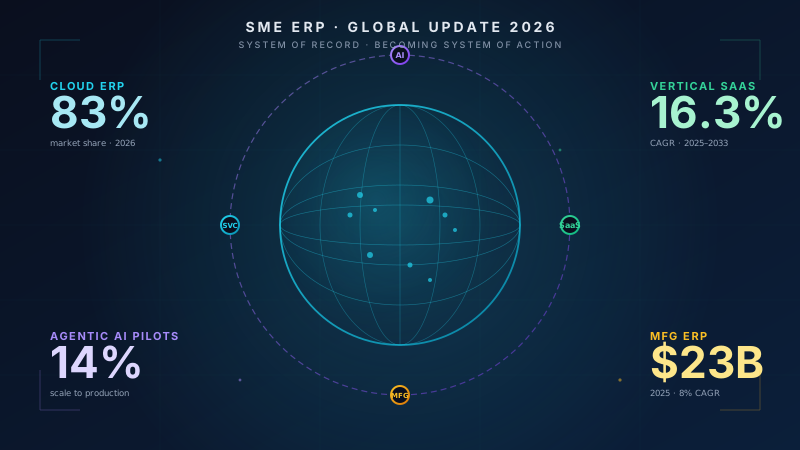
Analyses from ERP.today and erpsoftwareblog estimate that cloud ERP accounts for around 70.4 percent of deployments worldwide, and that 78.6 percent of new ERP selections in 2026 chose a cloud-based solution. Fortune Business Insights places the combined cloud and hybrid segment at 83.07 percent of the market in 2026. The overall cloud ERP market is projected to exceed $117 billion by 2030.
Three structural implications.
First, vendors that still depend on on-premise licensing are under pressure to move. Epicor has announced the end of on-premise releases and is consolidating innovation onto Epicor Cloud, which serves over 20,000 customers. Oracle, Microsoft, SAP, and Infor are moving in the same direction.
Second, pricing models are evolving. The per-user model long used by NetSuite and SAP is being challenged by Acumatica's consumption-based pricing, with no per-user fee. Customers get every feature at $15,000 to $40,000 per year depending on transaction volume and modules. This changes the economics of ERP for SMEs that grow team size quickly and do not want a user-count lock-in.
Third, time-to-deploy is changing. Many vendors now ship implementation packs with industry templates that cut project timelines from months to weeks. For SMEs without large customisation budgets, template-based deployment is now a realistic option.
In developing markets, India offers a useful data point. The Digital India programme has driven a 27 percent increase in SME ERP adoption since 2022, showing how government policy can accelerate adoption in markets still trailing the West.
Section 2. Manufacturing — Industry 4.0 and Agentic AI Reach the Shop Floor
Manufacturing ERP is the largest part of the market and the fastest-growing segment in 2026.
Manufacturing ERP reached roughly $23 billion in 2025, making up 32 percent of total ERP spending, and grew at an 8 percent CAGR, nearly twice the overall ERP rate. The growth is driven by Industry 4.0 and IoT integration, which have become must-haves for mid-market manufacturers.
The big story of 2026, however, is agentic AI reaching the shop floor.
According to ERP.today, Oracle has launched Agentic Finance with pre-built agents for payables and planning. Infor has launched Agentic Orchestrator, embedding industry-specific agents across CloudSuite for manufacturing, supply chain, and finance. These vendors are changing the role of ERP from a system of record to a system of action.
Real examples in the factory.
Before, procurement managers cut purchase orders manually whenever inventory ran low. Now, procurement managers audit decisions made by an AI agent that identifies supply delays, contacts suppliers for updated delivery estimates, and adjusts production schedules autonomously.
Before, plant managers supervised production lines directly. Now, plant managers supervise software agents that perform real-time replanning, while themselves reviewing the inventory cost reductions and efficiency gains the agents propose.
Before, predictive maintenance was a quarterly exercise. Now, predictive agents stage parts automatically and schedule interventions in low-impact windows, reducing unplanned downtime by double-digit percentages.
Who benefits first. Mid-market manufacturers that can deploy agentic AI on the shop floor without a production shutdown are positioned to start the day their vendor turns it on, while large enterprises with heavier governance face slower rollouts.
Where to be careful. Manufacturing Dive reports that only 14 percent of agentic AI pilots reach production scale. The 86 percent failure rate does not reflect technology weakness. It reflects governance frameworks the adopters had not put in place. SMEs with simpler governance can scale faster, if they design the framework from the pilot stage.
Section 3. Services and Vertical SaaS
While manufacturing grows at 8 percent CAGR, vertical SaaS grows at almost twice that, at 16.3 percent CAGR (Data Insights Market).
The vertical SaaS market sat at $94.86 billion in 2025, and is projected to reach the low hundreds of billions by the early 2030s. Within the SMB sub-segment, growth is at 14 percent CAGR over 2023 to 2028. SMBs hold about 60 percent of the global SaaS ERP market overall.
Why vertical SaaS is winning SME share.
Horizontal ERP such as standard SAP or NetSuite is built broad to cover many industries. The result is high implementation effort to map specific vertical processes onto generic modules. Vertical SaaS starts from the processes of one industry, such as hospitality, healthcare, or construction. Implementations are shorter, user adoption is better, and the vendor evolves the product against regulations that affect that one industry.
Industries growing fastest in 2026.
Healthcare. Stringent patient-data regulations and clinic, hospital, and lab workflows make horizontal ERP a poor fit. Vertical platforms focused on HIPAA and appointment systems are gaining traction.
Construction. Project-based accounting differs from standard accounting and integrates with design tools, equipment tracking, and subcontractor management. Acumatica's construction edition competes with Procore for operational leadership.
Hospitality. Revenue management, channel management, and guest experience need integrations that horizontal ERP does not provide. Cloudbeds and Mews are pulling mid-market share away from horizontal ERP.
Retail. Omnichannel inventory, POS, and e-commerce integration have become must-haves, putting retail-specific stacks such as Lightspeed and Shopify POS Pro into direct competition with horizontal ERP at the mid-market level.
Field service. Technician scheduling, mobile-first workflow, and on-site invoicing differ from office work. ServiceTitan is clearly extracting SME field service customers from horizontal stacks.
For SMEs in these industries, the question is not whether to choose horizontal or vertical. The question is whether the vertical platform integrates with a financial core. Many vertical SaaS systems are strong on operations but require a separate accounting backbone.