News

Plex Media Server is under active attack. The patch shipped in August, so why are office machines still exposed?

On 20 October 2026 CISA added four Plex Media Server flaws, which chain into code execution on the host, to its list of exploited vulnerabilities. The fix had been out since 4 August. Here is what a business with a NAS or small office server running this kind of software should check.

22 Oct 20266 minCISA
Plex Media ServerCISA KEVShadow ITNASCybersecurityPatch Management

Say your office has a NAS for shared files. One day someone in IT installs Plex Media Server on it so training videos and product clips can play on the meeting room TV, and turns on remote access so it works from outside the office too. The program never makes it onto the company software list, and nobody owns its updates.

If that program is compromised, the attacker gets whatever the Plex service account can reach, which often includes the work folders on the same NAS. This is happening right now.

What happened

On 20 October 2026 CISA, the US cybersecurity agency, added six entries to its Known Exploited Vulnerabilities (KEV) catalog. Four of them are in Plex Media Server: CVE-2026-96652, CVE-2026-96654, CVE-2026-96655 and CVE-2026-96656.

According to NVD, all four affect Plex Media Server before 1.43.3.10861. Each does something different:

  • Two are server-side request forgery (SSRF) flaws that make the Plex server send requests to a destination the attacker picks.
  • One lets an attacker call another plugin's functions with parameters of their choosing.
  • One lets an admin user write files that the server runs at startup. Its CVSS 3.1 score is 7.2.

Taken one by one, most of these scores look moderate. Censys, a company that scans internet-facing hosts, explains that chained together, in what the researcher named Plex2Shell, they let an attacker run code on the host with the privileges of the account running Plex.

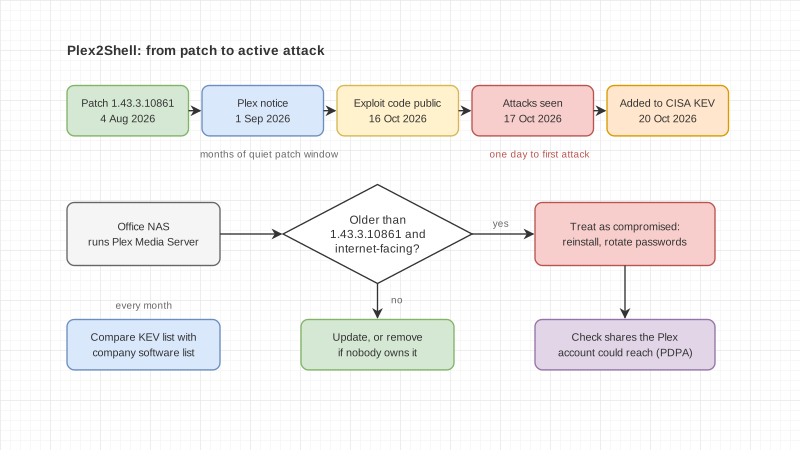
The timeline, as reported by Censys:

  • 4 August 2026: Plex releases 1.43.3.10861, which fixes the whole chain.
  • 1 September 2026: Plex publishes a security notice.
  • 16 October 2026: a researcher publishes the write-up and exploit code.
  • 17 October 2026: a honeypot operator sees exploitation in the wild, one day after publication.
  • 19 October 2026: Plex reports active, widespread exploitation. Compromised servers were used for crypto miners and proxy software.
  • 20 October 2026: CISA adds all four to KEV.

In the KEV catalog, CISA gives US federal agencies until 23 October to fix CVE-2026-96654 and CVE-2026-96656, and until 3 November 2026 for the other two.

The number worth sharing: the patch existed, the servers did not move

Censys counts about 324,000 hosts running Plex Media Server, and about 30% still run a vulnerable build. The figure worth repeating to your team: in the first three days after the exploit was published and attacks were reported, fewer than 2% of the still-vulnerable hosts upgraded.

Censys also summarises Plex's guidance. Windows and macOS installs update themselves if that option is on. Linux, NAS and Docker installs need a manual update, which is exactly where many companies forget.

More important than the numbers: updating does not mean you are clean. Plex advises treating any server older than 1.43.3.10861 that was reachable from the internet as possibly compromised. That means a clean reinstall, clearing the Codecs folder, checking the preferences file, signing out all devices and changing the Plex password, and treating anything the Plex account could reach, such as mounted shares and stored credentials, as potentially exposed.
The other two entries in the same batch

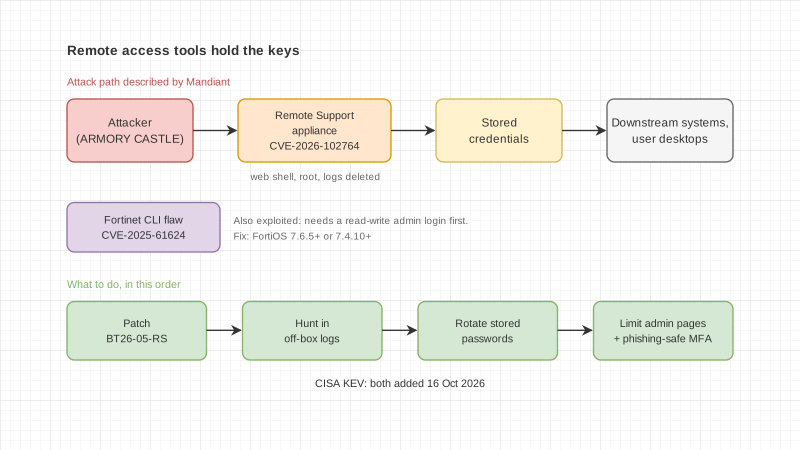
  • CVE-2026-106931 in SiteGuard Server Edition, web protection software from the Japanese company EG Secure Solutions. It is an OS command injection flaw that may allow commands to run with root or SYSTEM privileges.
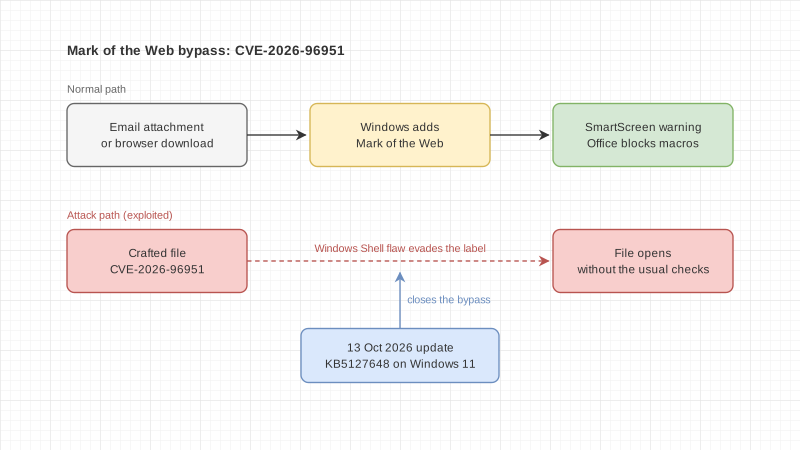
  • CVE-2026-110936 in Siemens Software Center, all versions before V4.0.9.8. The program loads DLLs from an uncontrolled search path, so an attacker who can already log in to the machine can run code with the program's privileges. Engineering firms and factories that use Siemens software should check engineers' workstations too.

Why this matters for a Thai business

Plex is home software, not a business system, so most companies never put it on the list of things to maintain. Yet programs like this end up on office NAS boxes, old PCs repurposed as small servers, or the home machines of IT staff who work remotely. All of these sit outside the monthly patch list.

The lesson goes beyond Plex. The gap between a patch shipping and real attacks can be months long. Once exploit code is public, that gap can shrink to a single day. If the company does not know a program is there, it cannot patch it in time.

If the compromised machine has customer or employee data in folders that Plex can reach, the problem is no longer a crypto miner. It may become a personal data breach that you need to assess under PDPA.

A checklist for this week

  1. Ask your IT team and outside providers where Plex Media Server is installed: NAS devices, servers, and the home machines of anyone with admin rights to company systems.
  2. If you find it, check the version. If it is below 1.43.3.10861 and was ever reachable from the internet, handle it as a possibly compromised machine: reinstall, then change every password that machine could reach.
  3. If the business does not actually need Plex, remove it rather than maintain software nobody owns.
  4. Check how much of the NAS the accounts running add-on programs can see. Limit them to the folders they need.
  5. If you run SiteGuard Server Edition or Siemens Software Center, apply the vendor's update.
  6. Add a monthly step to your patch routine: compare new KEV entries against the company's software list, including programs that never went through purchasing.

If your team does not yet have a way to decide which flaws come first, the idea of fixing what is actively exploited first is covered in our article on risk-based patch prioritization.

What Enersys does

We have built and supported business software for 14 years, covering ERP, AI and personal data work under PDPA. If you want to map which machines hold your business systems and files, who can reach them, and which personal data would be affected if one machine is compromised, talk to the Enersys team.

Sources

"Empowering Innovation,
Transforming Futures."

Contact us to make your project a reality.