A manufacturing order calls for 100 units. The first station has completed 20, but the next station is waiting for the full order. If those 20 units meet the plant's release conditions and are physically ready to move, the delay may come from how work is recorded rather than from a machine constraint.
Odoo 20 documentation describes Continuous Production for this situation. Recording a produced quantity on a work order releases the next dependent work order to process that quantity before the preceding operation finishes the full order.
This is an explainer for manufacturing operations and finance managers, prepared as of 19 October 2026. It draws on Odoo 20 documentation and Odoo's launch announcement dated 24 September 2026. It is not a report of a feature launching today, or confirmation that a particular plant's existing Odoo database already has this configuration available.
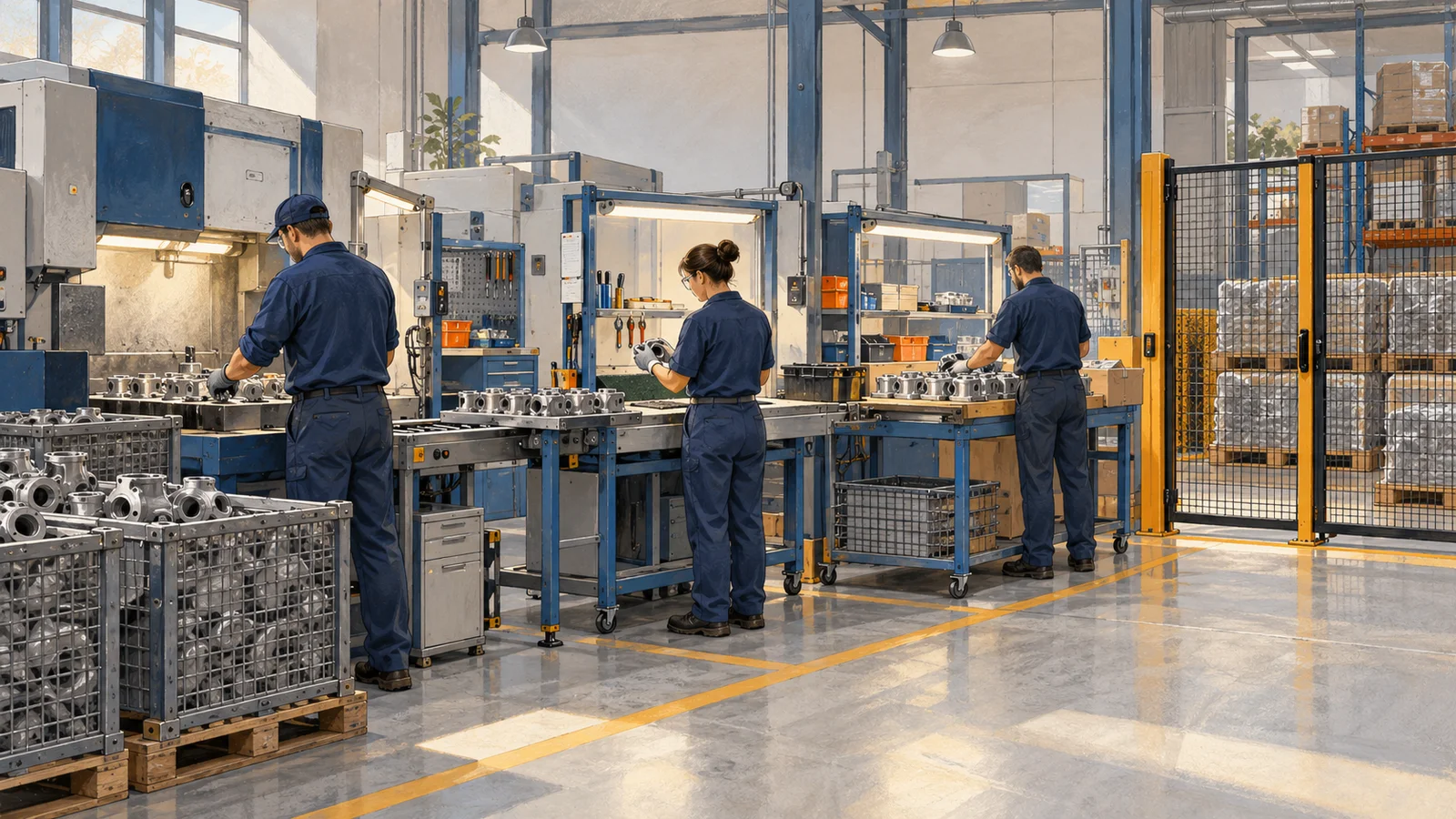
AI-generated illustration of work moving between stations. It does not depict a customer factory or an Odoo screen.
The first 20 units can move while the remaining 80 are still in production
Consider a manufacturing order (MO) for 100 units, with work orders for component preparation, assembly, and inspection. These quantities illustrate the workflow; they are not measurements from a factory trial.
The preparation station completes 20 units and its operator records that quantity. With Continuous Production enabled for the relevant bill of materials (BoM), the next work order can begin processing those units while preparation continues on the other 80.
The change concerns when work can pass between operations. The entire order does not need to finish its first operation before the next starts. Odoo describes this as useful for production moving through stations in smaller batches or a continuing flow.
Releasing a downstream work order does not create additional machine capacity. If assembly is already fully occupied, earlier release may simply move the queue. Managers should first establish whether the constraint is a release rule, machine capacity, or a necessary process condition.
Progress between stations is different from finished stock
The Continuous Production documentation states that produced quantities enter stock after the MO is complete. Recording 20 units at the first station does not automatically receive 20 finished goods into inventory.
Operations may see progress and begin a subsequent task while the warehouse should still treat those units as unfinished. Sales and customer service need the distinction when reserving goods or promising delivery dates.
In this example, “20 units done” needs a further explanation: which operation is complete, which checks have passed, and what use is now permitted? Without that context, a progress figure can be mistaken for an available-stock figure.
Finance should also examine cost recognition and work-in-progress reports in a test database. Documentation about passing quantities between operations does not establish how every plant's costing reports will behave. The assessment needs to cover costing methods, material consumption, recorded labor or machine time, and existing customizations.
Partial work-order progression and partial MO closure solve different problems
Continuous Production concerns the progression of work orders within a manufacturing process. Manufacturing backorders concern the quantity left when an MO is closed before its full demand has been produced.
Suppose the plant intends to make 100 units, but only 20 finished units have completed all required operations. The team needs to close the current order and handle the other 80 later. That calls for a separate review of the backorder process. The Continuous Production documentation says normal backorder handling applies if the MO closes before its full quantity is produced. The backorder documentation explains how completed work and remaining demand are separated.
Begin with the operational question. A station that needs to start while an upstream station is still working calls for reviewing partial progression. A team that needs to close a production run and carry remaining demand forward needs to review closure and backorder conditions. Similar quantities on two screens do not make the workflows interchangeable.
Quality and traceability must travel with the units
Quantity alone does not establish that work is ready to move. A process may require cooling, curing, test results, or approval before the next operation. Recording production does not remove those physical or quality conditions.
Before adoption, agree who may record a quantity and what completion means at each station. Establish how rejected units, rework, and scrap are separated from the quantity released downstream. Where lots or serial numbers are used, the team should be able to trace the units received by the next operation to their originating group.
Odoo documents quantity registration through work orders and recommends Shop Floor for this workflow. A quantity or lot entry field, however, does not prove that every plant-specific quality rule is enforced. Test the actual configuration, including connected systems where applicable.
Material consumption needs the same attention. If different operations consume different components, check the relationship between recorded output, time, and issued materials. Include late entries, duplicate entries, and corrected quantities. Enabling Continuous Production should not be assumed to repair inconsistent operational data.
Trial one real production flow before extending it across the plant
The following is a proposed evaluation approach, not a deployment result verified by Enersys. Start with one product that has multiple operations and actually moves in smaller batches. Choose a flow that operations, warehouse, quality, and accounting can describe consistently.
In a test database, create a 100-unit MO and record 20 units at the first operation. Check whether the next work order can start with the intended quantity. Then test subsequent batches, quantity corrections, scrap, lot traceability, and partial closure with remaining demand. Compare work-order status with warehouse balances and costing reports at each significant transition.
Acceptance criteria need not begin with a promised percentage reduction in production time. Measure waiting between stations before and during the trial, alongside data corrections and the recording burden on operators. State the measurement boundary. A trial on one product cannot establish a result for the whole factory.
Before approving live use, the team should be able to explain the conditions under which the first 20 units move, who resolves a quantity mismatch, and what warehouse and finance users will see. If their answers differ, agreeing on the meaning of the records comes before activation.
Enersys can begin an Odoo assessment with the plant's actual workflow and agree a test scope and acceptance criteria with the team. A useful starting point is the station currently waiting for an entire MO even though some units are already ready to move.
References
Documentation reviewed on 19 October 2026. The documentation pages below do not display publication dates; they support an explanation of Odoo 20 behavior, rather than a claim of a new change announced today.