TL;DR
The questions we hear most from new clients, candidates, and partners —
"What does Enersys actually do? And who does what inside the company?"
Short answer: Enersys is a Thai company that started as a software house in 2012 and is now transforming into an AI company — working across three lines: Odoo ERP, AI, and Data Privacy (PDPA) — for Thai enterprises, with two of our own products: Genesis AI Platform (agentic AI for enterprise) and PrivacyHub (end-to-end privacy governance).
Long answer: this article. We'll walk you through every door, every room, every role. You'll see who does what, who hands off to whom, and which AI assistant lives in each part of the workflow.
In 2026, when 92% of U.S. developers use AI tools daily (GitHub Developer Survey), every role in the company isn't just "a person" anymore — it's a person + an AI assistant working together.
Let's open the first door.
Big Picture — Who Enersys Is
Before we walk in, a 30-second framing.
Enersys was founded in 2012 as a software house serving leading Thai organisations in energy, banking, media & entertainment, and government — work has included a wildfire incident reporting application, the PDPA compliance platform deployed at two of Thailand's largest banks, and helping the Ministry of Public Health resolve the traffic crisis on the "Mor Prom" COVID-19 vaccine registration system.
In 2025 we earned Odoo Silver Partner status — confirming international-grade ERP standards — and listed Genesis AI Platform on the depa Thailand Digital Catalog.
Today the company focuses on three business lines:
- Odoo ERP Implementation & Customization — design, deploy, and customize Odoo for Thai enterprises (SME through large enterprise) as a Silver Partner — accounting, inventory, sales, manufacturing, HR
- Genesis AI Platform + AI Integration — our own agentic AI platform plus LLM, automation, and RAG work integrated into client workflows
- PrivacyHub + PDPA Compliance — our own privacy governance platform plus consulting / audit / implementation work, accumulated since 2021
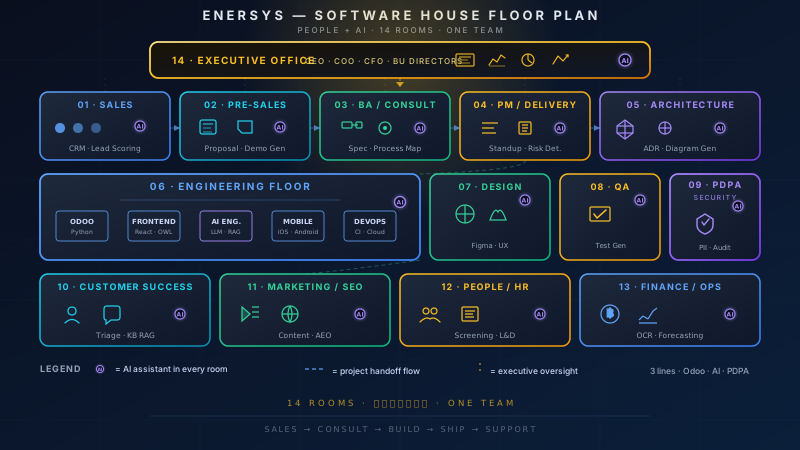
The company is structured into 14 rooms (an auspicious number in Thai tradition) — every room talks to every other room. There are no silos.
The tour starts at the front door.
Room 1 — Front Desk / Sales & Business Development
Every new client meets this room first.
What they do
- Listen to the client's initial pain points
- Qualify opportunities that match the company's capabilities
- Coordinate meetings between clients and pre-sales / consultants
- Manage pipeline and long-term relationships
Job functions in this room
- Sales / Business Development Executive — first contact, qualification, follow-up
- Account Manager — owns existing clients for upsell, renewal, expansion
- Partnership Manager — owns channel partners and technology vendors
AI tools they use
- CRM auto-summary — every meeting transcribed and summarized straight into the CRM
- Lead scoring AI — predicts which leads are likely to close
- Email drafting copilot — drafts follow-ups based on conversation context
- Meeting prep agent — pulls client company info and recent news ahead of the meeting
The result: sales spends more time on "real conversations" and less time on admin.
Room 2 — Pre-Sales / Solution Consulting
Past the first door — this is where "selling" becomes "designing a solution."
What they do
- Listen at a deeper level (technical + business)
- Design a high-level solution that matches the brief
- Write proposals, scopes, and estimates
- Demo prototypes so the client can see it
Job functions in this room
- Pre-Sales Consultant — interface between business and technical
- Solution Architect (pre-sales) — high-level architecture
- Demo Engineer — builds prototypes, screenshots, and demo videos
AI tools they use
- Requirement summarization — extract requirements from meeting transcripts
- Proposal drafting AI — generate proposal drafts from templates + client context
- Estimation copilot — compares scope against historical projects and suggests effort ranges
- Prototype generator — fast mockups for client demos (Figma + AI plugins)
The result: 2–3× faster RFP turnaround, sharper demos, clearer alignment before contracts.
Room 3 — Business Analyst & Functional Consultant
The "translation room" — translating business language into requirements the technical team can act on.
What they do
- Workshop with client stakeholders
- Write functional specs
- Design the TO-BE business process from AS-IS
- Run user acceptance testing before go-live
Job functions in this room
- Business Analyst — business process and requirement focused
- Functional Consultant (Odoo) — deep knowledge of Odoo modules and process mapping
- Process Designer — flowcharts, BPMN, swim lanes
AI tools they use
- Workshop transcription + summary — record meeting → AI summarizes points and action items
- Process diagramming AI — text → flowchart (Mermaid, draw.io AI)
- Spec validation copilot — checks the spec for ambiguity and contradictions
- UAT scenario generation — generates test cases from the functional spec
The result: more complete specs, less rework downstream, broader UAT coverage.
Room 4 — Project Management & Delivery
Every project passes through this room from start to finish.
What they do
- Plan timelines, milestones, deliverables
- Allocate resources to scope
- Manage risk and change requests
- Communicate with clients weekly
- Deliver against commitments
Job functions in this room
- Project Manager — overall accountability
- Delivery Lead — delivery + quality
- Scrum Master — per Schwaber & Sutherland's Scrum framework, a servant leader who helps the team work
- Product Owner — on Agile engagements — backlog priority, scope decisions
AI tools they use
- Standup notes AI — automatic daily standup summaries
- Status report generator — pulls from the project tool → generates weekly status
- Risk detection — AI spots patterns from past projects and flags risk
- Resource allocation AI — suggests who's free and who fits which task
The result: PMs spend more time on "real problems" and stakeholders, less time writing reports.
Room 5 — Architecture / Tech Lead
The room between the business rooms and the engineering floor.
What they do
- Design the technical architecture for each solution
- Decide on tech stack, integration, and security
- Review code at the design level
- Set technical direction for the team
Job functions in this room
- Solution Architect — system-level architecture
- Tech Lead — leads dev teams in a given track
- Integration Architect — designs data flow across systems
- Security Architect — keeps security patterns, PDPA, and compliance in every design
AI tools they use
- Architecture review copilot — AI reads ADRs and points out trade-offs that might be missed
- Pattern lookup — searches patterns used in other internal projects
- Security checklist AI — reads architecture diagrams → checklists (PDPA, audit log, encryption)
- Diagram generation — text description → system diagram
The result: faster architectural decisions with equal or better rigor.
Room 6 — Engineering Floor
The widest floor in the company — split into five zones.
Zone A: Odoo Backend Developer (Python)
- Build / customize Odoo modules
- Write ORM models, business logic, and workflows
- Integrate Odoo with external systems (APIs, webhooks)
- Migrate data from legacy to Odoo
AI tools: Claude Code / Cursor for pair programming, AI code review, test generation. Per GitHub research, developers can be up to 55% faster on specific tasks.
Zone B: Frontend Developer
- Build Odoo UI (OWL framework), web portals, custom dashboards
- React / Next.js for custom web apps outside Odoo
- Responsive, accessible, performant
AI tools: component generation, accessibility checker AI, design-to-code (Figma plugins), automated visual regression.
Zone C: AI Engineer / Integration
- Design + integrate LLM-based features (chatbots, copilots, RAG)
- Prompt engineering, evaluation, fine-tuning when needed
- Agentic workflow design (MCP, multi-agent)
- Model selection + cost optimization
AI tools: the role itself is "using AI to build AI" — eval frameworks, prompt optimization tools, observability platforms (Langfuse, Datadog).
Zone D: Mobile / Native Developer
- iOS, Android, Flutter, React Native
- Offline-first, sync with Odoo / backend
- Mobile-specific UX
AI tools: code generation, platform-specific helper AI, automated build/deploy.
Zone E: DevOps / Platform / Infrastructure
- CI/CD pipelines
- Cloud infrastructure (AWS / GCP / Azure / on-premise)
- Monitoring, logging, alerting
- Security hardening, secret management
AI tools: infrastructure-as-code copilot, log analysis AI, incident response assistant, cost optimization AI.
Room 7 — Design Studio (UX / UI)
A small room with outsized impact — users meet the UI before they meet the business logic.
What they do
- User research, personas, journey maps
- Wireframes, mockups, prototypes
- Design system, component library
- Usability testing
Job functions in this room
- UX Designer — research + flow design
- UI Designer — visual + interaction
- Design System Owner — keeps consistency across products
AI tools they use
- Figma AI / Magic UI — generates component variants
- Persona generator — creates personas from research data
- Copy generator — drafts UX copy that fits the brand voice
- Accessibility audit AI — checks contrast, screen-reader compatibility
The result: 3–5× faster design iteration, a design system with governance that actually holds.
Room 8 — Quality Assurance / Test Lab
The room nothing ships past.
What they do
- Write + run test cases (functional, regression, integration)
- Automate test pipelines
- Performance tests, load tests
- Light-touch security testing (deep work goes to Room 9)
Job functions in this room
- QA Engineer (manual) — exploratory testing, UAT support
- Test Automation Engineer — Playwright, Selenium, Robot Framework
- Performance Engineer — load testing, profiling
- QA Lead — strategy, coverage decisions
AI tools they use
- Test case generation — AI generates test cases from specs
- Test data generation — produces varied mock data
- Visual regression AI — smarter screenshot diffs
- Flaky test detector — flags tests that pass and fail intermittently
The result: higher coverage, fewer false alarms, safer deployments.
Room 9 — Data Privacy / Compliance / Security
A room at the heart of Enersys — because PDPA is one of our three business lines.
What they do
- Audit client systems against PDPA / GDPR
- Bake privacy-by-design into every architecture
- DPIA (Data Protection Impact Assessment)
- Train client staff on data privacy
- Respond to data subject requests and breaches
Job functions in this room
- Data Privacy Officer / Consultant — PDPA / GDPR specialist
- Security Engineer — pentest, vulnerability assessment
- Compliance Analyst — frameworks like ISO 27001, SOC 2
- DPO Advisory — fractional DPO for clients without one in-house
AI tools they use
- PII detection AI — scans documents/databases for personal data
- Policy generation — generates privacy policies / consent forms in context
- Audit log analysis — AI surfaces anomalies in access logs
- Vulnerability prioritization — models prioritize bugs by risk
The result: faster audits, clients pass PDPA confidently, privacy is baked into every project from the design stage.
Room 10 — Customer Success / Support / Training
After go-live the project isn't over — this room takes over.
What they do
- Onboard new clients
- Train users
- Answer support tickets
- Manage SLAs
- Read usage data → identify upsell / risk
Job functions in this room
- Customer Success Manager — strategic relationship
- Support Engineer (L1/L2/L3) — technical troubleshooting
- Trainer — workshops, videos, documentation
- Documentation Writer — manuals, FAQs, runbooks
AI tools they use
- Ticket triage AI — automatic priority and assignment
- Knowledge base RAG — chatbots that answer from real documentation
- Training video summarizer — auto subtitles and chapters
- Sentiment analysis — read client mood from tickets and email
The result: faster response times, clients get answers sooner, support engineers focus on the hard problems.
Room 11 — Marketing / Content / SEO
The room that makes people discover Enersys and trust us before they reach out.
What they do
- Content marketing (articles, videos, webinars)
- SEO / AEO / GEO — visibility across Google, AI assistants, and generative search
- Social media + community
- Events and partnerships
Job functions in this room
- Content Strategist — content roadmap
- SEO Specialist — keyword, on-page, technical SEO
- Content Writer — insight articles (like this one)
- Marketing Designer — visual assets, social cards, SVG art
AI tools they use
- Content research AI — sources + verification for articles
- SEO copilot — keyword research, content gap analysis
- AEO optimizer — checks whether articles surface in LLM-driven search
- SVG / image generation — illustrations for articles
The result: consistent content output, better rankings on Google and AI search, growing brand awareness.
Room 12 — People / HR / Talent
The room that takes care of the most important asset of a software house: people.
What they do
- Recruit talent (engineers, consultants, designers)
- Onboarding + culture
- Performance review + career path
- Learning & development
- Compensation + retention
Job functions in this room
- HR Business Partner — strategic HR
- Recruiter — sourcing, interviews
- People Ops — admin, payroll, benefits
- L&D Manager — training, upskilling
AI tools they use
- Resume screening AI — first-pass filter + bias checks
- Interview transcription + analysis — capture + analyze interviews
- Skill gap analyzer — team skills vs. project needs
- Internal mobility AI — match employees to internal opportunities
The result: faster hiring, less bias, better retention.
Room 13 — Finance / Operations
The back office that keeps the company running.
What they do
- Accounting, invoicing, billing
- Budget + forecast
- Procurement, vendor management
- IT admin, office, asset
Job functions in this room
- Finance Manager — accounting + reporting
- Operations Lead — process, vendor, facility
- Billing Specialist — invoices, payment tracking
- IT Admin — internal IT, assets, licenses
AI tools they use
- Invoice OCR + classification — incoming invoices → AI reads, categorizes, files
- Cash flow forecasting — model-based forecasting
- Vendor anomaly detection — flags unusual invoices
- Internal helpdesk bot — answers basic IT questions
The result: faster month-end close, less manual entry, more time for actual analysis.
Room 14 — Executive Office / CEO Suite
The last staircase — the room at the "top" of the building, with the door open all day.
This isn't the room where a boss sits and gives orders — it's the command bridge that sees the whole company and keeps the other 13 rooms moving in the same direction.
What they do
- Set the company's vision and direction on a 3–5 year horizon
- Make major strategic decisions — partnerships, expansion, investment
- Maintain C-level relationships with strategic clients
- Hire senior talent and shape culture company-wide
- Own P&L and the wellbeing of every employee
- Carry "ultimate responsibility" when crises hit
Job functions in this room
- CEO / Managing Director — vision, P&L, strategic clients
- COO — operational excellence across every room
- CFO — financial strategy + capital allocation
- Business Unit Director — head of each line (Odoo / AI / PDPA)
- Executive Assistant — the bloodstream of this room; keeps executives focused on what matters
AI tools they use
- Strategic dashboard — real-time P&L, project health, customer NPS — always on
- Market intelligence agent — auto-digest news, competitor moves, relevant trends
- Board prep AI — pre-meeting summaries + draft decks for the board
- Decision support / scenario AI — "what if we did X?" modeled on finance + ops data
- Executive inbox triage — filters email down to what actually needs attention
- Briefing agent — context summary before every major meeting
The result: executives spend more time with people and important decisions, less time on reports — the company moves faster because context is ready before the question is even asked.
The Enersys principle: leaders aren't "people behind a big desk." They are people who walk into every room at any hour, and this room is where every thread of the company comes together.
How the Rooms Connect — No Silos
The heart of the company is "rooms that talk."
A typical project flow
- Sales (Room 1) meets the client → hands off to Pre-Sales (Room 2)
- Pre-Sales designs a high-level solution → workshops with BA (Room 3)
- BA writes the spec and scope → PM (Room 4) plans the work
- Architecture (Room 5) decides the technical approach → guides Engineering (Room 6)
- Engineering builds + Design (Room 7) owns UX + QA (Room 8) verifies
- Data Privacy (Room 9) reviews at every milestone
- Go-live → Customer Success (Room 10) takes over
- Marketing (Room 11) captures the case study → amplifies the work
- HR (Room 12) + Finance (Room 13) support every room throughout
- Executive Office (Room 14) reads signals from every room, adjusts direction, makes strategic calls when needed
Rooms 12, 13, and 14 aren't in the project flow directly — but they're non-negotiable. People, cash flow, and direction are the bloodstream and the brain of the business.
AI Augmentation — All Rooms in One View
In 2026, every role in the company has at least one or two AI helpers running daily.
The principles we hold:
- AI reduces toil; it doesn't make decisions — repetitive low-cognition work goes to AI; humans spend time on thinking
- Human-in-the-loop, always — AI suggests, humans decide, especially anything touching clients, personal data, or contracts
- Audit trail for AI — we know what AI did, when, and why
- Company-wide AI literacy — every employee gets baseline training on using AI safely
- Client data never enters public LLMs — only private endpoints, on-premise models, or enterprise contracts
Aggregate numbers we see in our team (aligned with GitHub's 55% faster finding for developer tasks):
- Sales response time — down 40–60%
- Proposal turnaround — down 50%
- Development velocity — up 30–50% on routine tasks (not the 10× of the hype cycle)
- QA coverage — up 25%
- Support first-response time — down 50%
- Content output — 3–5× higher (insight articles publish consistently)
What Doesn't Change — Our Six Core Values
Rooms change. Technology changes. AI changes. The six Core Values of the company are the one constant — every room holds to them, and they have been with us since 2012.
1. Innovation
Not afraid to try, not afraid to fail — if a new technology genuinely solves a problem, we adopt it. From Odoo to cloud to LLMs to agentic AI.
2. Technical Excellence
What we deliver has to meet the bar — in code, architecture, and DevOps. Review, test, documentation, security — every box gets checked, every time. We don't skip because we're rushing.
3. Customer Focus
If the client doesn't actually benefit, we don't do it. We don't sell what clients don't need; we don't pad scope to bill more. The goal is the client's business outcome, not our billable hours.
4. Agility
When the problem changes, we change with it — we don't cling to the original plan if it isn't working. This is exactly why the company has been able to transform from a software house into an AI company.
5. Collaboration
Clients and partners aren't "outsiders" — they're on the team. We kick off with workshops, work together throughout the project, and keep the conversation going long after go-live.
6. Continuous Improvement
Yesterday was good; today has to be better. Retrospectives, learning sessions, and post-mortems happen after every milestone — not only when something went wrong.
This is why many of our clients renew past 5 years — not because we write the best code in the world, but because we deliver work that actually works, stay with clients after go-live, and keep getting better.
Closing — The Tour Ends at the Front Door
Fourteen rooms — from Sales to the Executive Office (an auspicious number, and not by accident).
Three things to take home:
- Enersys = a Thai company since 2012 — evolving from software house to AI company, with full-stack Odoo / AI / PDPA capability and our own products (Genesis AI, PrivacyHub)
- Odoo Silver Partner + Genesis AI listed on the depa Thailand Digital Catalog
- Every role is a person + an AI assistant working together
- 14 rooms talk to each other — no silos — including the Executive Office that watches the whole picture
- AI reduces toil; it doesn't replace people
- Anchored by six Core Values — Innovation, Technical Excellence, Customer Focus, Agility, Collaboration, Continuous Improvement
If you're a:
- Client — you now know what we do, who picks up your project, and how it moves — easier to kick off
- Candidate — you know which rooms have open seats and what we expect
- Partner — you know where our work and yours connect
If you want to keep talking — to engage us, join us, or partner with us — Room 1 is right there.
Sources