TL;DR
In software, the word SME often arrives with the assumption of incomplete systems. For some SMEs that holds. Across the category, it does not.
In 2026, SMEs that have invested in standards and systems ship enterprise-grade work every day. In dimensions like decision speed, deployment cadence, and direct ownership, some of them move faster than larger organisations with more complex structures.
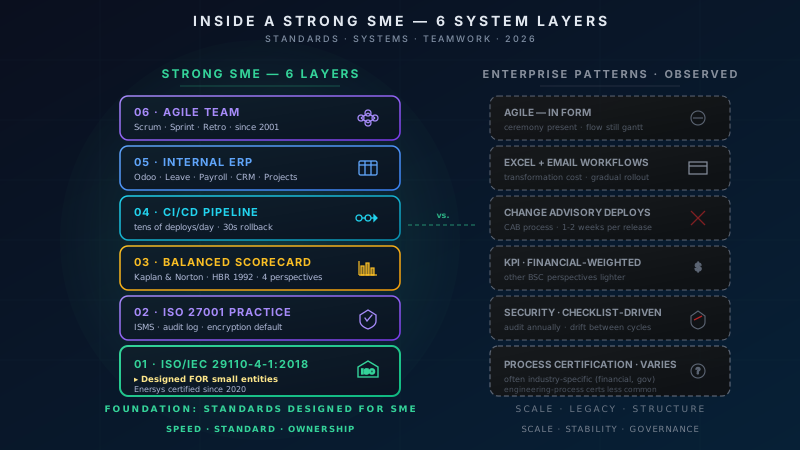
What follows opens the engine room of Enersys. Six layers, room by room, so clients, partners, and people choosing where to work have a concrete picture of what a strong SME looks like inside.
The road ahead:
- The six layers of standards and systems a strong SME actually runs on
- Observations from working alongside large enterprises and the trade-offs they live with
- What an engineer gains from a strong SME compared with a larger employer
- Eight questions to separate SMEs that have built systems from SMEs still in the early stages
Where "SME = No System" Comes From
The belief is not invented. It reflects real experiences.
Some engineers worked at SMEs in early stages of building systems, where processes lived in conversation rather than documents, where version control was loose, where FTP carried releases to production, and where deadlines slipped. Others interned at large organisations with deep org charts, full functional departments, and named owners for every domain, and equated size with system. Others absorbed the prevailing framing from recruiters and media, where large companies appear stable, structured, and well resourced.
All three experiences are partly true. None of them complete the picture.
Both sides have two faces. SMEs with strong systems exist next to SMEs still building them. Large companies with modern engineering practice exist next to large companies still modernising legacy. Company size and public listing reflect market capitalisation and regulatory compliance, not engineering quality. The proxy is weak.
What actually determines system quality is culture, leadership, and sustained investment. Size is not the variable.
Observations from Enterprise Engagements
Enersys has served leading organisations in energy, banking, media, and government since 2012. The engagements have given us a close view of how large companies run their codebases and engineering processes.
A recurring pattern shows up. Not at every enterprise, but at enough of them to be worth describing.
Codebases that are fifteen to twenty years old, understood in full by a small number of people. Deploy pipelines that have been automated in places and remain manual in others. Automated test coverage thin enough that manual QA still dominates each release cycle. Documentation distributed across people rather than collected in a single source of truth. Change requests on three to six month cycles through layers of committees. Vendor lock-in that turns supplier changes into multi-year programmes. Approval chains that lengthen even for small modifications.
The pattern is not the result of carelessness. It is shaped by context. Revenue is steady from long-term contracts and market position. Financial cushion permits gradual transformation. Regulation has to be respected. A customer base depends on the existing systems and cannot be moved overnight.
Large and stable does not imply modern engineering practice automatically. The two can coexist. They are not the same thing.
For an engineer focused on continuously improving technical skill, the engineering context of the organisation shapes the trajectory of a career more than most people expect.
The Six System Layers a Strong SME Runs On
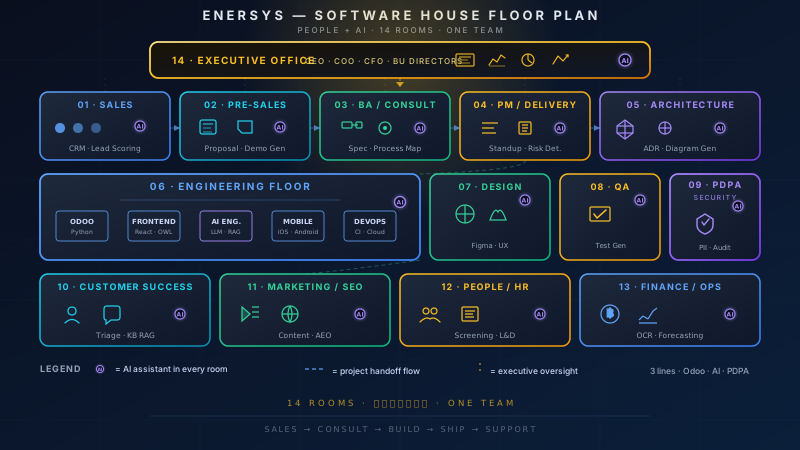
What is in the engine room. Enersys serves as one worked example, at a size where every engineer still knows everyone's name.
Layer 1. ISO/IEC 29110, a Standard Designed for SMEs
A point that gets missed. ISO publishes a software lifecycle standard built specifically for Very Small Entities of up to twenty-five people.
ISO/IEC 29110-4-1:2018 sets out two principal processes. Project management covers planning, monitoring, and control. Software implementation covers requirements, design, construction, integration, and verification. The standard names the core artefacts: project plan, requirements specification, software design, test plan.
Enersys earned the certification in 2020. Six years before the AI hype reached its peak, we put process investment ahead of scale, while still small.
A point worth weight. ISO considered SMEs important enough to design a dedicated standard. The message is not that small companies lack systems. The message runs the other way. Systems sized to small organisations are something large organisations find harder to do.
Layer 2. ISO 27001 Practice for Information Security
ISO/IEC 27001 is the international standard for an Information Security Management System.
Enersys works with PDPA-grade and bank-grade data. We are not certified, but the 27001 framework shapes how we operate. An access control matrix records who can reach what. Encryption at rest and in transit is the default on every project. An audit log captures every action that touches personal data. An incident response runbook spells out the steps when a breach happens. Every external integration goes through a vendor security review.
That is how we built PDPA platforms for two of Thailand's largest banks. Not because we were big. Because the practice was stricter than the IT inside many of the organisations we serve.
Layer 3. Balanced Scorecard, Management with Measurement
Kaplan and Norton published the Balanced Scorecard in Harvard Business Review in 1992. Four perspectives for measuring a business.
Financial covers revenue, profit, and cash flow. Customer covers NPS, retention, and satisfaction. Internal Process covers quality, speed, and efficiency. Learning and Growth covers skill development, retention, and innovation.
Enersys runs the BSC each quarter. Every room in the company holds KPIs across all four perspectives. The result is decisions grounded in data rather than the owner's intuition.
In practice, many organisations that say they run the BSC give weight to Financial and let the other three drift to the background. Holding the full four with equal seriousness is more achievable in a small company where everyone sees the same dashboard.
Layer 4. CI/CD and the Confidence to Deploy Many Times a Day
Continuous Integration and Continuous Delivery describe an automated pipeline. Every commit is tested. Code that passes tests is promoted to staging. After QA approval, production deployment takes minutes, not days.
Enersys deploys to production dozens of times a day. The team is confident because of what stands behind the pipeline. Automated coverage across unit, integration, and end-to-end. Feature flags that turn capabilities on and off without a deploy. Rollback in thirty seconds when something is off. Monitoring and alerting on every endpoint.
Some enterprise IT teams deploy through a Change Advisory Board on a one to two week cycle. That is a reasonable trade for their governance environment. It produces a different rhythm of iteration for the individual engineer.
Layer 5. An ERP the Company Actually Uses
A small irony. Enersys is an Odoo Silver Partner that installs ERP for clients, and runs Odoo internally as our own ERP.
Every employee files leave through Odoo, sees the leave balance, requests approval, and receives the result without an email chain. Payroll and accounting live in the same system; payslips, taxes, and benefits are visible to each person. CRM holds every lead, opportunity, and client record. Project and timesheet record working time, billable rates, and progress. Helpdesk handles tickets for internal and external requests. Documents live in central storage with deliberate permissions.
Some of our enterprise clients still run these workflows on spreadsheets and email in 2026. Not from lack of awareness. Transformation at that scale carries a real cost and timeline.
A strong SME is one that uses the tools it sells on its own work, with the same seriousness it asks of clients.
Layer 6. Agile, Practised Rather Than Performed
The Agile Manifesto was published in 2001. It states four values. Individuals and interactions over processes and tools. Working software over comprehensive documentation. Customer collaboration over contract negotiation. Responding to change over following a plan.
Enersys runs Agile in the way practitioners describe it. Sprints of two weeks with planning, daily standup, review, and retrospective. A Definition of Done that enforces test, review, and documentation before a story closes. Cross-functional teams where developers, business analysts, QA, and UX sit together, without handoffs across departments. Customers join sprint reviews every two weeks, with scope adjusted in real time.
Some large organisations adopt Scrum in form. The ceremonies happen on schedule. The internal flow still resembles waterfall because org structure and approval processes did not move with the new framework.
The difference is not the size of the company or the framework chosen. It is whether leadership commits to making the practice real.
What an Engineer Gains from a Strong SME
A perspective for anyone choosing a workplace with a three to five year horizon in mind.
Decision speed. At a strong SME, an idea reaches a decision and ships within one to two weeks. At many large companies, the same idea passes through committees, approvals, IT requests, and vendor pipelines, and several months go by. Both arrangements have reasons. Larger organisations carry governance and risk at scale. For a single engineer, velocity translates directly into iteration count, and iteration count translates into learning.
Surface area of skill. Engineers at SMEs usually carry work from design through deploy and support, and they see the whole stack. Engineers in larger organisations more often specialise, deeper but narrower. Both produce strong engineers of different shapes. The question is the shape an individual wants to build.
Tangible impact. At a thirty-person SME, a feature reaches hundreds of clients within days, and revenue moves. The author of the work sees the effect. At a company of five thousand, a feature is one of two hundred initiatives per quarter, and the effect is distributed across many. What engineers respond to is seeing the consequence of their work. A strong SME gives them a short, direct feedback loop.
Proximity to decision makers. At a good SME, founders and leadership work close to the codebase, and business decisions are visible in real time. At a large company, leadership sits further from daily execution, in exchange for the reach and resources that come with scale. Both are learning environments. They are different shapes.
Career trajectory. At a strong SME, the step to lead or architect can happen quickly when the work is ready, because the role has open ground. At a large company, paths are well marked, with a clear ladder and the benefits of structure and stability. Both work. The choice depends on knowing which suits the person making it.
Every Large Company Was an SME Once
A useful reminder when looking at SMEs. Every large organisation in view today began as a small one.
Apple in 1976 was Steve Jobs and Steve Wozniak in a Cupertino garage. Microsoft in 1975 was Gates and Allen. Amazon in 1994 was Bezos selling books out of a garage. Google in 1998 was Page and Brin in a Stanford rental. SCG opened Thailand's first cement plant in 1913. PTT was spun out of a government unit in 1978. CP started as a seed shop in an old market in 1921.
Every Fortune 500 and SET 100 company today is an SME that made the right call at the right time.
To dismiss SMEs in 2026 is to miss the chance of working with a company that may lead the market a decade from now, at the moment when it still needs engineers to help shape the direction.
Eight Questions That Help Identify a Strong SME
Not every SME has invested in standards and systems to the same degree. The questions below help anyone choosing a workplace, or a client choosing a partner, see the company more clearly.
Ask HR, the tech lead, or the engineering manager:
- What certifications relevant to engineering process does the company hold, for example ISO 29110, ISO 27001, SOC 2, Odoo Partner, or depa Catalog
- How often does the team deploy to production, and what does the cadence say about the maturity of the CI/CD pipeline
- What is the automated test coverage, and how reliable is it
- How long does the average engineer stay with the company
- Is there a recent project shipped in the last three months that can be discussed at the process level
- Which tools does the company use to run itself internally, and are they used daily
- How does code review happen, who reviews, and is there a checklist
- Is the founder or CEO still writing code, or stopped a long time ago
When an SME answers most of these clearly, it points to a company that has invested in its systems. When the answers do not arrive, it suggests an SME at an early stage of building them. That can be a strong fit for someone who wants to help build the systems. It is a poorer fit for someone seeking systems that are already in place.
Why Enersys Has Chosen to Be a Strong SME
The reasons are five.
The first is decision speed. Tomz as founder can change direction in a day when a change is needed.
The second is pride in the work. Engineers should spend their careers in environments that ship quality consistently.
The third is belief in systems. We invested in ISO 29110, CI/CD, Agile, and ERP while the company was still small, before scale forced the issue.
The fourth is the standard our clients ask for. We work with leading organisations in energy, banking, media, and government, and the work has to meet the expectations of large enterprises.
The fifth is ownership. Every person here carries direct accountability for the outcomes a client experiences, and the feedback loop is short and direct.
In 2026 we hold ISO/IEC 29110 certification, Odoo Silver Partner status, a depa Digital Catalog listing, and two of our own products, Genesis AI and PrivacyHub. All of it built at a size where every engineer still knows everyone's name.
The goal is the best of both worlds. The standards of an enterprise. The speed and ownership of an SME.
Closing
A note for anyone choosing where to work.
SMEs that have invested in systems exist. SMEs still at an early stage of building them exist. Large companies with modern engineering practice exist. Large companies still modernising legacy systems exist. The size of the company does not answer the question about engineering quality on its own.
In 2026, the speed of the market and the rise of AI have made context and leadership commitment weightier than size. The eight questions above are a checklist worth carrying. If an SME answers them well, it may be a company on the path to becoming a market leader within the next decade, at the moment when it still wants engineers to shape it.
At Enersys we hold the view that standards, rigour, and ownership weigh as much as size, sometimes more. We make the case for it daily through ISO 29110, Odoo Silver, our own internal ERP, a CI/CD pipeline that deploys dozens of times a day, and Agile teams that Fortune 500 scale clients in Thailand have trusted since 2012.
Sources
- ISO/IEC 29110-4-1:2018, Software engineering, Lifecycle profiles for Very Small Entities. The ISO standard designed for SMEs of up to twenty-five people. Enersys has been certified since 2020.
- Wikipedia, ISO/IEC 27001. The Information Security Management System framework we adopt in practice.
- Robert Kaplan and David Norton, The Balanced Scorecard: Measures That Drive Performance, Harvard Business Review, January and February 1992. The origin of the BSC.
- Wikipedia, Balanced Scorecard. Context and application.
- Agile Manifesto, 2001. The official source of the four values.
- Enersys, About Us and Certifications. Odoo Silver Partner, ISO 29110, and depa listing.