Say your company pays an outside IT provider to look after staff laptops. Every time someone reports a problem, a technician connects through the same remote support tool. That tool also keeps the passwords for servers and key systems, so technicians do not have to type them.
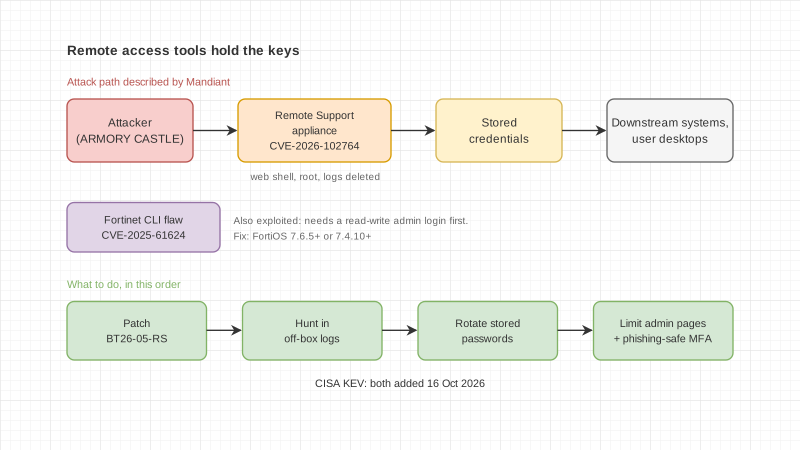
If an attacker gets into that tool, they do not see one machine. They see who connects to what, and they can take the stored passwords with them. That is what just happened with BeyondTrust Remote Support.
What happened
On 15 October 2026, BeyondTrust published security advisory BT26-05 for CVE-2026-102764 in Remote Support (formerly Bomgar). The advisory states:
- The CVSS 4.0 score is 9.3, rated Critical.
- Internal messaging components did not check where incoming messages came from, which let a remote attacker perform file operations on the appliance.
- All versions up to 26.2.3 are affected. The fix is patch BT26-05-RS for versions 24.3.1 to 26.2.3. Anyone older than 24.3.1 has to upgrade before the patch can be applied.
- SaaS customers were patched by 9 October. Self-hosted customers must apply the patch themselves unless they subscribe to automatic updates.
BeyondTrust's blog gives the timeline. The attacker used the flaw on 29 August 2026 against two customers: one instance hosted by BeyondTrust and one self-hosted appliance. BeyondTrust found the activity on 28 September, shipped the patch on 8 October and disclosed it publicly on 15 October. As of the blog's last update, BeyondTrust knew of only those two affected customers.
BeyondTrust attributes the activity to a suspected China-nexus espionage group that Google Threat Intelligence Group and Mandiant tracked as UNC5221 and now call ARMORY CASTLE. The group prefers edge devices and remote access appliances, and has used zero-days in Citrix NetScaler and Ivanti Connect Secure before.
Mandiant's report from 16 October describes what the attacker did once inside: planted a web shell, escalated to root, dumped the stored credentials, deleted several sets of logs, then used a hijacked admin account to raise some users from No Access to Administrator and open remote sessions to their desktops.
On 16 October, CISA, the US cybersecurity agency, added CVE-2026-102764 to its Known Exploited Vulnerabilities catalog together with Fortinet CVE-2025-61624. US federal agencies must deal with both by 19 October 2026, and CISA marks both as requiring forensic triage, not just patching.
The Fortinet flaw that came with it
CVE-2025-61624 is a path traversal flaw in the command line of FortiOS, FortiPAM, FortiProxy and FortiSwitchManager. According to Fortinet advisory FG-IR-26-122, someone who already has a read-write admin account can use existing commands to write or delete any file on the device.
Fortinet scores it 6.0, Medium, because an admin login is needed first. The advisory still lists it as known exploited. Fixed releases are FortiOS 7.6.5 or later and 7.4.10 or later. FortiOS 7.2, 7.0 and 6.4 need to move to a fixed release.