News

Anthropic Hands Agent Skills to the Linux Foundation: The Work Know-How You Teach AI Becomes Easier to Move Between Tools

On 22 October 2026, Anthropic donated the Agent Skills standard to the Agentic AI Foundation under the Linux Foundation. More than 70 agent platforms support it, including ChatGPT, GitHub Copilot and VS Code. What companies writing work procedures for AI should prepare.

25 Oct 20265 minAnthropic
Agent SkillsAI AgentAgentic AI FoundationLinux FoundationAI GovernanceEnterprise AIAI

Say your finance team has written a month-end close procedure for an AI agent to follow: pull outstanding payables, match bank balances, then prepare the report for the manager. It works well in the AI tool the team uses today.

Six months later, the company switches to another vendor. If the procedure is tied to the old tool, the team rewrites most of it.

News from 22 October 2026 lowers that risk, and adds something new for companies to look after.

What happened

Anthropic announced it is donating Agent Skills to the Agentic AI Foundation (AAIF), which sits under the Linux Foundation. The donation covers the standard itself, the Agent Skills name and logo, the GitHub organisation and the agentskills.io domain.

The Linux Foundation formed AAIF on 9 December 2025 with three founding projects: Anthropic's Model Context Protocol (MCP), Block's goose and OpenAI's AGENTS.md. Platinum members named in the Linux Foundation announcement include AWS, Google, Microsoft, OpenAI, Cloudflare and Bloomberg.

According to Anthropic's announcement:

  • More than 70 agent platforms have integrated Agent Skills, including ChatGPT, Cursor, GitHub Copilot and VS Code
  • 1 million skills have been published
  • Skills have been installed nearly 280 million times

Under AAIF, the standard will be maintained by individual engineers from Anthropic, Google, OpenAI and other companies, rather than by those companies as organisations. The lead maintainers are David Soria Parra and Mahesh Murag. Anthropic says the aim is to keep the standard "open, community-driven, and vendor-neutral", and anyone can use or contribute to it without joining AAIF.

Three pieces of work are planned next: a roadmap with versioned releases, a formal proposal process for changes, and security guidance for people who write and install skills. The announcement does not yet describe that guidance in detail.

What Agent Skills are

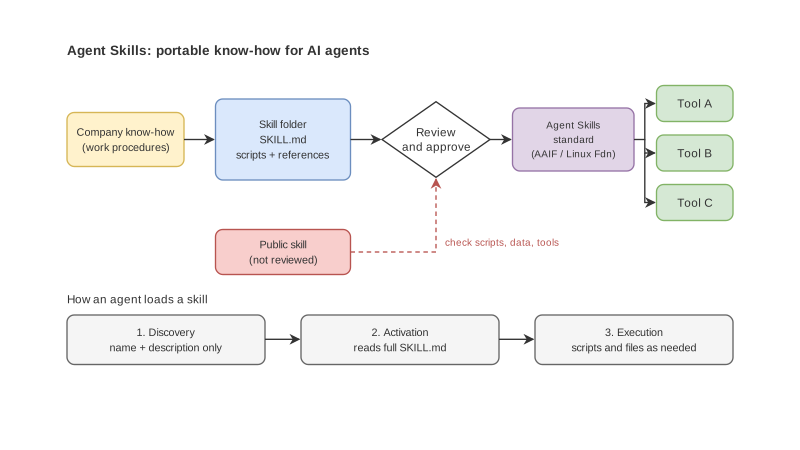
A skill is a folder containing at least a SKILL.md file. The file holds a name, a description of what the skill does and when to use it, and the steps the agent should follow. The folder can also carry runnable scripts, reference documents and templates.

Agents do not read every skill up front. At startup they see only names and descriptions. When a task matches a description, the agent opens the full instructions, and it opens supporting files only when it needs them. That lets a company keep many skills available without slowing the agent down.

Put simply, a skill is a work manual written for AI to read, and the same manual now works across tools from different vendors.
Why it matters for Thai businesses

The clear benefit is that your company's know-how is less tied to a single vendor. A purchase order check, a reply procedure under your returns policy, or credit approval rules written to this standard can move with you when you change tools. Having a neutral foundation in charge also means the format is less likely to change on one company's say-so.

The other side is that a skill is not just a document. It can include scripts the agent runs, and it can list tools the agent is pre-approved to use (that field is still marked experimental in the specification). With a million public skills available, an employee installing one from the internet is close to installing software nobody has reviewed.

PDPA also comes into it. If a team puts real customer records into a skill's reference files as examples, that data goes to everyone who receives the skill, and it travels with the skill when you change tools.

What to do now

  1. Find out which teams have already written procedures for AI agents, where they are stored and who owns them.
  2. Keep company skills somewhere with version history, and name an approver before a skill goes into real use, as you would for any policy document.
  3. Do not allow outside skills to be installed without review, especially ones with scripts or ones that ask for tools that can change data.
  4. Check that skills contain no personal data, passwords or access keys. Use made-up sample data instead.
  5. When choosing a new AI tool, ask the vendor whether it supports Agent Skills and how you can export the skills you already have.
  6. Watch for the security guidance AAIF publishes, and update your internal rules to match.

If nobody owns items 2 and 3 yet, set those rules before teams extend skills to work that touches customer or financial data.

What Enersys does

We have built and supported business software for 14 years, and we work on AI and personal data protection. If your organisation is letting AI agents work with ERP, documents or customer data, and you want clear rules on who writes procedures for AI, who approves them and what data must never go into them, talk to the Enersys team. You can also read about the PDPC's AI guidelines under PDPA.

Sources

"Empowering Innovation,
Transforming Futures."

Contact us to make your project a reality.