Picture a company where sales runs a chatbot on the website, accounting uses AI to summarise supplier invoices, and IT is piloting an AI agent that pulls customer records from the back office to draft emails. All of it touches personal data. Until now, Thailand's data protection regulator had not written down how the PDPA applies to work like this.
Now one has.
What happened
On 7 October 2026 the Office of the Personal Data Protection Committee (PDPC) posted version 1.0 of its guidelines on personal data protection in the development and use of artificial intelligence. The document is an 80-page PDF in Thai.
The cover states that the Personal Data Protection Committee issued it under Section 16(3) of the Personal Data Protection Act B.E. 2562 (2019), and that it was prepared by the PDPC Office together with the Electronic Transactions Development Agency (ETDA).
The PDPC had opened a draft of the same guidance for public comment in February 2026, so this is the post-consultation version. Thai business daily Thansettakij reported the release on 13 October, and law firm Tilleke & Gibbins published an English summary on 14 October.
The guide says plainly that it is advice only. It has no binding legal force and does not bind any finding of an offence. The PDPA it interprets is already in force, though, so the document shows how the regulator reads existing law when AI is involved.
Five points from the executive summary
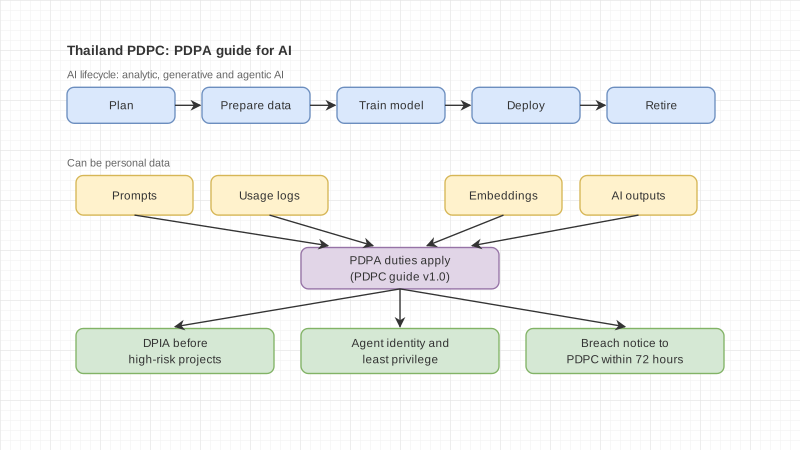
The guidance covers analytic, generative and agentic AI, from planning and data preparation through training, deployment and decommissioning. Its executive summary lists five points.
- Personal data in AI takes more forms than people expect. Prompts, usage logs, embeddings and AI-generated output can all be personal data if a person can still be identified directly or indirectly. A model trained on personal data is not automatically anonymous.
- Each organisation must state whether it is a controller or a processor for each activity, based on who actually decides purposes and means rather than on role labels. If an AI provider uses customer data to train its own models, that provider becomes a controller in its own right.
- Consent should be the last option, not the first. Organisations should work through the legal bases in Sections 24 and 26 first. Relying on legitimate interest requires a documented assessment (LIA). Relying on consent alone creates operational risk when people withdraw it.
- High-risk AI projects, such as automated decisions that affect people's rights or training on sensitive data, should go through a data protection impact assessment (DPIA) before they start, along with AI-specific controls such as input and output guardrails, restricted permissions for AI agents, and logging that supports later investigation.
- Data subject rights still apply when the technology is complex. Removing data from a trained model is technically hard, but that does not remove the legal duty. Systems should be designed so data can be deleted, for example by keeping it in a retrieval (RAG) store separate from the model and filtering output until the next model update.