ERP (Enterprise Resource Planning) is business management software that runs accounting, purchasing, sales, inventory, manufacturing and HR on a single shared database. It replaces the mix of separate programs and spreadsheets where the same data gets typed in again and again. It suits any company where several departments need the same numbers, from SMEs to large enterprises.
If you are searching "what is ERP", your company is probably running into something like this. Sales has issued an invoice but the warehouse had no idea stock was about to run out. Accounting cannot close the month until every department sends its files. And the sales figure in one manager's report never matches the one in another's. This guide answers the questions Thai businesses search for most, one at a time, using the vendors' own documentation as the reference.
What is ERP and how does it work?
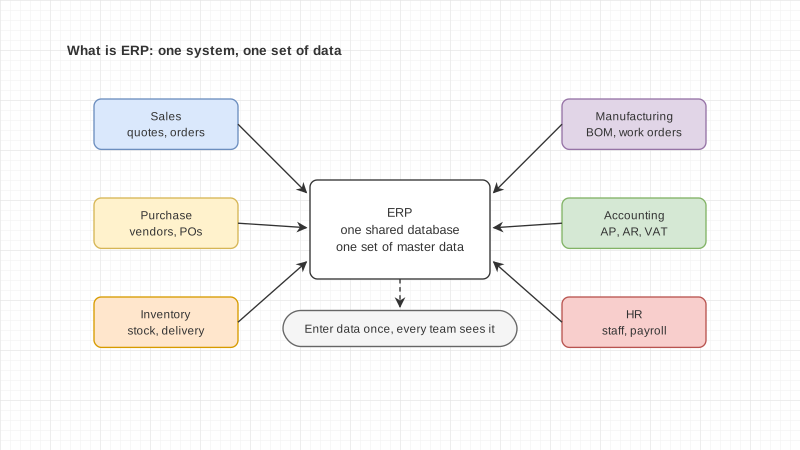
ERP is a system where every department records and reads data from one central database, so what one team enters reaches the others straight away.
Oracle describes ERP as software organisations use to manage day-to-day activities such as accounting, procurement, project management, risk management and compliance, and supply chain operations. IBM puts the emphasis on architecture: the business applications in an ERP are connected and share one common database.
Picture a single sales order. Without ERP, a salesperson types the quote in Word, the warehouse checks stock in a separate Excel file, and accounting keys the invoice again into the accounting program. One piece of information gets typed three times. In an ERP, that order reduces stock, creates the invoice and posts the receivable from the same source record.
Oracle gives the example of a car maker where the same part has different names in different systems: front brake pads in one, front brakes in another. The company then cannot say how much it spends on that part each year. ERP fixes this by defining one set of master data everyone uses.
Where ERP came from
ERP grew out of production planning software. In Oracle's account of the history, Black and Decker became the first company to adopt a material requirements planning (MRP) system in 1964. MRP II followed in 1983, organised into modules, and similar ideas spread to finance, customer management and HR. By 1990, technology analysts had a name for the category: enterprise resource planning.
What modules does an ERP system have?
An ERP is made of modules that each handle one area of the business, and a company can choose only the modules it needs.
IBM explains that each module focuses on a specific business area but they work together, and because no two businesses are alike, companies pick the modules that fit. The table below lists the modules IBM and Oracle mention most often.
| Module |
What it handles |
| Finance and accounting |
Payables, receivables, period close, financial reports, reconciliation |
| Purchasing |
Vendor lists, purchase requests, purchase orders, quote comparison |
| Sales |
Quotations, sales orders, invoicing |
| CRM and customer service |
Contact history, emails, customer purchase history |
| Inventory and supply chain |
Stock levels, receipts and deliveries, shipping |
| Manufacturing |
Production planning, bills of materials, work in progress, MRP |
| Human resources |
Employee records, attendance, payroll, review documents |
| Project management |
Project budgets, costs, time spent |
If you are asking which accounting features an ERP includes, think of accounting as one module rather than a separate product. When sales issues an invoice or the warehouse receives goods, the matching accounting entries come from that same data.
For Thai companies, the accounting module also has to handle Thai tax. As an example, the Odoo 19 documentation says its Thailand localization includes 7% VAT, withholding tax, purchase and sales VAT reports, PND3 and PND53 files for upload to RD e-Filing, and PromptPay QR codes on invoices. The same page states plainly that the final PND report and the withholding tax certificate still need an external tool. Check details like these with any system you consider.
What are the benefits of ERP?
The main benefit is that everyone in the company works from the same numbers, close to real time, so decisions are faster and errors are fewer.
Oracle lists a range of ERP benefits. These are the ones Thai SMEs usually notice first:
- Better visibility from reports built on current data, without waiting for month-end spreadsheets
- Lower operating cost because nobody re-enters the same data in several systems
- Easier cross-department work since everyone sees the same contracts, requisitions and purchase orders
- Lower risk thanks to cleaner data and clearer financial controls
- Faster learning for staff because every module shares the same look and feel
IBM sums it up in similar terms: higher productivity, lower operating cost, flexibility and integrated information.
None of this arrives automatically after you buy a licence. If master data such as product codes, customer lists or the chart of accounts is messy to begin with, ERP simply moves the mess from Excel into a new system.
How is ERP different from accounting software?
Accounting software covers finance only. ERP covers the whole business, and accounting is one of its modules.
According to IBM, accounting software typically handles financial reporting, payables and receivables, banking and basic sales revenue, while ERP has modules that reach every part of the business. Oracle draws the same line: financials is a subset of ERP.
| Aspect |
Accounting software |
ERP |
| Scope |
Accounting and finance |
Accounting, sales, purchasing, inventory, manufacturing, HR, projects |
| Main users |
Accounting team |
Every department |
| Where accounting data comes from |
Keyed in from documents other teams send |
Created directly by sales, purchasing and stock transactions |
| Inventory and production |
None, or basic |
Dedicated modules |
| Customer and sales data |
Limited |
Sales and CRM modules |
| Good fit for |
Businesses where a few people still run the core work |
Businesses where several departments share the same data |
IBM also notes that a fast-growing small business may outgrow traditional accounting software. That does not make accounting software a bad choice. A shop or a small service firm with a handful of staff can run on it for a long time.
When does an SME need ERP?
An SME should look at ERP when the time spent stitching data together from different places starts to exceed the time spent on the actual work.
Check these signals. If three or more apply to your company, it is time for a serious ERP conversation.
- The same data is typed into more than one system, for example sales orders in both Excel and the accounting program
- Closing each month means waiting several days for files from different departments
- System stock does not match physical stock, so staff phone the warehouse before accepting an order
- Management asks for profit by product or by customer and someone has to build it by hand
- You are opening a branch, a second warehouse, or selling through several channels at once
- Key data lives on one employee's laptop and leaves with them if they resign
- Auditors or banks ask for past documents and the team spends a long time hunting for them
If only one or two apply, fixing the process or connecting the tools you already have may be better value than replacing everything.
What drives ERP cost?
ERP cost depends on the number of users, the modules you choose, where the system runs, and how much implementation and customisation the project needs. There is no single price that fits every company.
We do not quote prices here because they change by vendor, package, country and date. The cost structure, though, is similar across vendors. Odoo's pricing page separates clearly what the subscription covers and what it does not, so we use it as the worked example.
- Licence or subscription. Odoo charges a single price per user. Other vendors may charge per module or per package, so ask whether any usage-based fees are hidden in the quote.
- Number and type of users. Odoo offers a Light User type for staff who only need a few functions, such as time off, expenses or payslips.
- Where the system runs. IBM groups ERP into on-premises, cloud and hybrid. On-premises needs your own IT team to maintain it; in the cloud, a provider manages the software.
- Implementation. Odoo's pricing page says implementation is not part of the subscription and covers project management, business needs analysis, data import, customisation, development and training.
- Customisation and code maintenance. The more company-specific code you add, the higher the long-term upkeep. Odoo states that maintenance of custom code is not included in its plans.
- Usage-based add-ons. Odoo sells in-app credits separately for items such as SMS or AI scanning of vendor bills.
When you compare quotes, add all of these up over three to five years instead of looking only at the first-year licence.
How do you start an ERP project?
Start by writing down the business problem, then choose the system. Not the other way round.
- List three to five problems you want solved, each with a number you can measure, such as days to close the month or how often stock counts are wrong
- Map how each department works today, from order to cash and from purchase to payment
- Review master data (products, customers, vendors, chart of accounts) and remove duplicates before migration
- Pick the modules you need in phase one and leave the rest for later
- Compare at least two or three systems, and ask each vendor to demo with your real scenarios, not sample data
- Choose an implementation partner by looking at references and how they work. Odoo's pricing page notes that mid-size and large companies with more than 50 employees usually work with a local partner
- Test with real data, train users in every department, then go live
- After go-live, track the numbers from step 1 to see whether they actually improved
Common ERP examples
ERP systems widely used by small and mid-size businesses include Odoo, SAP Business One, Microsoft Dynamics 365 Business Central and Oracle NetSuite. The descriptions below come from each vendor's own website or documentation.
| System |
What the vendor says |
| Odoo |
An open source suite of business apps in two editions: Community, which is free, and Enterprise, which adds apps, infrastructure and services. Runs on PostgreSQL and can be hosted on Odoo's cloud or on premise |
| SAP Business One |
ERP for small businesses and the lower midmarket, covering accounting, purchasing, inventory, sales, customer relationships and reporting. An SAP News article from December 2025 reports more than 83,000 customers in over 170 countries |
| Microsoft Dynamics 365 Business Central |
ERP for small and midsize businesses that Microsoft says is used by 55,000 companies. Works with Outlook, Excel and Teams and covers finance, sales, service, projects, supply chain and manufacturing |
| Oracle NetSuite |
Oracle's documentation describes it as a SaaS application for business management that includes ERP, CRM, PSA and e-commerce |
No system is best for every company. What matters more than the brand is how well the system handles Thai tax and documents, whether the partner in Thailand understands your business, and the total cost over the life of the system.
Frequently asked questions
Is "ERP software" the same as an "ERP system"?
Yes. People often say software when they mean the product, and system when they include the processes and data configured inside it.
Can a small SME use ERP?
Yes. Several vendors design products for small businesses, such as SAP Business One and Business Central, and Odoo has a One App Free plan that lets you use one app free for unlimited users. The more useful question is whether your company has problems ERP would actually solve.
Is cloud ERP safe?
IBM names the main drawback of cloud ERP as the risk of trusting a vendor with your data. Before signing, ask where the servers are, how backups work, who can access what, and how you get your data out if you leave.
Do we have to switch every module at once?
No. IBM explains that companies can choose the modules that suit them. Many start with accounting, sales, purchasing and inventory, then add manufacturing or HR in a later phase.
How long does ERP implementation take?
It depends on the number of modules and users, how clean the existing data is, and how much customisation is involved. Ask the implementer for a phased plan rather than a single number.
What Enersys does
Enersys is a software house that has built business systems for Thai companies for 14 years, since 2012. Our Odoo practice is recent: 2026 is our second year. This year we won Best Starter APAC at the Odoo Awards 2026. Our partner page on odoo.com lists us as an Odoo Silver Partner and a top 3 Odoo partner in Thailand on the Q2 2026 Partner Leaderboard, with 6 references, 100% customer retention, an average project of 35 users and a largest project of more than 200 users.
If you are not sure whether your company needs ERP yet, we can look at how you work today and tell you honestly where to start. See our Odoo ERP page for details, or check the system comparison pages before you decide.
Sources
- What Is ERP?, Oracle
- What is Enterprise Resource Planning (ERP)?, IBM
- Open Source ERP and CRM, Odoo
- Odoo Pricing, Odoo
- Thailand fiscal localization, Odoo 19.0 documentation
- 10 New Customers a Day: The Global Success of SAP Business One, SAP News Center (15 December 2025)
- Business Central, Microsoft Dynamics 365
- Oracle NetSuite Cloud Adapter 12.2.1.1.0, Oracle Help Center
- Enersys Co., Ltd. partner page, Odoo