The question our team hears most often right now is "Is the AI law in force yet?" The short answer, as of 1 October 2026, is no. Thailand does not yet have an AI Act in force.
That does not mean organizations can use AI however they like. Several rules that cover AI use already apply today, and the draft AI Act is clear enough about its direction to start preparing. This article keeps the two apart so that management, legal and IT can work from the same picture.
Note: our article Thailand AI and Digital Platform Rules, published in April, stated that Thailand's AI Act took effect on 1 March 2026. That was wrong. We have corrected that article and apologise for the error.
Where the draft AI Act is in the process
The Electronic Transactions Development Agency (ETDA) opened a public hearing on the full draft Act on Artificial Intelligence in early July 2026 and closed it on 14 August 2026 (Tilleke & Gibbins, Rajah & Tann Asia).
Next, ETDA revises the draft based on the comments, the responsible ministry submits it to the Cabinet for approval in principle, and it then goes through Parliament. Rajah & Tann estimates it could take 6 to 24 months to be enacted and come into force.
An Act must pass Parliament and be published in the Royal Gazette before it takes effect. The draft AI Act has not reached that stage.
A verified timeline
| When |
What happened |
Status |
| 11 to 24 June 2025 |
ETDA consults on the draft principles of an AI law |
Draft |
| 18 July 2025 |
OCPB notification on disclosures in AI-generated advertising |
In force |
| 12 September 2025 |
Bank of Thailand policy direction on AI risk management for financial institutions |
In force |
| November 2025 |
OIC publishes AI governance guidelines for insurers |
Guidance |
| February to March 2026 |
PDPC holds two hearings on draft guidelines for personal data in AI development and use |
Draft |
| 25 March 2026 |
TCCT guidelines for multi-sided e-commerce platforms |
In force |
| Early July to 14 August 2026 |
ETDA consults on the full draft AI Act |
Draft |
| 2 August 2026 |
EU AI Act Article 50 transparency duties apply |
In force (for services in the EU) |
| 2 December 2027 and 2 August 2028 |
EU high-risk AI rules, after the delay |
Future |
Rules that already apply to AI use
There is no AI Act yet, but organizations using AI must already follow these rules.
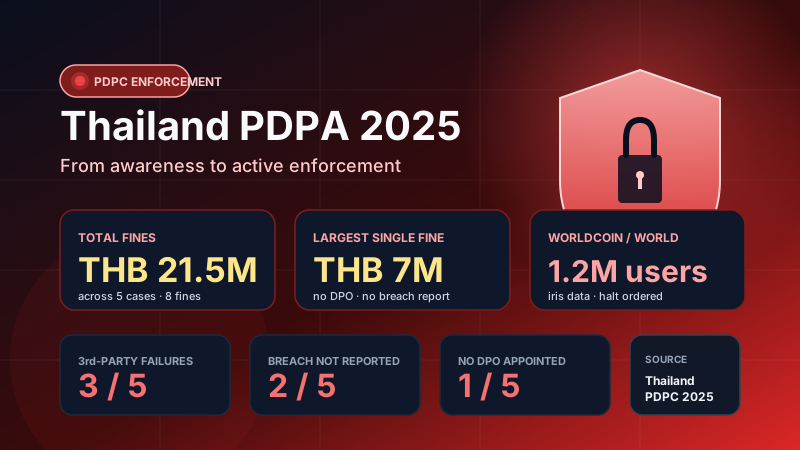
PDPA applies to every AI system that processes personal data, whether it is a customer service chatbot, a CV screening tool, or AI that summarizes documents containing customer names and phone numbers. Lawful basis, purpose notices and data subject rights apply just as they do to any other processing. The PDPC announced 8 administrative fines across 5 cases on 1 August 2025, which shows enforcement is real (Formichella & Sritawat).
The OCPB notification on AI-generated advertising (18 July 2025) requires adverts made with AI to say so. Marketing teams using AI images or video already have this duty (Baker McKenzie).
The Bank of Thailand policy direction (12 September 2025) sets out how financial institutions should manage data, model-development and cyber risks from AI (Bank of Thailand).
The Trade Competition Commission of Thailand (TCCT) guidelines for e-commerce platforms have applied since 25 March 2026. They cover conduct such as using algorithms to favour a platform's own products or suppress sellers' visibility, and unfair use of seller data (Bangkok Biz News). The TCCT received 16 platform complaints in the first half of 2026 (Thansettakij).
EU AI Act Article 50 has applied since 2 August 2026. Thai organizations offering chatbots or AI-generated content to users in the EU must tell users they are dealing with AI and label AI-generated content. The EU's high-risk rules have been delayed to December 2027 and August 2028 (Cuatrecasas, Gibson Dunn).
There is also non-binding guidance that regulators expect organizations to follow, such as ETDA's AI Governance Guideline for Executives (OECD.AI) and the OIC guidelines (Asia Insurance Review).
What is still a draft, and where it points

Photo: Royal Government Gazette collection, National Library of Thailand, December 2024, by Paul_012, Wikimedia Commons, licensed CC BY-SA 4.0, resized
The draft AI Act
According to Tilleke & Gibbins, the July draft groups AI into prohibited AI, high-risk AI, and designated AI that may need notification or a licence. The points organizations should know:
- Providers of high-risk AI must make systems fit for purpose, transparent, fair and subject to meaningful human control
- Deployers of high-risk AI must run risk management, assign oversight staff, keep operational logs for at least six months, and report unforeseen risks
- Foreign AI providers must appoint a local coordinator or representative in Thailand
- Systems that generate or modify images, audio or video must embed machine-readable marks identifying AI content
- Administrative fines range from THB 1 million to THB 5 million
These details may change before enactment, but the core duties, such as keeping logs, naming owners and labelling AI content, are things organizations can start now without wasted effort.
The PDPC's draft AI guidelines
The PDPC's draft guidelines on personal data in AI development and use are not yet final (Tilleke & Gibbins, Daily News), but several points directly affect how organizations buy AI services:
- If an AI provider uses a customer's data to train or fine-tune its own model, the provider may become a data controller in its own right
- Data processing agreements should prohibit model training and require deletion at the end of the engagement
- High-risk AI using personal data should have a data protection impact assessment (DPIA) before use
Why start now
A 2024 survey by ETDA and NSTDA found that about 17.8% of Thai organizations already use AI and another 73.3% plan to (The Thaiger). AI systems installed while the law is still a draft are the systems that will need adjusting once it takes effect. If data and ownership are recorded from the start, that adjustment is much lighter.
Where to start
We have ordered these from what already applies to what you can prepare in advance.
- List the AI systems you use, including AI features built into software you buy, such as website chatbots, AI assistants in ERP or CRM, and tools staff use on their own. Note what data each one uses and whose decisions it affects.
- Check your AI vendor contracts for whether your data is used to train models, where it is stored, and when it is deleted. This falls under the PDPA, which already applies.
- Run a DPIA for AI that uses personal data and affects people, such as candidate screening, credit approval or customer scoring.
- Label AI-generated content in advertising under the OCPB notification, and tell users when they are chatting with AI, especially if you serve customers in the EU.
- Name an owner and keep logs for important AI systems. The draft proposes at least six months. Starting now helps with troubleshooting today and with proving compliance later.
- Follow the draft AI Act through ETDA and review this list again once the draft passes the Cabinet.
How Enersys can help
We help organizations list their AI systems and assess gaps against both the rules in force and the draft that is coming. We use PrivacyHub to keep processing records, DPIAs and PDPA evidence in one place, and we set AI permissions in Odoo before AI features are switched on, as described in our guide to Odoo 20 MCP permissions.
If your organization already uses AI and wants to know what to tackle first, talk to the Enersys team.
References
- Cover photo: Sappaya-Sapasathan by Supanut Arunoprayote, Wikimedia Commons, licensed CC BY 4.0, resized
- Thailand Releases New Draft Artificial Intelligence Act, Tilleke & Gibbins via Mondaq (3 July 2026)
- Thailand's Proposed AI Law: Moving Towards a Risk-Based Regulatory Framework, Rajah & Tann Asia (28 July 2026)
- Thailand: 2026 AI Regulatory Landscape for Businesses, Baker McKenzie (March 2026)
- ETDA public hearing on the draft principles of an AI law
- Thailand Seeks Feedback on Draft Data Protection Guidelines for AI, Tilleke & Gibbins via Mondaq
- PDPA Phase 2, Formichella & Sritawat
- Daily News: progress on the PDPC AI guidelines
- Bank of Thailand hearing on AI risk management policy
- Thailand regulator publishes guidelines for AI governance, Asia Insurance Review
- AI Governance Guideline for Executives, OECD.AI
- Bangkok Biz News: TCCT platform guidelines
- Thansettakij: platform complaints in H1 2026
- Digital Omnibus on AI has been published, Cuatrecasas
- EU AI Act Omnibus Agreement, Gibson Dunn
- 17% of Thai organisations use AI, 73% plan future adoption, The Thaiger



.jpg)