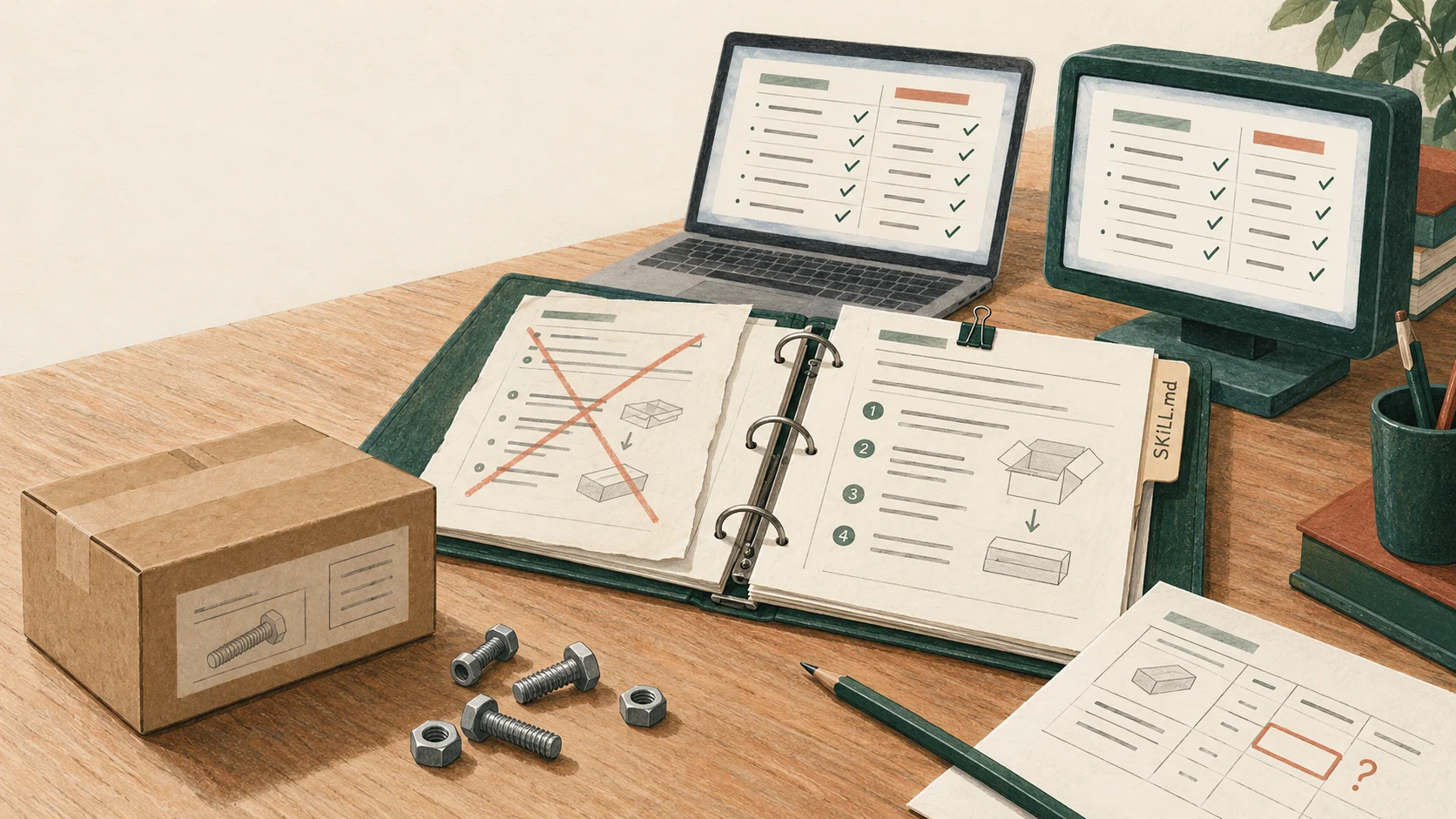
A company changes how it includes freight in supplier comparisons, but the guide in its shared folder still contains the old rule. An employee who knows about the change might ask a manager first. An AI assistant given the old file might finish the table under the old rule, leaving the reviewer to assume it is ready to use.
This is a hypothetical example of a problem that clearer instructions alone cannot solve. When a company gives AI its own procedures, someone must also decide which revision is valid, who approves changes and where the work goes when information is missing.
Agent Skills is a format for packaging instructions and supporting material for a specific AI task. An SOP, or Standard Operating Procedure, describes how an organisation performs work. A company can turn material from an SOP into a skill while continuing to manage ownership, revisions and acceptance of the work.
Episode 2 explained how APIs and MCP let AI retrieve ERP data. This episode looks at the next layer: how to explain what to do with that data in a way people can check and revise. It is a workflow explainer, not an announcement of a new product.
SKILL.md carries instructions, while the company retains approval authority
The Agent Skills specification defines a skill as a directory containing SKILL.md. That file has YAML metadata followed by Markdown instructions, with required name and description fields. A skill may also include executable scripts, reference documents and supporting files in scripts/, references/ and assets/. Agent Skills specification
For the people doing the work, this package should explain which task it covers, what information is needed, when to begin and when to stop. References let the owner check the full policy or conditions without putting every detail into one long instruction.
For example, an ERP tool supplies item codes, units and prices; the skill explains how to organise a comparison table. Permission to create a purchase order and authority to choose a supplier still belong in the company's systems and approval process. A file saying "do not place an order" is one layer of instruction. The technical team must also restrict the actual account permissions accordingly.
On October 22, 2026, Anthropic announced the donation of Agent Skills to the Agentic AI Foundation under the Linux Foundation, including the name, logo, GitHub organisation and agentskills.io domain. Anthropic announcement We covered that announcement in a separate news article. Here the question is how a company prepares its procedures so they remain usable after a move.
Examine the decisions inside one SOP
A guide that says "check prices and choose a suitable supplier" leaves many questions unanswered. Staff may consider units, delivery dates, freight, credit terms or quality history using knowledge that never reached the document. AI may interpret "suitable" differently from the team.
Ask the process owner to compare a completed routine case with one that needed a manager's decision, then explain why they followed different paths. If the team has not agreed what belongs in the compared price, purchasing should settle that before anyone writes the skill.
For a quotation comparison, the purchasing lead should own business criteria such as comparable units, freight treatment and exceptions. The technical team checks whether the necessary documents and ERP tools can be accessed. Reviewing the work together establishes whether the procedure can run with the actual tools and whether those tools follow the intended rules.
The starting document should identify scope, minimum inputs, expected output, stop conditions and the person who receives an escalation. Include the source policy and its approver. Internal information the AI does not need, such as real customer details, passwords or access keys, belongs in systems with suitable access controls rather than travelling with the skill package.
Follow a quotation comparison through human review
The following is a proposed pilot, not a customer deployment result. Suppose AI prepares a consumables comparison from two quotations and a purchase request. A purchasing officer still checks the table, selects the supplier and requests approval through the existing process.
The purchasing lead requires matching item codes and units, with pre-tax prices, freight and delivery dates shown separately. An ERP tool supplies the company's item and unit references. Each table entry must be traceable to its source document.
AI prepares the table and marks missing fields. The officer opens the documents to check values, units and calculations before using it. Any change to a value or comparison method needs a recorded reason. The necessary evidence therefore includes source references, the skill revision and the reviewer's changes, rather than only AI's final answer.
Now one supplier quotes by the box and the other by the item, but neither document confirms the number of items in a box. AI should mark the unit-price comparison as incomplete and return the question to the officer. Leaving that field unresolved makes the next action visible. Guessing a pack quantity to fill the table would create an unsupported basis for selecting a supplier.
Once the supplier confirms the pack quantity, the officer adds the supporting reference and asks for a new calculation. Acceptance at this point means the table matches the documents and agreed criteria. It does not give AI permission to issue the purchase order.
Test the same cases before moving between tools
Being able to open SKILL.md is a starting point. The destination application may handle supporting files, tools or scripts differently. The specification offers compatibility for environmental requirements and describes allowed-tools as experimental, with support varying between implementations. Compatibility and Allowed Tools
That limitation is a reason to test execution. A field name does not prove that the destination enforces permissions. The following proposed cases are a starting set for the comparison task; the team should add cases from its own business exceptions.
Starting cases for testing a quotation-comparison skill
| Test case | What should be observed before acceptance |
|---|
| Complete documents with matching units | Prices, calculations and source references match the examples checked by the process owner. |
|---|
| Boxes versus items with an unknown pack quantity | Stop the incomplete comparison and request information without inventing a number. |
|---|
| Revised freight treatment | Apply the new rule and identify the skill revision used. |
|---|
| ERP tool unavailable or read access denied | Identify the missing information and hand it to a responsible person without fabricating substitute data. |
|---|
| A request to create a purchase order when the pilot only prepares tables | Refer the request to the authorised process, with no purchase transaction created by the pilot account. |
|---|
Use the same sample documents in each tool. Record the application, model version, relevant settings and permissions to the extent the system exposes them. The process owner checks the table's meaning; the technical team checks tool use and access. When results differ, establish whether only the wording changed or whether prices, references or stopping behaviour changed too.
For a first pilot, I would start with instructions and references, adding scripts when calculations or data transformations justify them. The team should review their code and permissions before use. This is a proposal to limit initial maintenance, not a restriction in the standard. Externally sourced skills and scripts also need a source review before installation.
A rule change must reach work already in progress
If freight treatment changes, the purchasing lead should identify the effective date and affected cases. The team updates the skill and test examples. The responsible owner then approves the new revision and decides what happens to unfinished work using the old one.
Git or a document-control system can preserve change history, but someone still has to decide how a revision will be used. It should be possible to find which skill and SOP revision a task used, who reviewed it and which work needs another look after a rule changes.
Start with one kind of price comparison if that is enough. Have purchasing and IT review routine and exceptional cases until they agree how to accept the work, then expand the scope. If nobody currently owns the valid procedure, adding more skills will make that problem harder to track.
Episode 4 will follow work passed to another party's assistant through A2A: who owns the result, whether authority travels with the request and what evidence to retain before expanding a pilot.