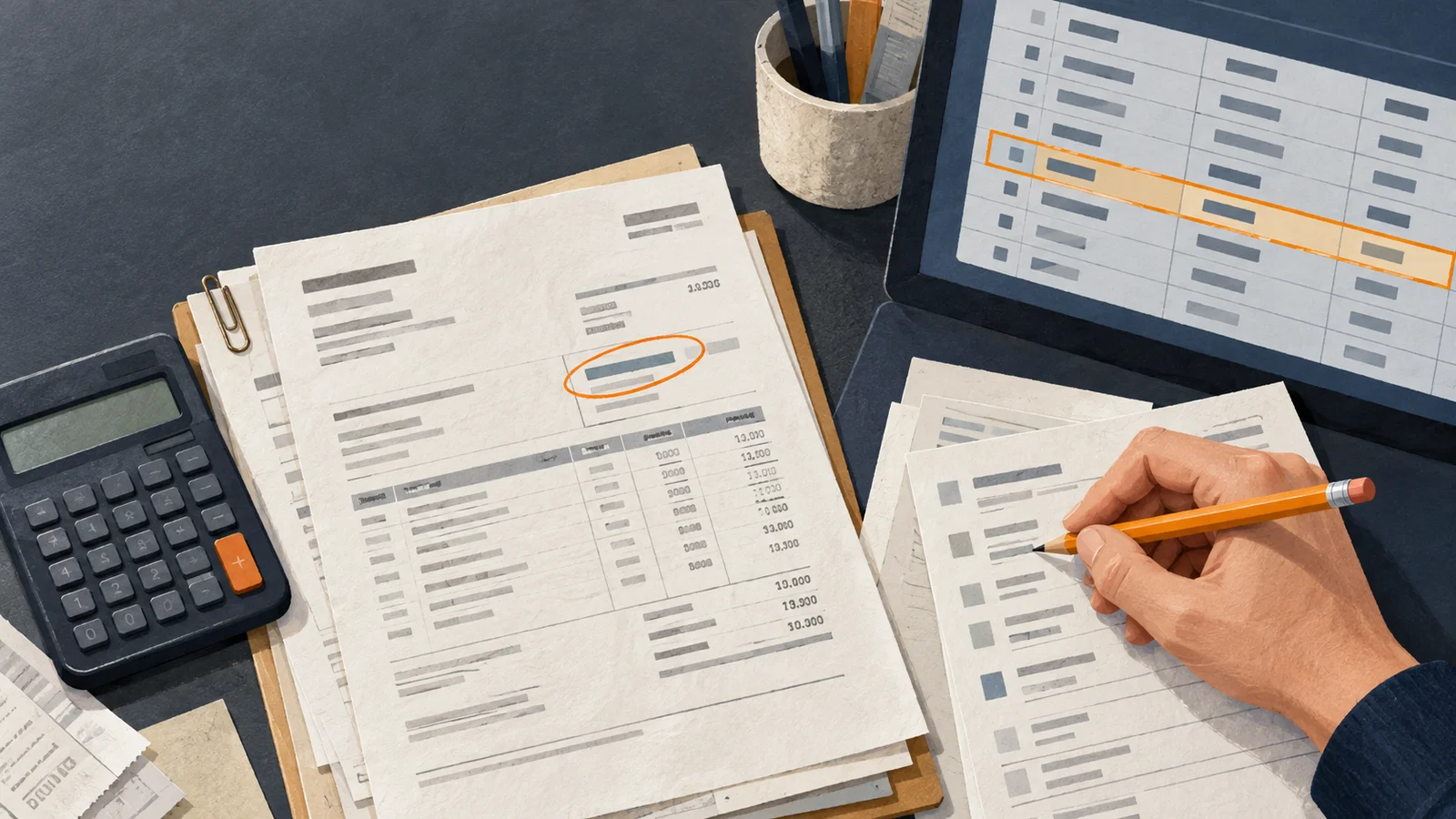
Suppose the accounts team has a vendor bill for 1,000, but the bank record shows a debit of 1,003. If the entire debit is matched to the bill without an explanation, the extra 3 disappears from the accounting trail. Before closing the transaction, find out what the 3 represents and whether a bank or payment record supports it.
This is an explainer based on the Odoo 19 bank reconciliation guide and reconciliation model guide, checked on November 25, 2026. It is not a new feature announcement. The amounts are hypothetical, not a customer transaction or an instruction to use a particular expense account.
Start with a bank transaction you can trace
Keep the source bank file or transaction record, including its date, amount, reference, and counterparty. Compare it with the bill and payment instruction before matching. When importing a file, Odoo lets users map CSV or XLSX columns and run Test and Import to check the format first. Odoo's bank transaction guide
Automatic bank synchronization is another option, but Odoo 19's synchronization guide says it requires an Enterprise subscription and depends on bank and provider support. Check the institution your business actually uses. Do not plan a close on the assumption that a Thai bank connection is available or that transactions arrive in real time. If an expected transaction is missing, check the bank source and import status before creating a duplicate.
Match the bill, then investigate the remainder
In this hypothetical case, the accountant matches the 1,003 debit to the 1,000 bill in Bank Matching. The remaining 3 needs its own explanation. Odoo describes matching an existing bill or journal item and adding a counterpart item, an accounting entry for the remaining amount; its documentation uses a 100 bill and a 103 debit as an example of applying a bank-fee reconciliation model to the extra 3. Bank reconciliation · Bank-fee model example
The company still has to verify that the bank actually charged a fee. The accountant can compare the payment confirmation, fee schedule, and bank transaction. If the evidence agrees, record the difference in the account approved by the responsible reviewer and retain the evidence with the transaction. If it does not, leave the item for investigation and ask the payment owner to check the reference or contact the bank. A fee rule should not erase every small difference.
Define rules after you understand the exceptions
Odoo provides default matching rules and reconciliation models with conditions such as journal, partner, amount, and transaction label. If more than one automated model matches, the first in the sequence applies. Odoo's reconciliation model guide A broad rule that treats every small difference as a bank fee could therefore misclassify transactions.
Our proposed control is to trial the rules against one previous closing period. Separate transactions with clear evidence, differences that need approval, and items that need investigation. Have the accountant record the reason and a second reviewer sample the suggested matches. If a rule produces a wrong match, stop using it, narrow the conditions, and test it against transactions not used to tune the rule. This is a suggested control process, not a claim that the software can replace human review.
Before the next close, pick one transaction that does not match its bill. Can the team show the bank source, the document it matched, evidence for the difference, the approver, and the owner of any unresolved item? Those answers matter more than a screen that says “matched” without an audit trail.