Odoo Is No Longer Just an ERP — It Has Become an Organization’s Operating System
When Odoo launched version 19 in September 2025, followed by Odoo 19.1 on January 20, 2026, the company’s message was clearer than ever — this was not a routine software update. It was a major repositioning that declared Odoo as an "Enterprise Operating System" with AI embedded into every process, not simply an add-on purchased later.
For Thai organizations evaluating an ERP transformation, this is a shift worth watching closely.
Native AI Agents with Support for ChatGPT, Claude, and Odoo AI
At the core of Odoo 19.1 is a native AI Agent system that is not limited to a single AI vendor. Companies can choose to use:
- ChatGPT (OpenAI) for tasks requiring a versatile language model
- Claude (Anthropic) for tasks that demand accuracy and deeper analysis
- Odoo AI, developed by Odoo itself and fine-tuned specifically for business context
What sets this apart from traditional AI integrations is that these AIs are not separate chatbots. They are embedded directly into real workflows. For example, when a sales representative opens a quotation, the system can automatically recommend suitable products and pricing. When the accounting team performs period-end close, AI can detect anomalies and match documents without waiting for someone to initiate the process.
Measurable Real-World Results: Not Just Numbers on a Slide
Zolute Consulting reported results from organizations actually using Odoo 19.x in early 2026:
Retail — Mid-sized retail group
- 30% improvement in Inventory Reconciliation speed
- Significant reduction in errors from manual stock counting
- Warehouse teams spent less time on manual tasks and more time on higher-value work
Manufacturing — Mid-sized factory
- 22% shorter Lead-to-Cash cycle
- Sales and Production teams worked from the same data set, reducing miscommunication caused by inconsistent information across departments
Finance — A transformed Financial Close process
- Reduced from 10–15 days per cycle to just 3–5 days
- Executives gained access to actual numbers faster and could make decisions based on fresher data
These figures are not projections from overseas case studies. They come from organizations that actually deployed Odoo 19.x in early 2026.
Market Scale That Confirms the Direction Is Right
Odoo now has 16 million users and 170,000+ organizations worldwide across 180 countries. Even more noteworthy, in early 2026, more than 1,000 organizations migrated from other ERP systems, including some that moved away from SAP — a signal that Odoo is no longer competing only in the SME segment.
Odoo’s achievement of 20 million euros in new ARR in January 2026 alone, combined with its goal of surpassing 1 billion euros in revenue by 2027, indicates that the platform’s momentum is accelerating, not slowing.
PDPA Perspective: A Single Database Means Easier Audits
One issue often overlooked in ERP discussions for Thai organizations is PDPA (Personal Data Protection Act).
The problem with the multi-vendor environments many organizations still use is that customer data is scattered across multiple systems — accounting in one, CRM in another, HR in a third. When there is a data subject request (DSR) for access or deletion, or when regulators request an audit, teams must scramble to collect data from multiple systems. This takes time and carries a high risk of missing something.
Odoo 19.1 as a unified platform addresses this by storing all data in a single database. Compliance teams gain complete audit trails, can respond to DSRs more quickly, and reduce the risk created by duplicate or conflicting records across systems.
At a time when the PDPC (Personal Data Protection Committee Office) is beginning to enforce the law more seriously, having an audit-friendly system is not optional — it is essential.
Why Odoo 19.1 Is a Major Opportunity for Thai SMEs
The market segment Odoo identifies as its primary target aligns closely with Thailand’s business landscape — mid-market enterprises that need SAP-level capabilities without the budget or IT team size of a multinational corporation.
For Thai SMEs in this segment, Odoo 19.1 offers a combination that previous generations of ERP could not deliver at once:
Comprehensive coverage — From accounting, procurement, and warehouse management to CRM, manufacturing, and HR in a single platform, eliminating the need to pay ongoing integration costs between systems
Practical AI — Not an AI demo at an exhibition, but AI that works inside the workflows teams use every day
SME-friendly cost structure — Subscription-based pricing that scales with actual usage, compared with SAP, where combined license and implementation costs can reach tens of millions of baht for a single project
A growing partner ecosystem — 12,000+ certified partners worldwide, providing a level of support and expertise that smaller vendors cannot match
Next Steps for Organizations Interested in Exploring Further
If your organization is evaluating whether to replace its ERP or improve its existing systems, there are two questions worth asking first:
- How many systems is our data spread across? — If the answer is more than 3, the hidden cost of reconciling data may be higher than expected.
- Is the AI we are using today connected to our ERP? — If not, that AI is not improving real processes; it is just another standalone tool.
As an official Odoo Silver Partner, Enersys has continuously implemented Odoo by Enersys for Thai organizations. The company also integrates the Genesis AI Platform with Odoo to extend Predictive Analytics and Business Intelligence where standard Odoo capabilities may not fully address Thai business requirements.
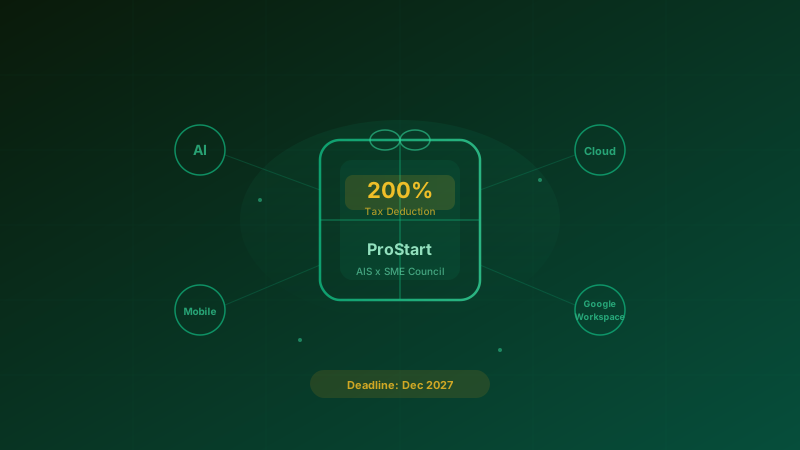
For organizations considering investment, be sure to review the 200% tax deduction incentive for SMEs investing in software and ERP systems, which can significantly reduce total project cost.
Source: Zolute Consulting (March 3, 2026)
Book a free ERP assessment with the Enersys consulting team — no obligation, and you will receive a preliminary roadmap tailored specifically to your business.