The 200% Tax Benefit — What It Is and Who Qualifies
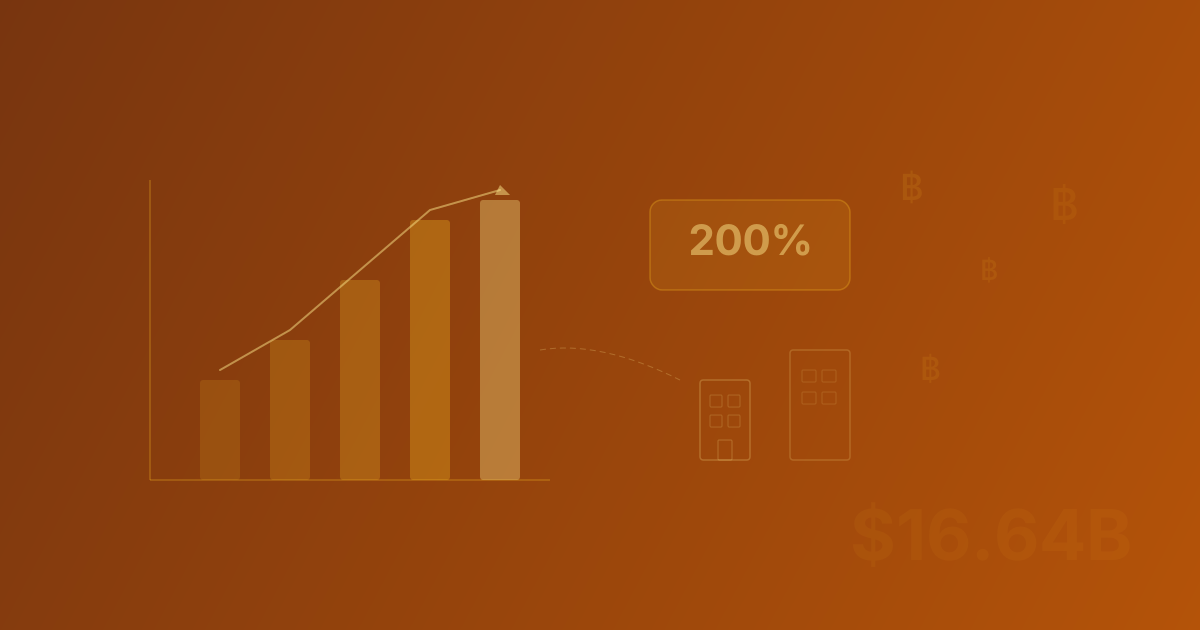
The Thai Cabinet has approved a new tax incentive that Thai SMEs need to know about: a 200% tax deduction on digital expenses, up to 300,000 baht, for eligible expenses incurred between June 24, 2025 and December 31, 2027.
In practical terms, if an SME pays 300,000 baht per year for ERP software, it can deduct 600,000 baht for tax purposes — potentially reducing its actual tax burden by hundreds of thousands of baht per year.
Eligible expenses include:
- Software costs: ERP, CRM, accounting, HR, project management
- Cloud service costs: hosting, storage, compute
- AI tool costs: chatbots, analytics, automation tools
- Cybersecurity costs: firewall, endpoint protection, PDPA compliance tools
- Digital transformation consulting fees: from registered vendors
Thailand’s Digital Transformation Market — Key Numbers You Should Know
Thailand’s digital transformation market in 2026 is valued at $10.94 billion, and is projected to grow to $16.64 billion by 2031 (CAGR 14.95%).
Other notable figures:
- Thailand’s digital economy is expected to grow 4.2% in 2026 — twice the pace of overall GDP
- Digital-sector investment is rising 3.0%, with private-sector growth of 6.2% driven by FDI in cloud and data centers
- More than 40% of Thai manufacturers have already started adopting Industry 4.0 technologies
- Robotics adoption is expected to increase by 50% by the end of 2026
The “Rising Stars” of Thailand’s 2026 Economy
Based on an analysis of 45 Thai economic trends, the businesses categorized as “rising stars” in 2026 are all digital-first:
- Cloud Services — the foundation of every digital business
- Cybersecurity — the more digital you become, the more protection you need
- Creator Economy — content, influencers, digital media
- AI Solutions — automated marketing, analytics, smart operations
While analog businesses are declining, companies that move into digital faster gain a clear competitive advantage.
The Real Challenges Thai SMEs Face
Despite the opportunity, transformation is not easy. Research and survey findings show that Thai SMEs commonly face the following challenges:
Data Is Not Ready
65% of Thai manufacturers say data quality is the main obstacle to adopting AI — data is fragmented, lacks standards, and is often managed in different Excel formats across teams.
Limited Talent
The shortage of digital talent is an ongoing challenge — SMEs cannot compete with multinationals on salary, so they need partners who can help implement solutions effectively.
Unclear Starting Point
Many SMEs know they need to transform, but do not know which use case will deliver the fastest ROI. They often start with projects that are too large and end up failing.
How to Get Started Effectively
From our experience delivering digital transformation for Thai organizations, the approaches that work are:
1. Start with a Real Business Problem, Not the Technology
Do not start with “we want to use AI.” Start with “our sales team spends three days preparing quotations, and we keep losing customers because of the delay.” Once the problem is clear, the solution becomes much easier to define.
2. Choose ERP as the Backbone
A good ERP system brings everything together in one place — sales, purchasing, inventory, accounting, HR. Data flows through a single system, eliminating duplicate entry and endless Excel exchanges. Once data is centralized in the system, extending it with AI becomes much easier.
3. Maximize the 200% Tax Deduction
ERP costs, cloud costs, and AI tool costs are all eligible for the 200% tax deduction — plan your investment so it is fully covered before the benefit expires at the end of 2027.
4. Work with a Partner That Understands Thai SMEs
Successful digital transformation is not just about buying software. It requires support in redesigning workflows, migrating data, training users, and providing post-go-live support.
ERP + AI + PDPA — Three Priorities That Must Move Together
For SMEs planning to transform in 2026, this is not just about ERP. You need to think across all three dimensions:
- ERP — the operational backbone where all data flows through one system
- AI — automates repetitive work and analyzes data for faster decision-making
- PDPA — ensures compliance with data protection regulations from the outset, rather than fixing issues later
Organizations that address all three together can build systems that are efficient, intelligent, and compliant.
How Enersys Helps SMEs Transform
Enersys provides end-to-end services for SMEs pursuing digital transformation:
- Odoo ERP — a practical ERP system for SMEs, cost-effective and comprehensive across modules
- Genesis AI Platform — embeds AI directly into ERP, with no need for separate integrations
- PrivacyHub — all-in-one PDPA compliance for consent, DSR, data mapping, and breach notification
- Custom Software — for specialized use cases that off-the-shelf solutions cannot address
All of these costs are eligible for the 200% tax deduction — with the right plan, businesses can improve their systems while also reducing tax costs.
Sources: Thailand.go.th: Digital Economy Forecast to Grow 4.2% | LexNova: SME Policy Updates 2026 | Nation Thailand: 45 Key Trends 2026 | World Bank: Thailand's Digital Future | Manufacturing IT Summit Thailand 2026