Quick Summary
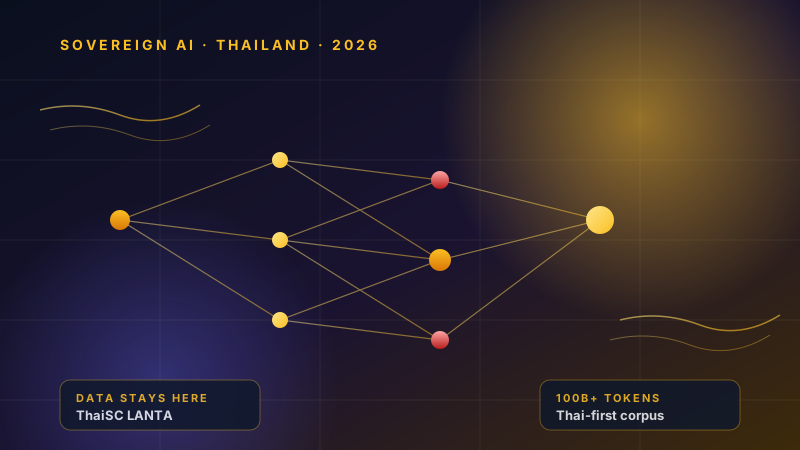
In April 2026, Thailand officially launched ThaiLLM — a national Sovereign AI initiative bundling 4 Thai-language models, trained on 100+ billion tokens, running on Thailand's own supercomputer (ThaiSC LANTA), with a free API at launch.
The first question everyone asks: "Can it replace ChatGPT?" The short answer is no, not for everything — but yes, for a lot of things. And in some Thai-specific tasks, it actually beats Claude or GPT.
This piece covers what Thai businesses should know:
- What ThaiLLM is, who built it, where it runs
- 4 models in the family and what each is good for
- Why "Sovereign AI" matters in the PDPA era
- Honest strengths and weaknesses vs Claude/GPT
- How to actually start using it
- Use cases that fit and ones that don't yet
- What this means for software houses and Thai businesses
Straight talk — no hype, no putting our own work down either.
The Day Thai-Native AI Actually Arrived
Picture this scene — a mid-sized accounting firm in Bangkok, an employee asks ChatGPT: "How much can I deduct for parental care under Thai personal income tax 2025, and what are the conditions?"
ChatGPT answers confidently — quoting numbers, citing sections, listing conditions. Looks great.
Except the numbers are wrong — it pulled 2022 figures and mixed them with foreign tax law that happens to look similar.
This happens daily in Thai offices — not because ChatGPT is dumb, but because it was built for an English-speaking world. Thai is roughly the 30-something most-prioritized language for those companies.
The problem isn't just language — it's context:
- Official Thai has its own structure
- Thai law has terms that don't exist in other languages
- Thai communication culture (deference, indirectness, politeness) differs from Western norms
- Thai data is less than 1% of the training corpus for frontier models
That's why ThaiLLM matters — it's not "ChatGPT in Thai." It's cognitive infrastructure designed for Thai context from day one.
ThaiLLM in Brief
ThaiLLM is Thailand's national Sovereign AI program, officially launched April 2026, built by:
- MHESI — Ministry of Higher Education, Science, Research and Innovation
- NSTDA / NECTEC — National Science and Technology Development Agency
- DEF — Digital Economy and Society Development Fund
- Industry partners: SCB 10X, KBTG, AIEAT, VISTEC
The team is over 700 people — researchers, engineers, and trained students.
Key specs:
- 2 sizes: 8B parameters (fast) and 30B parameters (high-performance)
- Trained on 100+ billion tokens of high-quality Thai data (government documents, research papers, legal texts)
- Runs on ThaiSC LANTA — Thai supercomputer, no foreign cloud dependency
- OpenAI SDK-compatible API format — existing code barely needs changes
- Free during launch period (rate limit: 5 req/s, 200 req/min)
- Endpoint: playground.thaillm.or.th
- Focused on Agentic AI capabilities, not just Q&A chat
What's interesting — under one ThaiLLM umbrella, there are 4 models from 4 different organizations, sharing infrastructure and a common leaderboard so users can pick what fits.
Why Sovereign AI Matters
"Sovereign AI" sounds political or nationalistic, but it's really about business — cost, risk, and legal compliance.
1. PDPA + Cross-border data transfer
When you send a prompt to ChatGPT, Claude, or Gemini, that data leaves Thailand and gets processed in US data centers.
If the prompt contains personal information (names, ID numbers, phone numbers), that's cross-border data transfer under PDPA — which requires consent or another lawful basis.
Many Thai organizations use AI without realizing they're skating close to PDPA violations — they think "I'm just asking a question, I'm not transferring data."
ThaiLLM processes "in Thailand only" — that risk drops immediately.
2. A weak Thai baht makes AI more expensive
Frontier model APIs are priced in USD. When the baht weakens, your costs rise without using the service more.
For SMEs paying tens of thousands of baht per month in API fees, FX volatility hits the budget directly.
ThaiLLM is free now, and if it ever charges, it'll likely be in baht — no FX risk.
3. Cultural and linguistic accuracy
Thai isn't just one language — it's:
- Official Thai (formal documents)
- Business Thai (reports, meetings)
- Everyday Thai (daily conversation)
- Youth slang (changes every year)
- Regional dialects (North, Northeast, South)
Frontier models handle middle-of-the-road Thai fine, but if you need formal letters with phrases like "ขอเรียนเชิญ" or "พร้อมนี้ได้แนบ" or "ด้วยเหตุนี้จึงเรียนมาเพื่อโปรดทราบและพิจารณาดำเนินการต่อไป" — ThaiLLM does it more naturally.
4. Data sovereignty at the national level
In an era where many countries worry about AI dependency on foreign companies, Sovereign AI is a long-term hedge.
If OpenAI raises prices 10x or restricts access from certain countries, organizations deeply embedded with frontier models hit a supply chain risk overnight.
ThaiLLM = national backup plan.
The 4 ThaiLLM Models — Who's Each For?
Under the ThaiLLM umbrella, 4 models are developed independently but share infrastructure. All are primarily 8B parameters; the difference is training data and fine-tuning approach.
1. OpenThaiGPT-ThaiLLM-8B-Instruct-v7.2 (by AIEAT)
- Strength: General purpose, community-driven, continuous version evolution
- Best for: General chatbots, content generation, prototyping
- Why: AIEAT (AI Entrepreneur Association of Thailand) is a developer community — the model evolves with market needs
2. Pathumma-ThaiLLM-qwen3-8b-think-3.0.0 (by NECTEC)
- Strength: Supports "thinking" mode (chain-of-thought), bias toward research/academic domains
- Best for: Long-document analysis, research summarization, reasoned Q&A
- Why: NECTEC is a public research arm — it values quality and explainability over raw throughput
3. Typhoon-S-ThaiLLM-8B-Instruct (by SCB 10X)
- Strength: Trained on business, finance, fintech data
- Best for: Banking chatbots, financial customer service, commercial document understanding
- Why: SCB 10X is the tech arm of SCB with deep finance domain expertise
4. THaLLE-0.2-ThaiLLM-8B-fa (by KBTG)
- Strength: Trained for banking and financial domains specifically
- Best for: Compliance work, risk analysis, internal banking workflows
- Why: KBTG is KBank's tech arm with extensive regulated-financial AI experience
How to choose
Don't ask "which is best" — ask which fits your use case:
- General + chatbot → OpenThaiGPT
- Documents + research → Pathumma
- Business + finance → Typhoon-S
- Banking + regulated → THaLLE
Best move: try all four with your real prompts on the free playground, then decide.
Honest Comparison vs Claude/GPT
This is the part everyone wants — so let's be straight.
ThaiLLM wins at
- Thai-specific facts: catches Thai info (laws, regulations, sections) more accurately
- Official Thai writing: produces formal documents more naturally
- Data sovereignty: data doesn't leave the country = PDPA-friendly
- Cost: free now, likely cheaper than frontier models long-term
- Currency stability: priced in baht, no FX risk
- Local community: Thai-language support, Thai dev community
Claude / GPT win at
- Creative writing: novels, scripts, high-end creative content
- English content: broader and deeper
- Multimodal: image, audio, video — ThaiLLM doesn't have this
- Long context: Claude has 200K tokens — ThaiLLM is much smaller
- Deep agentic tools: tool use, code execution, computer use
- Scale & SLA: production-grade infrastructure, enterprise SLAs
- General world knowledge: covers global topics deeply
The bottom line
From the humansneednot tests — ThaiLLM 8B shows it understands Thai-language data and Thai-context facts better than Claude Sonnet in many tasks. But Claude is still stronger at creative narrative and general reasoning.
The takeaway: complement rather than directly compete. Use them together, don't pick one or the other.
If you're thinking "team A or team B" — you're framing this wrong. Smart companies will use both.
How to Get Started — Practical Guide
Step 1: Try the playground first
Go to playground.thaillm.or.th and run real prompts from your work — test all 4 models, compare outputs.
Don't jump straight to API integration — each model behaves differently. You need to know which one fits your task before building anything.
Step 2: Get an API key
Through the ThaiLLM portal — uses OpenAI SDK-compatible format, so if you already use the openai library, just swap the base URL and API key.
This is one thing the team got really right — no new SDK to learn.
Step 3: Know the rate limits
- 5 requests per second
- 200 requests per minute
That's enough for pilots or internal tools, but not enough for production-scale customer-facing apps.
For production usage, plan for:
- A caching layer in front of the API
- Queue system to absorb burst traffic
- Fallback to frontier models when rate-limited
Step 4: Need to scale? Download the model
ThaiLLM lets you download models for on-premise or private cloud deployment.
This is the path for larger orgs — run it on your own GPUs, no rate-limit worries, but you take on infrastructure costs.
Caveat: Free now — what about later?
Free at launch is great, but don't build a long-term business plan around the assumption it stays free.
Safer approach:
- Pilot it for free now
- Measure real ROI
- Budget for commercial pricing later
- Compare costs against frontier models so you know your alternatives
Use Cases That Fit ThaiLLM
Based on real evaluation — these are where ThaiLLM does well and the cost makes sense.
1. Thai-language customer service chatbots
Thai customers asking questions in Thai, getting answers in Thai — ThaiLLM handles this better than frontier models, without sending data abroad.
2. Government and legal document analysis
Ministerial regulations, official notices, statutes — the kind of formal Thai that frontier models often misinterpret. ThaiLLM (especially Pathumma) handles the context better.
3. Internal tools that need data sovereignty
HR systems, finance reports, legal review — data that "shouldn't leave the company, so shouldn't leave the country either."
4. Thai NLP research
Thai researchers and students working on NLP now have a free Thai-language baseline for benchmarking.
5. Hybrid workflows
ThaiLLM for Thai-specific tasks + Claude/GPT for English/global content + vision tasks — combine to get the best of both worlds.
Use Cases That Don't Fit Yet
Don't push ThaiLLM into work it can't do well:
- High-end creative writing — novels, screenplays, poetry. Claude/GPT trained on massive creative corpora are still significantly better.
- Very long context tasks — Claude has a 200K context window; ThaiLLM 8B is much smaller.
- Multimodal tasks — images, audio, video. ThaiLLM at launch is text-only.
- Deep agentic workflows — tool use, web browsing, code execution. Claude Managed Agents and GPT function calling have more mature ecosystems.
- Production scale needing SLAs — 99.99% uptime, enterprise contracts, dedicated support. ThaiLLM is in launch phase, no clear enterprise SLA yet.
What This Means for Software Houses and Thai Businesses
From the perspective of a Thai software shop, ThaiLLM changes the equation in several ways.
1. Direct cost optimization
Companies paying hundreds of thousands of baht monthly to OpenAI/Anthropic can migrate Thai-language workloads to ThaiLLM and cut costs immediately (while it's free), and plan budgets long-term.
2. PDPA compliance gets easier
Personal data that worried teams about cross-border transfer — there's now an option that "stays in Thailand."
The AI tool shifts from compliance liability to compliance solution.
3. New service offerings
Software houses can offer "Thai-first AI products" built on Sovereign AI infrastructure.
Government and state-enterprise clients hesitant about data leaving the country now have a viable option.
4. Risk: government infrastructure lock-in
Don't only see the upside — depending on state-run infrastructure has its own risks:
- Government changes, policy may change
- ThaiSC budget could be cut later
- Model roadmap depends on agency decisions
How to manage: never tie yourself 100% to ThaiLLM — always run a multi-model strategy.
5. Long-term: stronger Thai tech ecosystem
Having a baseline Thai-language model that anyone can use lowers the barrier to entry.
Thai developers can build AI products without going through foreign foundation models — that pays dividends over the next 3-5 years.
Things to Watch Out For
Six honest warnings before bringing ThaiLLM into your workflow:
- Quality varies by task — same model, different task, very different quality. Don't generalize from one use case.
- Limited context window — check it first if your workflow needs long documents. Don't assume frontier-model sizes.
- Rate limits aren't production-ready — 5 req/s is fine for internal tools, not public-facing apps with hundreds of concurrent users.
- No clear enterprise SLA — if the service goes down, accountability and support are still unclear.
- Roadmap uncertainty — government-funded projects carry political risk. Don't put business-critical operations entirely here.
- Don't deploy blind — test with real use cases, benchmark against a baseline (Claude/GPT), measure quality and latency. If it's good enough, ship. If it's significantly behind, wait for the next version.
The Enersys Take
As a software house working with Thai clients daily, we evaluate AI models on a few simple principles:
1. Use case over hype
The "best" model in any article might not be the best one for your client. We test every model against real workloads before recommending anything.
2. Multi-model approach
We never recommend tying clients to a single model — Claude for reasoning, GPT for general tasks, Gemini for multimodal, and now ThaiLLM for Thai-specific work and data sovereignty.
3. PDPA-first design
For clients with high compliance needs, Sovereign AI is a new option we'll evaluate as the default for workloads with personal data.
4. No vendor lock-in
We design architectures where models can be swapped without rewriting the system — because the AI landscape changes fast, and what's best today might not be in six months.
ThaiLLM doesn't replace frontier models — it's a teammate that's strong in some areas and weaker in others, like every model out there.
Our job is to pick the right tool for the right job, for the right client.
Wrap-up
ThaiLLM is a real milestone for Thailand — the first time we have a national Sovereign AI that's actually usable, free, and runs on our own infrastructure.
But don't mistake it for a Claude/GPT replacement — it complements where frontier models are weak (Thai context, data sovereignty, cost) and frontier models still win where they're strong (creative, multimodal, scale).
For Thai businesses in 2026, my advice:
- Try playground.thaillm.or.th today — free, nothing to lose
- Test it on your real use cases — judge by results, not articles
- Think multi-model — you don't need to pick a side
- Watch your data — use ThaiLLM for workloads with Thai personal data to reduce PDPA risk
- Don't go all-in — keep frontier models as options, don't lock yourself to anyone
Next year we'll see ThaiLLM v2, v3 — meanwhile, this is the best time to learn and build experience with Thailand's Sovereign AI.
If your team is thinking about this — it's the moment to start, not the moment to wait.
Sources
All sources verified on the day of publication. Numbers and specifications may change as ThaiLLM releases new versions.