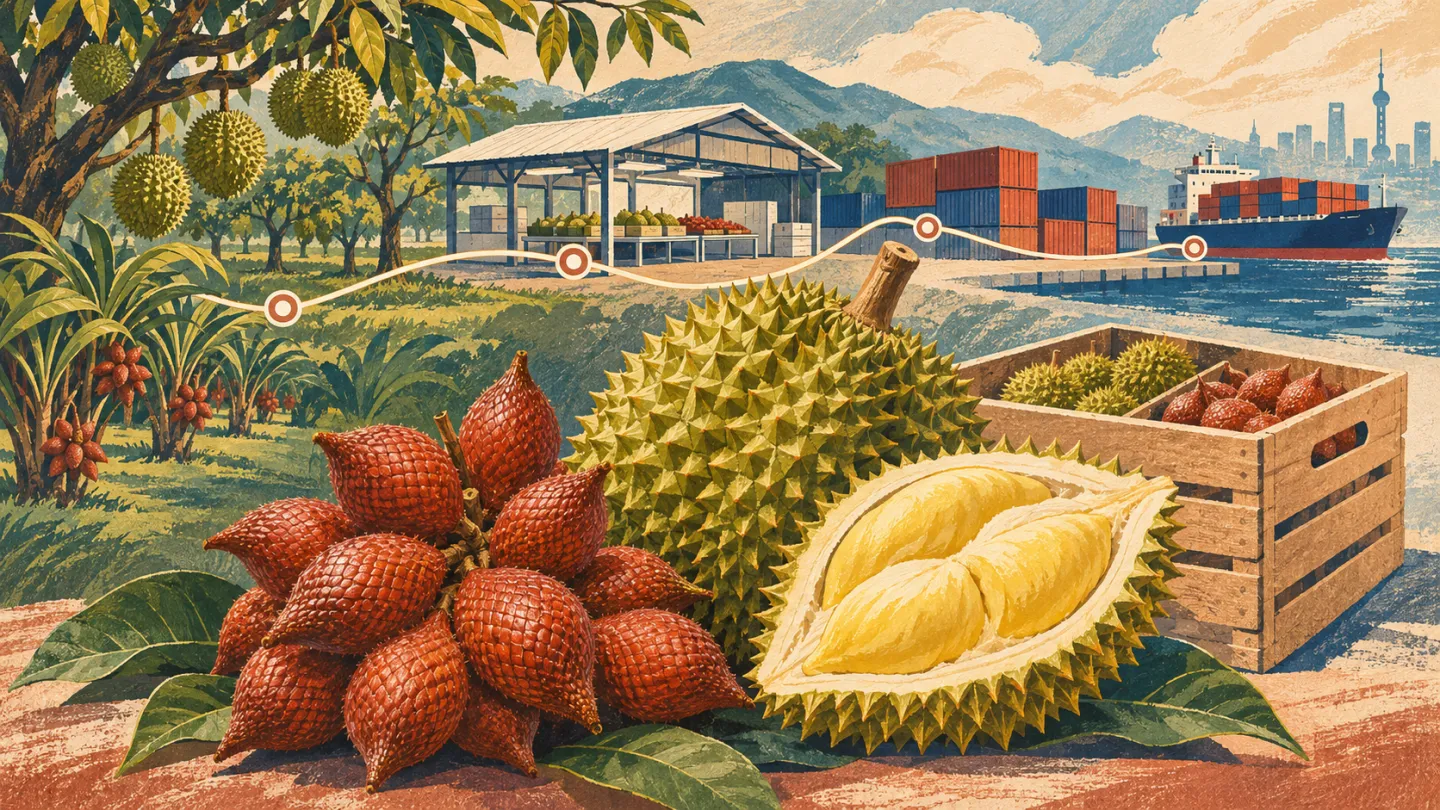
A packinghouse receives fruit from two orchards on the same day. Once the cartons are sealed, can the export team tell which orchard supplied the fruit in each carton and which documents cover the shipment? It’s a practical test for businesses preparing to export fresh salak to China and for durian exporters serving existing buyers.
A route to market for salak and updated rules for durian
Thailand and China signed and exchanged eight cooperation documents on November 13, 2026. Two were phytosanitary protocols between Thailand’s Ministry of Agriculture and Cooperatives and the General Administration of Customs of China (GACC). One sets out a pathway for Thai fresh salak, also known as snake fruit, to enter the Chinese market. The other updates requirements for fresh durian, which Thailand already exports to China. Royal Thai Government announcement
Thailand’s agriculture ministry estimated potential salak exports at around 2,000 metric tons, worth approximately THB 76 million a year. The ministry said the revised durian protocol focuses on quarantine pest management, traceability from orchard to packinghouse, and a food safety testing plan. Thai agriculture ministry briefing
The November 10 Cabinet briefing describes good agricultural practices (GAP), integrated pest management, packinghouse requirements, inspections, and a phytosanitary certificate. It also specifies an additional declaration on the certificate for fresh salak. Before committing to a ship date, exporters should confirm the implementation date, eligible orchards and packinghouses, and the exact declaration wording with Thailand’s Department of Agriculture and their Chinese importer. Thai Cabinet briefing
Trace one shipment lot back to the orchards
Start with the lot number on a carton ready to load. The warehouse team should be able to find the incoming lots and orchard records, the packing run, and the shipment record. If a packing run draws fruit from several incoming lots, retain every source lot ID and the quantity used. If a lot goes on hold, the team can identify which cartons are affected.
In an ERP system, receiving staff can record orchard IDs and incoming lots. The packinghouse can link those lots to the finished lot, and the export team can check that the relevant records are current and refer to the same shipment before releasing it. If the orchard ID on a document differs from the receiving record, put the shipment on hold until the responsible person checks and resolves the mismatch. This is an internal workflow that can be adapted to the requirements for each fruit.
Before the next shipment, give the team one carton lot number and ask them to find every orchard that supplied its fruit and the phytosanitary certificate for the shipment. Any link that takes a phone call or a fresh search through paperwork is a good first fix before export volumes grow.