Introduction — The End of the “Buy Tools” Era and the Rise of “Buy Outcomes”
Imagine this: instead of paying a monthly subscription for accounting software and hiring accountants to use it, you pay only for the finished output — complete financial statements — without even needing to know whether a human or an AI produced them behind the scenes.
That is the core idea behind the thesis recently published by Sequoia Capital — the legendary venture capital firm behind Apple, Google, and Airbnb — under the title “Services: The New Software.”
The line that shook the industry:
"The next trillion-dollar company will be a software company disguised as a services business."
But why now? And what happens over the next two years? This article breaks down the thesis from every angle.
The Number That Changes Everything: The 1:6 Ratio
Sequoia points to a simple but powerful equation:
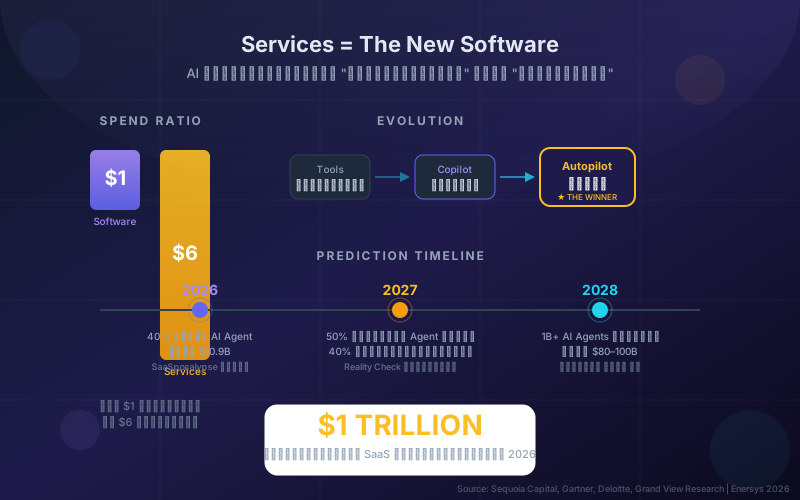
For every $1 an organization spends on software, it spends $6 on services.
What does that really mean? The software market we already consider enormous is actually only 1 out of every 7 dollars companies spend to “get work done.” The other 6 parts go to accountants, lawyers, consultants, IT support staff, insurance brokers, recruiters, and many more.
How big are these services markets?
| Services Industry | Approximate Market Size |
|---|---|
| Management Consulting | $300–400B |
| Recruiting / Staffing | $200B+ |
| Procurement / Supply Chain | $200B+ |
| Insurance Brokerage | $140–200B |
| IT Services | $100B+ |
| Accounting and Audit | $50–80B |
| Healthcare Billing | $50–80B |
| Claims Adjustment | $50–80B |
| Tax Advisory | $30–35B |
| Transactional Legal Services | $20–25B |
AI is about to compete in these markets — not just in software.
The Framework: “Intelligence” vs. “Judgement”
Sequoia divides work into two broad categories:
Intelligence — Rule-Based Reasoning
These are tasks that may be complex but still follow clear rules, such as drafting NDA contracts, medical coding across 70,000+ ICD-10 codes, tax processing, or screening job applications.
AI has already crossed this threshold — in many cases, it performs at or above human level.
Judgement — Experience-Based Decision-Making
These are tasks that require discretion, such as deciding which product feature to build first, negotiating a critical contract, or setting business strategy.
This is still human territory — but the boundary is moving.
Sequoia’s warning is clear: today’s judgement becomes tomorrow’s intelligence. As AI accumulates more data about what “good judgement” looks like in each field, it will steadily learn what used to belong only to humans.
Copilot vs. Autopilot — Why “Assistants” Will Lose to “Doers”
The Copilot Model (Selling Tools)
- Sell software for professionals to use
- The professional still owns the outcome
- Revenue comes from the “tools budget” — the smaller budget
The Autopilot Model (Selling Outcomes)
- Sell the completed work directly to the customer
- The customer no longer needs to hire the professional
- Revenue comes from the “labor budget” — 6 times larger
A clear example: Crosby does not sell NDA drafting software to lawyers. It drafts NDA agreements directly for businesses, without requiring a lawyer in the middle. Same outcome, at a fraction of the cost.
Why Copilot Gets Trapped
Because shifting from Copilot to Autopilot means cutting your own customers out of the equation. If you sell tools to lawyers and then one day say, “You don’t need lawyers anymore — we’ll do it for you,” your existing customers will not be happy. This is the Innovator’s Dilemma in the AI era.
The Evidence: The 2026 “SaaSpocalypse”
This is no longer just theory. The market is already reacting:
- Early 2026: software stocks saw more than $1 trillion in market value wiped out in the first 6 weeks of the year
- Palantir fell around 22% year-to-date
- Adobe, Salesforce, and ServiceNow each dropped 25–30%
- Analysts at Jefferies dubbed the event the “SaaSpocalypse”
Goldman Sachs compared it to “the end of the beginning” — similar to what happened to the newspaper industry when the internet arrived.
At the same time, ServiceNow acquired Moveworks for $2.85 billion to make AI Agents core to its platform, while Zendesk shifted to outcome-based pricing — charging based on “issues resolved” rather than “number of users.”
Predictions for the Next 2 Years (2026–2028)
2026 — The Year of “Choosing Sides”
What is happening right now:
- 40% of enterprise applications will include AI Agents within them — up from <5% last year (Gartner)
- 57% of organizations are allocating 21–50% of their digital budgets to AI automation (Deloitte)
- The AI Agent market is worth roughly $10.9 billion (Grand View Research)
- Investment into AI is hitting record levels — in February 2026 alone, global startup funding reached $189 billion
What will happen this year:
- Many Copilot companies will try to pivot into Autopilot, but they will hit the Innovator’s Dilemma — creating an opening for Autopilot-first startups to take market share
- Per-seat pricing will begin giving way to usage-based and outcome-based models
- Accounting, insurance, and IT support will be among the first sectors where AI Autopilot competition becomes obvious