The Short Version
In early 2026, the Thai government rolled out what may be the most aggressive SME incentive package in years. Here are the numbers that matter:
- CIT exemption up to 13 years depending on activity and location
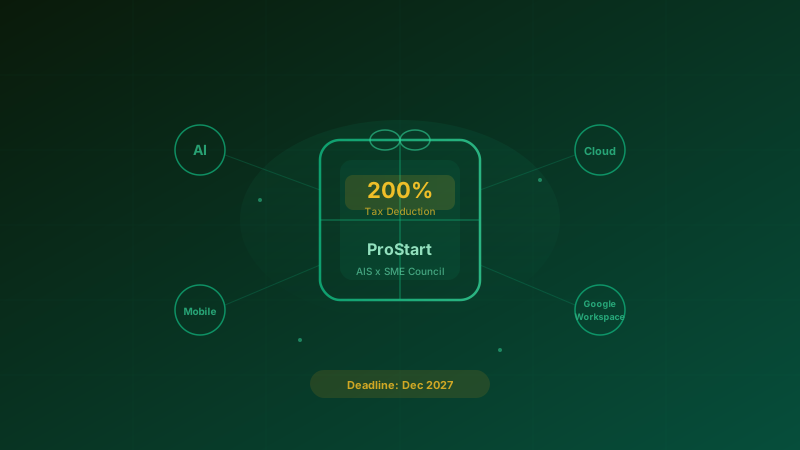
- Digital Transformation now qualifies for 5-year CIT exemption at 100% of investment value (up from 3 years / 50%)
- BOI's Fast Pass Plan targets expedited approval of 480 billion baht (~$15.5B) in investment applications
- Counter-incentives specifically addressing the 36% US reciprocal tariff — one of the highest in ASEAN
- OSMEP's $60 million relief package targeting 15,000 SMEs
- GDP growth forecast upgraded from 1.6% to 2.1%
This is not a single policy announcement. It is an entire system overhaul that fundamentally changes the cost equation for Digital Transformation in Thailand.
The Policy Landscape: What Changed and Why It Matters
On January 15, 2026, the Board of Investment (BOI) announced refreshed investment promotion measures, replacing the expired 2025 programs.
The overhaul was driven by multiple converging pressures:
Geopolitics: The US set a 36% reciprocal tariff on Thai goods, demanding immediate counter-measures.
ASEAN competition: Vietnam and Indonesia are aggressively courting investment from China and the US. Thailand needed stronger sweeteners.
World Bank guidance: Future expansion depends on AI capacity, sustainable manufacturing, digital services, and tourism. Without accelerated digital transformation, Thailand risks falling behind.
Sluggish SME digitization: Despite years of policy support, digital technology adoption among Thai SMEs has lagged targets. The incentives needed to be compelling enough to move the needle.
The result: Thailand's 2026 incentive package is the most aggressive in years.
BOI 2026: What Actually Changed
Streamlined Process, Expanded Benefits
The 2026 BOI measures restructure multiple dimensions simultaneously:
- Simplified application procedures, especially for SMEs
- Reduced minimum investment requirements — SMEs previously below threshold may now qualify
- CIT exemption up to 13 years based on activity type and location
- 50% CIT reduction for up to 10 additional years after the tax holiday expires
- Import duty exemptions on machinery
- More flexible rules for hiring foreign specialists
- 100% foreign ownership permitted under BOI promotion
S-Curve Industry Focus
The refreshed measures prioritize S-Curve industries: high-technology, digital transformation, and sustainable economic growth — aligned with World Bank recommendations for Thailand's growth trajectory.
Fast Pass Plan
BOI also prepared a Fast Pass Plan to expedite approval of investment applications totaling 480 billion baht (~$15.5 billion) — a clear signal that the government wants capital flowing quickly.
The Digital Transformation Incentive: Why This Is a Game-Changer
This is the most consequential change for Thai SMEs.
Before vs After
| Detail |
Pre-2026 |
2026 New |
| CIT exemption period |
3 years |
5 years |
| Value cap |
50% of investment |
100% of investment |
| Scope |
Machinery, digital systems |
Machinery, digital systems, AI, quantum computing, advanced robotics, generative AI |
What Qualifies
SMEs investing in the following areas can receive the incentive:
- Machinery upgrades & automation — transitioning from manual to automated processes
- Digital technology adoption — ERP, BI, AI, cloud systems
- Energy-saving measures — green tech that reduces costs and meets ESG criteria
- International sustainability standards — ISO, carbon neutrality standards
- Transitioning into emerging industries — moving from legacy sectors to S-Curve industries
Why "Game-Changer" Is Not Hyperbole
Simple math:
An SME investing 10 million baht in ERP + AI automation:
Old rules: 3-year CIT exemption capped at 50% = exemption on 5 million baht
2026 rules: 5-year CIT exemption capped at 100% = exemption on the full 10 million baht for 5 years
That is a multiple-fold increase in tax benefits — transforming the ROI equation from "needs careful consideration" to "not investing now means leaving money on the table."
New AI & Automation Subcategories
BOI added specific subcategories for technologies that previously lacked clear frameworks:
- Quantum computing — for organizations investing in quantum-ready infrastructure
- Advanced robotics — both manufacturing and service robots
- Generative AI — covering both development and deployment of AI systems
The Tariff War: Countering the 36% US Tariff
The Situation
The US imposed a 36% reciprocal tariff on Thai goods — among the highest in ASEAN. Thailand's trade surplus with the US, which grew to $51.3 billion in 2025, is the primary reason Thailand was targeted.
BOI's Counter-Measures
BOI unveiled counter-incentives under the package named "Thai Enterprise Competitiveness Enhancement Measures for the New Global Era", focusing on two sectors:
- EV (Electric Vehicles) — special incentives for local content production
- Electronics — incentives for components and assembly
Key Requirements
Qualifying is not automatic. Businesses must demonstrate substantial transformation:
- Minimum 4-digit customs tariff code (HS Code) change — meaning products must undergo significant transformation, not just repackaging or relabeling
- Local content incentives for EVs and electrical appliances
The Tariff Opportunity
What businesses should recognize: companies relocating production from China to Thailand under the China+1 strategy need digital infrastructure immediately — ERP, supply chain management, AI quality control. They need it now, not in two years.
Smart Visa & Foreign Talent
What Is the Smart Visa
Smart Visa is a special visa category designed to attract foreign specialists and investors to targeted industries:
- Up to 4-year permission to stay
- No separate work permit required
- Covers targeted industries: next-gen automotive, smart electronics, medical/wellness tourism, agriculture/biotech, automation/robotics, aviation/logistics, and digital businesses
2025-2026 Reforms
Criteria have become stricter — applicants must have an established business and Thai agency certification. This reflects the government's preference for quality over quantity.
For Foreign Investors
The combination of BOI promotion + 100% foreign ownership + Smart Visa makes Thailand one of the most attractive ASEAN destinations for tech companies looking to establish regional operations.
OSMEP's $60 Million Relief Package
The Office of SMEs Promotion (OSMEP) launched complementary support measures:
Relief Details
- $60 million budget for SME assistance
- Targeting 15,000 SMEs affected by recent disruptions
- Expected to generate a $600 million economic boost
- Focused on businesses impacted by flooding and border tensions
SME Definitions (OSMEP)
To determine if your business qualifies:
- Micro: 5 or fewer employees, family-owned/sole proprietor
- Small: 30-50 employees, revenue above 1.8M THB but under 100M THB (manufacturing)
- Medium: 100-200 employees, structured organization
Impact & Opportunity: 6 Things Thai Businesses Should Do Now
1. Digital Transformation = Double Win
You modernize operations and get 5 years of tax exemption on 100% of investment value. ERP, AI, and automation all qualify.
2. ERP Is the Right Vehicle for SMEs
Not every ERP fits SME budgets. Solutions like SAP or Oracle have TCOs that exceed what small-to-medium businesses can justify.
Odoo offers enterprise-grade functionality at an SME-appropriate TCO — and critically, it qualifies as a digital transformation investment under the new BOI measures.
3. PDPA Compliance Comes Built-In
Digital Transformation that includes proper data governance delivers PDPA compliance as a side benefit — no separate investment needed, no regulatory risk.
4. The China+1 Opportunity
Companies relocating production from China need immediate ERP and digital infrastructure. This is a new market opening alongside the tariff counter-measures.
5. Foreign Investors: Thailand Is Increasingly Attractive
BOI + 100% foreign ownership + Smart Visa = a package that competes with Singapore and Vietnam, especially for tech companies targeting the ASEAN market.
6. The Compounding Advantage
Companies that digitize now under the 5-year incentive will have 5 years of AI/automation maturity tax-free. Competitors who wait will pay full price and be 5 years behind simultaneously. This compounding advantage is often overlooked.
For Team Enersys
Enersys is not an energy company. We are a Software House specializing in Odoo ERP, Enterprise AI, and Data Privacy (PDPA).
This policy package aligns directly with what we do every day:
- Odoo ERP is a BOI-qualifying digital transformation investment — enterprise functionality at SME-appropriate TCO
- Enterprise AI roadmaps we help clients design fall squarely within BOI's new AI/automation subcategories — generative AI, advanced robotics, and automation are all in scope
- PDPA compliance comes naturally when digital transformation is designed with proper data governance from the start
We do not share implementation details here (that is our competitive advantage). But what we can say is this: if you are considering leveraging the 2026 BOI measures to upgrade your business with digital systems, we are ready to consult.
Summary
2026 is not a year to wait and see. It is a year to act.
- BOI overhaul — CIT exemption up to 13 years, 50% reduction for 10 more years, 100% foreign ownership
- Digital Transformation Incentive changes the game — from 3 years/50% to 5 years/100%, now covering AI, quantum, and robotics
- US Tariff counter-measures — creating new opportunities from China+1 migration
- Smart Visa + foreign talent — easier specialist recruitment
- OSMEP $60M relief — safety net for affected SMEs
- GDP forecast upgraded — market expanding despite uncertainty
Businesses that invest in digital transformation today secure both tax benefits and a competitive advantage that compounds for the next 5 years.
If you want to discuss how your business can leverage these policies — Team Enersys is ready to help.
Sources
This article is a policy impact analysis for Thai businesses by Team Enersys — all data and facts are sourced from the references listed above.