Say you signed off tens of millions on AI last year. Sales runs a chatbot, finance tried AI report summaries, and IT shipped three pilots. A year later the board asks what came back.
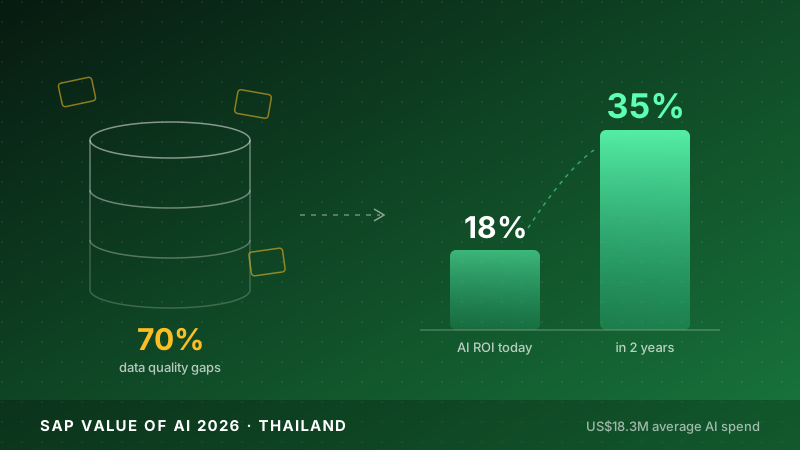
There is now a benchmark for that answer. On 15 September 2026, SAP published the Thailand findings of the SAP Value of AI Report 2026, produced with Oxford Economics. The study surveyed 2,600 business leaders in 13 countries, 200 of them in Thailand.
Thailand's headline numbers
| Metric |
Thailand |
Global average |
| Average AI spend per company per year |
US$18.3M (about THB 602.9M) |
US$28M |
| Return on AI this year |
18% (US$3.5M) |
21% |
| Expected return in two years |
35% (US$8.8M) |
38% |
| Share of tasks AI supports today |
24% |
30% |
| Share of tasks AI supports in two years |
42% |
48% |
Thai companies expect AI budgets to grow another 44% over two years. 71% are satisfied with the returns they see today, and 55% admit AI is not yet delivering its full potential.
Thailand sits only slightly behind the global average, and the returns are now measurable. Kulwipa Piyawattanametha, Managing Director of SAP Indochina, describes Thai businesses as moving from experimentation to execution. The more useful part of the report is what stands between today's 18% and the expected 35%.
The barrier is data and governance, not the model
- 70% cite problems with data quality or availability
- 79% have occasionally received low-quality AI output
- 47% still run AI team by team rather than across the company
- 74% have employees using third-party AI tools the company has not approved, often called shadow AI
- 62% worry about data leakage or IP exposure
Almost none of this comes from AI being not smart enough. It comes from AI fed with poor data, and from nobody tracking who uses what.
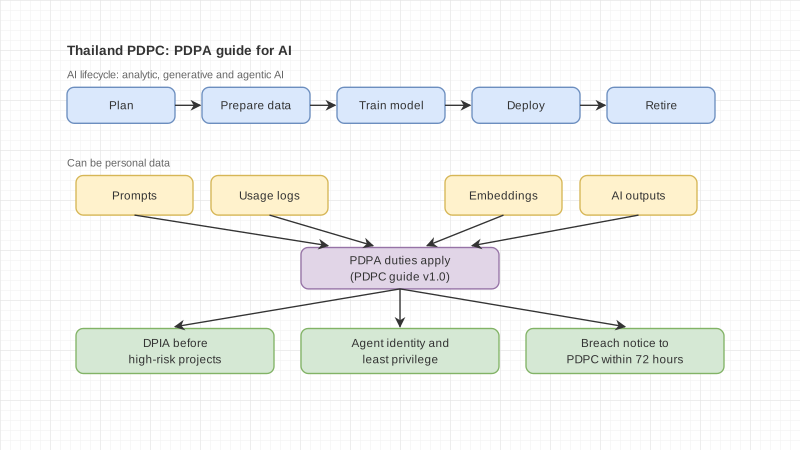
If an AI reads sales figures from three conflicting versions of an Excel file, its answer may be inaccurate. Entering customer data into an AI tool without checking how the provider stores or uses it may create personal-data or intellectual-property risks. Any obligations under Thailand's PDPA depend on the data, purpose, and processing context.
Agentic AI: widely wanted, 2% ready
We think this is the most important finding in the report. 78% of Thai businesses see agentic AI, meaning AI that takes actions on its own, as having moderate to very high potential to transform them. Only 2% say they are fully prepared.
The gap is in the controls. 40% have no step for a person to check before AI acts (human-in-the-loop), and another 40% have no standard approval process. 39% keep no registry of the AI agents they run, and 65% agree, or don't know, that they are deploying agents faster than they can govern them.
Leadership is not ready either. 40% have no dedicated AI leader, and only 13 to 14% say their AI governance skills and frameworks are fully ready.
An AI that answers wrongly costs someone reading time. An AI that acts wrongly, by approving a document, moving stock or emailing a customer, causes real damage. The more AI is allowed to do, the earlier permissions and approvals need to be in place.
What we see on client projects
These numbers match what the Enersys team sees on almost every client project.
Companies stuck at the pilot stage usually picked an AI tool first and then went looking for data to feed it. The demo looks good, but the tool never reaches daily use because each department's data disagrees.
An organisation might start by bringing core data into a system departments can use together, then defining who can see what, what AI may do, and which tasks need human approval before expanding use. However, the report does not compare these approaches or say that any one of them produces a 35% ROI. The 35% figure is the average return respondents expect in two years, not a guaranteed result.
Before you set next year's AI budget
- Is your core data in one place? If customers, products, stock and accounts live in many files, AI will give you many versions of the truth.
- Do you know which AI tools staff use? Keep a register, and define which data must never go into them.
- Does a person check before AI acts, especially on anything that touches money, stock or customers?
- Did you set the measure before you started: hours saved, errors reduced or revenue gained?
What Enersys does
We build the data foundation on Odoo ERP so every department works from the same data, set permissions and approval steps before AI is allowed to act, and use PrivacyHub to manage PDPA for the data AI touches. Our guide to Odoo 20 MCP permissions shows an example of the permission design.
If you have invested in AI and the returns are not what you expected, talk to the Enersys team. We will help you find whether the blocker is data, permissions or process.
Sources