News

Thailand's AI Adoption Gap at 10.7% Against Singapore's 69%: TH-AI Passport, a 1.6 Billion Baht Programme, Opens Registration 5 June 2026

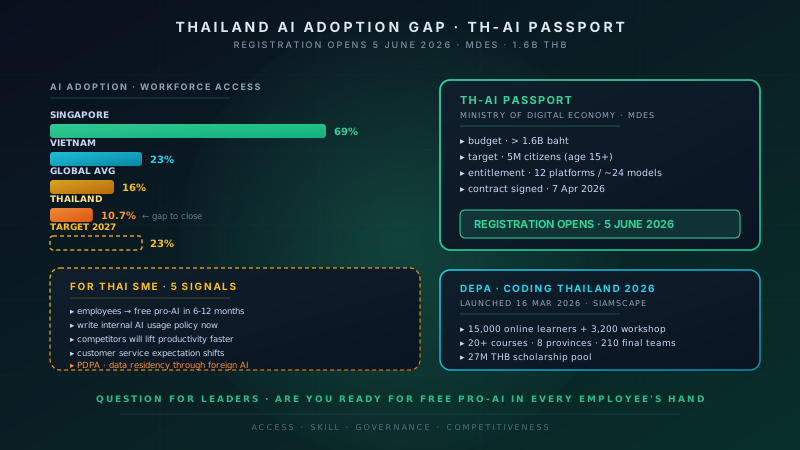
Thailand's AI adoption rate sits at roughly 10.7%, against Singapore at 69% and Vietnam at 23%. The Thai government's answer is the TH-AI Passport, a programme worth more than 1.6 billion baht that aims to give 5 million citizens aged 15 and over access to professional AI tools across 12 platforms and 24 to 25 models, through a single entitlement. Registration opens 5 June 2026. This piece sets out the programme, the criticism it has drawn, and what Thai SMEs should take from the signal.

TH-AI PassportThailand AIAI AdoptionDEPAMDESSMEGovernment Policy

TL;DR

Thailand's AI adoption among workers sits at roughly 10.7%, against Singapore at about 69%, Vietnam at 23%, and the global average near 16%. The Thai government's response is the TH-AI Passport, a programme worth more than 1.6 billion baht.

The Ministry of Digital Economy and Society (MDES) owns the programme. It is designed to give 5 million Thai citizens aged 15 and over access to professional AI tools through a single entitlement that bundles roughly 12 platforms and 24 to 25 models. The procurement contract was signed on 7 April 2026. Public registration opens 5 June 2026, one week from now.

The policy target is to raise national AI adoption from 10.7% to 23%, the level Vietnam holds today.

The programme has drawn criticism on transparency in procurement and on the risk of long-term dependency on foreign AI. Former Prime Minister Abhisit Vejjajiva has called for scrutiny of the bidding process. The Bangkok Post has published analysis on foreign-reliance risk.

This piece covers the facts of the programme, the criticism, and the angle business leaders in Thailand should take from the signal.


The Numbers Behind the Programme

Before the programme itself, the numbers it responds to.

From Global AI Adoption 2024 data, the share of the national workforce with access to AI tools in selected countries.

  • Singapore at about 69%
  • Vietnam at about 23%
  • Global average near 16%
  • Thailand at about 10.7%

This is not a gap to glance at and move on from. Over the next two to three years, the share of the workforce that can reach AI tools affects business productivity, the structure of industries, and overall competitiveness.

In MDES's reading, 10.7% signals urgency. Vietnam, not far from Singapore in this dimension and growing faster than Thailand over the last three years, has moved ahead. If Thailand allows the gap to widen further, regional tech investment flows will choose other paths.


What the TH-AI Passport Is

The TH-AI Passport is a programme that gives Thai citizens access to professional AI tools through a digital entitlement.

The shape of the programme.

  • Owner: Ministry of Digital Economy and Society (MDES)
  • Total budget: more than 1.6 billion baht
  • Target audience: Thai citizens aged 15 and over, totalling 5 million people
  • Scope: about 12 platforms and roughly 24 to 25 AI models
  • Structure: centralised subscription to professional AI across multiple vendors
  • Registration: opens 5 June 2026

Five million people, against a Thai workforce of about 40 million, equals roughly 12.5%. A single programme will not close the entire gap. It provides a base of access at a moment when access is needed.

The procurement contract was signed on 7 April 2026, following a competitive bidding process involving three private firms.


Criticism

The programme has drawn criticism on three fronts.

The first is procurement transparency. Former Prime Minister Abhisit Vejjajiva has called for review of the bidding process, with questions raised about specifications that critics read as tailored to particular vendors. The responsible minister has stated that the process followed all legal requirements.

The second is foreign-reliance risk. The Bangkok Post has published analysis on the concern that an entitlement giving access to foreign AI at this scale, without parallel investment in domestic Thai-language model development, creates a long-term dependency that Thailand will find hard to control.

The third is a policy question on outcomes. Providing tools does not mean people will use them. Programmes of this scale in other countries have seen post-registration engagement run several times below registration numbers. Without a parallel skills layer, the programme could become many sign-ups and few daily users.

At the time of writing, the minister has confirmed that the programme is proceeding to the 5 June 2026 registration opening.

DEPA Coding Thailand 2026, the Skills Layer

In parallel with the TH-AI Passport, the Digital Economy Promotion Agency (DEPA) launched Coding Thailand 2026 on 16 March 2026 at the SiamScape Building in Siam Square.

The two programmes differ in purpose. The Passport focuses on access to tools. Coding Thailand focuses on building skills.

The Coding Thailand 2026 design.

  • Online learning targeting at least 15,000 learners
  • Regional workshops for 3,200 students
  • More than 20 coding and AI courses
  • Workshops in 8 provinces
  • Three-day intensive coding and AI competitions
  • An incubation programme for selected teams
  • A national competition for the top 210 teams
  • Focus areas: Smart Industry, Green Innovation, Health and Well-Being, and Creative Economy
  • Scholarships and funding worth more than 27 million baht

Dr Warin Ratchananusorn, Acting Deputy Director-General of DEPA, announced the programme.

Coding Thailand 2026 builds on the original Coding Thailand initiative DEPA launched in 2018 to develop a digital skills base in Thai youth.


What This Means for Thai SMEs

For business owners, the signal across all three data points, the Passport, Coding Thailand 2026, and the 10.7% figure, points in five directions.

First, the government has placed AI adoption on the national agenda. A 1.6 billion baht programme is not a small pilot. It is an investment that says MDES expects a private-sector response.

Second, employees will have access to professional-grade AI tools over the next 6 to 12 months, free or near free, through the Passport. If an internal policy on employee AI use does not yet exist, this is the moment to put one in place, before employees start using AI tools without guardrails.

Third, competitors in the same industry will move to lift productivity through AI faster. If national adoption moves from 10.7% to 23% within a short period, the cost of standing still rises sharply.

Fourth, customers will also have AI in hand. Expectations on service and response time will move accordingly.

Fifth, the risk side. The programme will route significant volumes of personal data through foreign AI services. Organisations that handle personal data under PDPA need to review employee policy on external AI tools and the data residency of information that flows through them.


From the Enersys Perspective

We read the TH-AI Passport as a structural change, not a small event. Over the next 12 months we expect to hear similar questions across many enterprise clients.

How to enable employees to use AI safely. How to design governance for internal AI use. How to integrate AI with existing ERP and workflow.

For organisations that need AI built for enterprise context, with PDPA as a binding constraint, the Enersys team has built Genesis AI Platform, an agentic AI platform built for Thai enterprises. We welcome conversations with leaders shaping their own AI strategy.


Closing

The 10.7% figure is not a number to read and forget. It is a marker for the workforce, the industries, and the economy in the year ahead.

The TH-AI Passport is the state's answer to that gap. Whether it meets the target depends on how the private sector, the education sector, and civil society respond over the 12 to 18 months that follow the registration opening.

For business owners in Thailand, the question is not whether to invest in AI. The question is how to respond to the fact that employees will have professional-grade AI tools in their hands, free, within the next month.


Sources

"Empowering Innovation,
Transforming Futures."

ติดต่อเราเพื่อทำให้โปรเจกต์ของคุณเป็นจริง