The Website Price ≠ The Real Price — Why TCO Matters More Than You Think
Imagine you are choosing ERP software for your company. A quotation is sitting on your desk for THB 1 million. It looks affordable. You sign the contract...
But six months later, customization costs THB 800,000. Data migration adds another THB 500,000. Employee training costs THB 300,000. A consultant to support go-live costs THB 400,000. Then come monthly hosting fees you did not account for, plus premium support you end up needing...
Bottom line: software priced at THB 1 million turns into a real 3-year TCO of THB 4–5 million.
This is not hypothetical. According to Panorama Consulting Group’s 2025 report:
- More than 25% of organizations exceed their planned budgets
- The main causes are underestimated staffing (38%), scope expansion (35%), and technical/data issues (34%)
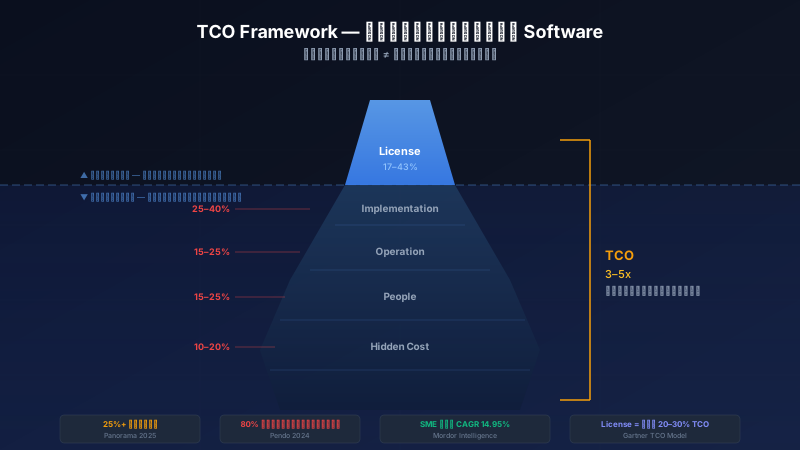
- Software licensing accounts for only 20–30% of total ERP spending
These figures align with Gartner’s definition of TCO, which includes both direct and indirect costs — from hardware and software to operating costs, downtime, and inefficient usage.
In Thailand, the Digital Transformation market was valued at $9.21 billion in 2024 and is growing rapidly, especially in the SME segment, which is expected to grow at a 14.95% CAGR through 2031. That means Thai SMEs are spending more on software every year — but the real question is: are they spending wisely?
What Is TCO? — Not Just the “Price,” but the “Lifetime Cost”
TCO (Total Cost of Ownership) is the calculation of all costs associated with owning and using software over its full lifecycle — not just the amount paid on day one.
Gartner, which set the global benchmark for TCO, divides costs into two major groups:
- Direct Costs: software, hardware, operations, and system administration
- Indirect Costs: end-user support, downtime, and underutilization
Forrester also has a well-known framework called TEI (Total Economic Impact), which looks at four dimensions: costs, benefits, flexibility, and risk. It has been widely used for more than 20 years.
In this article, however, we will go deeper with a more practical structure: a 5-layer TCO framework designed for real-world use by Thai executives.
The 5-Layer TCO Framework — Breaking Down Software Costs Layer by Layer
Think of software like an iceberg. What you can see above the water is only a small tip. The real costs — 70–80% of them — are hidden below the surface.
Layer 1: License / Subscription Cost — What You See on the Quotation
This is the number vendors show you first — and the one that is most likely to mislead you.
What to watch out for:
- Per-user vs. per-company pricing: THB 500/user/month sounds cheap, but with 100 users that becomes THB 50,000/month = THB 600,000/year
- Tiered pricing: Many vendors offer 3 tiers — Basic, Professional, Enterprise. The features you actually need are usually in the highest tier
- Year 1 vs. renewal pricing: Some vendors offer a 50% first-year discount, but charge full price from year 2 onward. You need to review pricing over 3–5 years
- Add-on module fees: The core system may look inexpensive, but key features such as advanced reporting, API access, or multi-currency often require extra modules
- Minimum user commitments: Some vendors require a minimum purchase of 50 users, even if you only have 20 employees
- License fees by environment: Dev, Staging, and Production — some vendors charge separately for each environment
Real-world example: Enterprise ERP systems often start with license quotes of THB 2–5 million, but that is only the beginning.
Layer 2: Implementation Cost — The Cost of Making the Software Actually Work
This is the layer that many organizations underestimate the most. Based on industry data, implementation costs are often 1–3 times the license cost, and in some cases can be as high as 5 times.
Cost items in this layer:
A. Customization & Configuration
- Adapting the system to match your organization’s workflows
- Creating custom fields, reports, and dashboards
- Adjusting business logic to comply with Thai regulations such as 7% VAT, withholding tax, and tax invoices
- Average cost: 30–50% of license cost
B. Data Migration
- Moving data from legacy systems such as Excel, old accounting software, or an old CRM
- Data cleansing — old data often has duplicates, inconsistent formats, or missing information
- Verifying data accuracy after migration
- Average cost: 15–25% of license cost
C. Integration
- Connecting the system with other tools such as accounting, e-Commerce, HR, banking, or Revenue Department systems
- Building API connections or middleware
- Paying for off-the-shelf connectors if available, or custom integration development if not
- Average cost: 20–40% of license cost depending on how many systems need to be connected
D. Consulting & Project Management
- Business process re-engineering consulting
- Project manager fees from the vendor or implementation partner
- Travel and accommodation costs if consultants are coming from another province or country
- In the U.S., ERP consultants typically charge $150–400/hour; in Thailand, rates are around THB 3,000–15,000/hour
A simple rule of thumb: For complex projects such as manufacturing ERP or multi-branch operations, first-year implementation costs are often 3–5 times the annual license/subscription cost.
Layer 3: Operation Cost — The Daily Cost of Keeping the System Running
After go-live, costs do not stop — in many ways, they are just beginning.
Cost items in this layer:
A. Hosting & Infrastructure
- Cloud server costs for cloud-based systems
- Bandwidth and storage costs that grow with your data volume
- SSL certificate, domain, and CDN fees
- Backup storage
- Over 3 years: hosting costs often increase by 10–20% per year as data grows
B. Maintenance & Updates
- Annual Maintenance fees, often 18–22% of license cost per year for on-premise systems
- Update/upgrade costs — some vendors require upgrades every 2 years or they stop support
- Post-go-live bug fixes (note: warranty periods are often only 3–6 months)
C. Support
- Support tiers such as Silver/Gold/Platinum — higher tiers cost more but offer faster response times
- After-hours support if your system needs to run 24/7
- Dedicated support engineer fees if required
D. Security & Compliance
- Annual security audit costs
- PDPA-related compliance costs or penalties
- Penetration testing and vulnerability assessments
- Security patching and emergency fixes
E. Internal Administration Cost
- Time spent by your IT team managing the system — even with SaaS, someone still has to own it internally
- Monitoring tools
- User account administration, including opening, closing, and changing permissions
Layer 4: People Cost — The Human Cost Most Companies Forget
This is the layer that never appears on a quotation, yet is often one of the biggest costs.
Cost items in this layer:
A. Training
- Vendor training fees, often charged per day at THB 20,000–80,000/day/group
- Employee time taken away from regular work to attend training — an opportunity cost
- Repeat training for new hires, especially if staff turnover is high
- Creating Thai-language training materials and user manuals, since vendors often provide only English documentation
B. Productivity Dip — The “Valley of Loss”
Every system change creates a 3–6 month period where employee productivity falls by 20–40% because:
- Staff need to learn the new system
- They may need to run both the old and new systems in parallel
- Mistakes happen due to unfamiliarity
A simple calculation: 50 employees × THB 30,000 average monthly salary × 30% productivity loss × 4 months = THB 1,800,000 quietly lost
C. Change Management
- Hiring a change management consultant
- Executive time spent communicating and building buy-in
- The cost of resistance — some employees will push back against the new system, and that takes time and resources to manage
- The cost of internal “champions” who drive adoption, often while being pulled away from their core responsibilities
D. Hiring
- You may need to hire new staff with specialized skills such as a system admin or data analyst
- Recruitment and headhunter fees
- Higher salaries for employees with niche ERP expertise
Layer 5: Hidden / Opportunity Cost — The Least Visible but Most Expensive Cost
This layer is the “silent killer” that wrecks budgets after go-live.
Cost items in this layer:
A. Downtime
- Losses caused by planned or unplanned outages
- Calculation formula: Revenue per hour × number of downtime hours × number of incidents per year
- For an e-Commerce business earning THB 10 million/month, a 4-hour outage can mean a loss of more than THB 50,000
B. Vendor Lock-in
- The cost of switching vendors later
- The more customization you build, the deeper the lock-in
- If the vendor raises prices by 20–30%, will you move or pay? In most cases, you will have to pay
- Data export costs — some vendors intentionally make this difficult
C. Future Scalability
- Will the system support your growth?
- If your user count grows from 50 to 200, will costs scale linearly or exponentially?
- If you expand to multiple branches or countries, can the system handle it, or will you need to re-implement?
D. Technical Debt
- Forrester reports that technical debt consumes 10–20% of new product development budgets
- Customizations may break when the vendor releases a new update
- Temporary workarounds often become permanent and create compounded problems over time
E. Low Feature Adoption
- Pendo reports that 80% of built features are not meaningfully used
- In other words, you may pay for licenses covering 100 features while only using 20
A Real TCO Calculation Example — Comparing 3 Options Over 3 Years
Assume a mid-sized company with 80 employees needs a full ERP system covering accounting, inventory, sales, procurement, and HR.
Option A: Enterprise ERP (On-Premise) — “Expensive but Comprehensive”
| Item |
Year 1 |
Year 2 |
Year 3 |
3-Year Total |
| License (perpetual) |
3,000,000 |
- |
- |
3,000,000 |
| Annual Maintenance (20%) |
600,000 |
600,000 |
600,000 |
1,800,000 |
| Implementation & Customization |
4,500,000 |
500,000 |
200,000 |
5,200,000 |
| Data Migration |
800,000 |
- |
- |
800,000 |
| Integration (5 systems) |
1,200,000 |
200,000 |
200,000 |
1,600,000 |
| Hosting & Infra (on-prem server) |
500,000 |
200,000 |
200,000 |
900,000 |
| Training |
400,000 |
100,000 |
100,000 |
600,000 |
| Productivity Loss |
1,800,000 |
- |
- |
1,800,000 |
| Additional IT Staff (1 person) |
600,000 |
600,000 |
600,000 |
1,800,000 |
| Total |
13,400,000 |
2,200,000 |
1,900,000 |
17,500,000 |
3-year TCO = THB 17.5 million (The license is only THB 3 million = just 17% of TCO)
Option B: Cloud ERP (Subscription) — “Pay Monthly”
| Item |
Year 1 |
Year 2 |
Year 3 |
3-Year Total |
| Subscription (80 users) |
1,440,000 |
1,584,000 |
1,742,000 |
4,766,000 |
| Implementation & Config |
2,000,000 |
300,000 |
150,000 |
2,450,000 |
| Data Migration |
500,000 |
- |
- |
500,000 |
| Integration (5 systems) |
800,000 |
150,000 |
150,000 |
1,100,000 |
| Training |
300,000 |
80,000 |
80,000 |
460,000 |
| Productivity Loss |
1,200,000 |
- |
- |
1,200,000 |
| Premium Support |
200,000 |
200,000 |
200,000 |
600,000 |
| Total |
6,440,000 |
2,314,000 |
2,322,000 |
11,076,000 |
3-year TCO = THB 11.1 million (The subscription is THB 4.77 million = 43% of TCO)
Note: Subscription prices often increase by 8–10% per year. The year 2–3 figures reflect this.
Option C: Open-Source ERP + Partner (e.g. Odoo) — “Flexible and Cost-Effective”
| Item |
Year 1 |
Year 2 |
Year 3 |
3-Year Total |
| License (Enterprise) |
480,000 |
528,000 |
581,000 |
1,589,000 |
| Implementation & Customization |
1,500,000 |
300,000 |
150,000 |
1,950,000 |
| Data Migration |
400,000 |
- |
- |
400,000 |
| Integration (5 systems) |
600,000 |
100,000 |
100,000 |
800,000 |
| Hosting (Cloud) |
180,000 |
200,000 |
220,000 |
600,000 |
| Training |
250,000 |
80,000 |
50,000 |
380,000 |
| Productivity Loss |
1,000,000 |
- |
- |
1,000,000 |
| Partner Support |
360,000 |
360,000 |
360,000 |
1,080,000 |
| Total |
4,770,000 |
1,568,000 |
1,461,000 |
7,799,000 |
3-year TCO = THB 7.8 million (The license is THB 1.59 million = 20% of TCO)
Comparison Summary
| Criteria |
Enterprise ERP |
Cloud ERP |
Open-Source + Partner |
| 3-Year TCO |
THB 17.5M |
THB 11.1M |
THB 7.8M |
| Initial Cost (Year 1) |
THB 13.4M |
THB 6.4M |
THB 4.8M |
| Ongoing Cost / Year |
~THB 2M |
~THB 2.3M |
~THB 1.5M |
| License vs TCO |
17% |
43% |
20% |
| Vendor Lock-in |
Very high |
High |
Low–Medium |
| Flexibility |
Low |
Medium |
High |
| Go-live Speed |
12–18 months |
6–12 months |
4–8 months |
| Best for |
Large organizations, 500+ staff |
Mid-sized organizations, 100–500 staff |
SMEs with 20–200 staff |
Key takeaway: Non-license costs such as implementation, people, and operations account for 57–83% of TCO across all three options.
TCO Checklist — 25 Questions You Must Ask a Vendor Before Signing
Before buying any software, ask the vendor every question below — and get the answers in writing:
License / Subscription Costs
- What is the per-user monthly/annual price? Is there a minimum number of users?
- How will pricing increase in years 2, 3, and 5? Can pricing be locked in?
- Can we reduce the number of users later? Is there a penalty?
- Which modules must be purchased separately? What is the price per module?
- Are Dev/Staging environment licenses charged separately?
Implementation Costs
- What is the full implementation cost? Does it already include customization?
- How many months will implementation take? If the project runs late, what additional costs apply?
- Is data migration included in the package or charged separately?
- What is the integration cost per external system? Please specify by system name.
- Is the contract fixed-price or time-and-materials?
Operating Costs
- What is the monthly hosting/cloud cost? Does it include backup?
- What is the annual maintenance cost? (As a percentage of license cost?)
- What are the prices for each support tier (Silver/Gold/Platinum)? What are the SLA terms?
- Are security audits and penetration tests included, or do we need to hire separately?
- What are the costs for major updates/upgrades?
People-Related Costs
- How much does training cost? How many days? How many participants per session?
- Are Thai-language training materials available?
- Will we need to hire additional staff to manage the system? If so, how many?
- Do you provide change management support?
Hidden Costs
- If we want to leave the system, how can we export our data? Is there a fee?
- If your company is acquired or shuts down, what happens to the contract?
- What uptime SLA do you guarantee? If it is missed, is there compensation?
- Where is our data stored? (Thailand or overseas — relevant for PDPA)
- Are API calls limited? If we exceed the limit, what is the charge?
- Is there an exit clause in the contract? What is the early termination fee?
Tip: Print this checklist and bring it to every vendor meeting. The vendor that can answer everything clearly and completely is usually the more trustworthy one.
5 Mistakes That Make TCO Spiral Out of Control
Mistake 1: Deciding Based Only on the License Price
This is the most common trap. Executives often compare vendors only by license price and choose the cheapest one, without considering the rest of the cost structure.
Result: Cheap software that needs heavy customization can end up costing more than more expensive software that works out of the box.
Fix: Compare 3–5 year TCO, not just year-one pricing.
Mistake 2: Ignoring People Costs in the Budget
Many organizations budget only for the software itself and forget that they also need to:
- Send staff to training, delaying work for 2 weeks
- Absorb productivity loss during transition
- Potentially hire 1–2 additional admins
Result: Budgets overshoot by 30–50%.
Fix: Calculate People Cost using Layer 4 of the framework above.
Mistake 3: Over-Customizing
“We want it to work exactly like our old system.” That sentence is more dangerous than it sounds.
Too much customization leads to:
- Soaring implementation costs
- Difficult upgrades, because customizations may break every time the vendor releases a new version
- More complex vendor support, because your system no longer resembles the standard product
Fix: Adapt your process to the software by 80%, and customize only the 20% that is truly necessary.
Mistake 4: Having No Change Management Plan
Buying good software is not enough if employees refuse to use it. This is one of the most common post-go-live problems.
Result: You spend millions, but staff still secretly work in Excel.
Fix: Start change management before the project begins. Communicate clearly why the change is happening, not just that “everyone has to use it.”
Mistake 5: Forgetting the Exit Strategy
“What happens if one day we need to leave this system?”
If you do not ask that question from day one, you may later discover that:
- Data is difficult to export, or exported in a format that is hard to reuse
- The contract locks you in for 3–5 years with steep penalties
- The vendor keeps increasing prices because they know you cannot move
Fix: Review exit clauses, data portability, and switching costs before signing the contract.
How to Negotiate with Vendors — Tips for Thai SMEs
Tip 1: Ask the Vendor for a Full TCO Breakdown
Instead of asking only “How much does it cost?”, ask: “Can you provide a full 3-year TCO breakdown?”
A good vendor can provide this quickly. A weak vendor will try to avoid the question — which is a warning sign.
Tip 2: Compare at Least 3 Vendors
Do not evaluate just one. Request proposals from at least 3 vendors and compare them using the same TCO framework.
Each vendor structures pricing differently — some bundle everything, others break it into many separate items. Using one framework helps you compare them on an apples-to-apples basis.
Tip 3: Negotiate the “Package,” Not Just the “Price”
Instead of pushing only for a lower license fee, which vendors often resist, negotiate for value such as:
- 2–3 free training sessions (worth THB 200,000+)
- Free first-year support or a higher support tier
- Data migration included in the package
- A longer warranty period, for example 12 months instead of 3
- A 3-year price lock for subscription fees
These concessions often deliver more total value than a 10–15% license discount.
Tip 4: Ask for References from Similar Customers
Do not be impressed only by big client logos on the vendor’s website. Ask to speak with customers similar to you in size and industry.
Ask them:
- What was the actual TCO versus the vendor’s proposal?
- What unexpected costs came up?
- If they had to choose again, would they still choose the same vendor?
Tip 5: Use Thailand’s 200% Tax Deduction Incentive
For Thai SMEs, the government offers a 200% tax deduction for Digital Transformation investments under SME support measures, which can reduce real TCO even further.
Check whether the software you plan to buy qualifies for the incentive, and prepare the required documentation before signing.
Tip 6: Run a Proof of Concept (POC) First
Do not rely on a demo. Ask for a POC using your real data and let your real team test it for 2–4 weeks.
A POC may cost THB 50,000–200,000, but it can prevent a multi-million-baht decision mistake.
Conclusion — TCO Is Not “Boring Finance,” It Is an Executive’s Secret Weapon
As Thailand’s Digital Transformation market keeps growing, industrial software expands at 7.8% per year, and SMEs invest more in technology every year, buying software without calculating TCO is like buying a house based only on the list price, while ignoring mortgage payments, common area fees, and maintenance costs.
Remember:
- License cost is only 17–43% of TCO — the real cost lies in implementation, operations, people, and hidden costs
- Use the 5-layer TCO framework every time you evaluate software
- Ask vendors the 25-question checklist before signing
- Compare at least 3 options using the same standard
- Do not forget the human cost, which is often the most overlooked and most expensive part
If you want expert support to analyze TCO for your project or need consulting to select and implement the right ERP/software system for your business, contact the Enersys team. We help Thai organizations make technology decisions based on data — not gut feeling.
References