If you're searching for "Software House" or "software company" in 2026, you're probably in one of these situations: you need a new system for your organization, your old system is no longer workable, or you want to know which company to choose from the hundreds of options in Thailand.
The problem is that every company claims to be “good.” Their websites look polished. Their portfolios look impressive. But when the work actually starts? Global data shows that 70% of software projects fail or are delivered late. That means choosing the wrong partner can cost you money, time, and business opportunities.
This article covers everything you should know before making a decision — from what a Software House actually is, how it differs from a freelancer or IT outsourcing provider, what services it offers, 8 practical criteria for choosing a software company, and 5 questions you must ask a vendor before signing a contract.
What Is a Software House?
A Software House is a company that provides software design, development, and maintenance services for other organizations. It has an in-house team of software engineers, UX/UI designers, system analysts, and project managers who work together under a structured, standardized process.
The term Software House comes from the idea of being the “home” of software — the place where systems are built systematically. It’s not just about writing code and handing it over. It includes requirement analysis, architecture design, testing, deployment, and post-launch support.
In Thai, this is commonly referred to as a software company or software development company, and sometimes simply a system development provider. In practice, they all refer to the same concept.
Software House vs IT Outsourcing vs Freelancer vs Digital Agency — What’s the Difference?
Many people confuse these terms, so here’s a clearer comparison:
| Criteria |
Software House |
IT Outsourcing |
Freelancer |
Digital Agency |
| Team Size |
10–200+ people |
Flexible based on contract |
1–3 people |
5–50 people |
| Core Expertise |
Deep software development |
Staffing + project-based work |
Specialized individual skills |
Marketing + websites |
| Typical Deliverables |
Custom software, ERP, AI, mobile apps |
Staff assigned to work within scope |
Small, focused tasks |
Websites, campaigns |
| Post-Go-Live Support |
Clear SLA |
Depends on contract |
Usually ends at handover |
Limited |
| IP & Source Code |
Can be transferred to client |
Depends on terms |
Often retained by freelancer |
Often retained by agency |
| Risk Level |
Low — dedicated team |
Medium — staff may change |
High — one person does everything |
Medium — less technical depth |
| Best For |
Enterprise systems, complex projects |
Team augmentation, labor cost reduction |
Fast small jobs, prototypes |
Marketing websites, landing pages |
Simple summary:
- If you need a complex system for real organizational use → choose a Software House
- If you need to add people to your internal team → choose IT Outsourcing
- If you need a small job done quickly on a tight budget → choose a Freelancer
- If you need a website plus digital marketing → choose a Digital Agency
What Does a Software House Do? — 6 Core Services
A good software company does more than just “write code.” It provides end-to-end services from strategy and analysis to long-term support. Here are the 6 core services most Software Houses offer:
1. Custom Software Development
This is the core service of every Software House — gathering client requirements, analyzing, designing, developing, testing, and delivering a system built specifically for that organization.
Examples include a warehouse management system integrated with ERP, an internal approval system that supports a company’s unique workflow, or a CRM that integrates with LINE OA.
What off-the-shelf software often cannot do is adapt to the organization’s actual business process. Instead of forcing your organization to change for the software, custom development lets the software fit the way you really work.
2. Mobile Application Development
This includes iOS, Android, and cross-platform apps that run on both systems from a single codebase. A Software House typically handles everything from mobile UX/UI design — which is fundamentally different from web design — to publishing the app on the App Store and Google Play.
A good mobile app should work even without internet access (offline-first), support push notifications, and integrate with phone hardware such as the camera, GPS, or biometrics.
3. Web Application Development
This is not just a “website.” A Web Application is a browser-based system with complexity comparable to a desktop application. Examples include ERP systems accessed via browser, executive dashboards, or e-commerce platforms that support tens of thousands of users simultaneously.
Modern web apps must load fast, feel intuitive like a native app, and work seamlessly across all devices, from smartphones to large desktop screens.
4. AI & Machine Learning Solutions
In 2026, AI is no longer a “nice to have” — it is a core capability that a modern Software House should offer. This includes intelligent chatbots, predictive analytics, anomaly detection systems, and AI Agents that automate tasks previously done by people.
According to Gartner’s 2026 report, organizations that adopt AI seriously can reduce operating costs by 20–35% and increase revenue by 15–25%.
5. ERP Implementation & Customization
ERP (Enterprise Resource Planning) is the backbone of organizational management — combining accounting, inventory, HR, production, and more into one system.
A Software House with ERP expertise can help you select the right platform, customize it to your business process, migrate data from legacy systems, train employees, and support the system after go-live.
One popular ERP platform among Thai SMEs is Odoo, an open-source ERP that is flexible, affordable, and supported by a large global community.
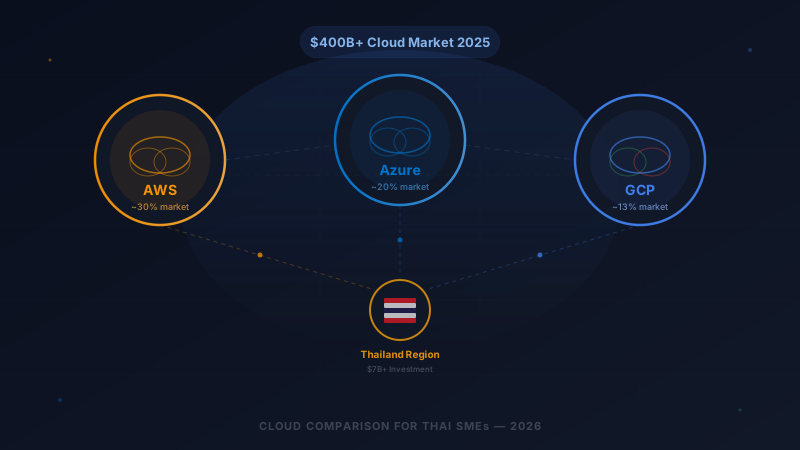
6. Cloud Migration & Infrastructure
Many organizations still rely on on-premise servers that are expensive to maintain, hard to scale, and vulnerable in disaster recovery situations. A Software House can help move your systems to the cloud safely — whether public cloud, private cloud, or hybrid.
The key is not just “moving to the cloud,” but designing the right architecture so the system can auto-scale, be properly monitored, stay cost-efficient, and meet security standards.
Why Outsource Instead of Building In-House? — Buy vs Build Analysis
Many organizations think, “Wouldn’t it be cheaper to hire programmers and build it ourselves?” In reality, it’s far more complex than that.
The Hidden Costs of Building In-House
| Item |
Hire a Software House |
Build In-House |
| Team Salaries (5–8 people x 12 months) |
Included in project cost |
THB 3–6 million/year |
| Recruitment + Onboarding |
None |
THB 200,000–500,000 |
| Time to Build Team |
Can start immediately |
3–6 months |
| Turnover Risk |
Vendor’s responsibility |
Organization bears the risk |
| Specialized Expertise |
Access to a multidisciplinary team |
Must be built internally |
| Technology & Best Practices |
Continuously updated across projects |
Limited to internal exposure |
| Dev Infrastructure Cost |
Included in project cost |
Must invest separately |
When Should You Build In-House?
An in-house team makes sense when:
- Software is your core product (for example, you are a tech startup)
- You need to iterate very quickly every day or every week
- You have the budget to hire a full-time team continuously
- You already have a strong CTO or Tech Lead
When Should You Hire a Software House?
- Software is a business tool, not your core product
- You need a system that is ready for real use within 3–9 months
- You do not have technical expertise internally
- You want to reduce risk — paying by milestone instead of carrying long-term salary costs
The 80/20 rule: For most organizations in Thailand, especially SMEs where software is not the main business, hiring a Software House is the better value in almost every case. It saves time, reduces risk, and delivers results faster.
For a deeper cost analysis, read more here: How to Calculate TCO Before Buying Software
8 Criteria for Choosing a Thai Software Company — A Checklist Every Executive Should Know
These 8 criteria come from real experience in the Thai market and apply to both SMEs and enterprises.
Criterion 1: Look at Real Portfolio, Not Just Client Logos
Many companies love displaying big-name client logos, but never explain what they actually delivered. Sometimes it was only a small website project.
What to look for:
- Projects similar to what you need
- The complexity of systems they have built
- Real client references you can contact
- Measurable business outcomes (for example, reduced process time by X% or saved Y baht in cost)
Red flag: A company that refuses to provide references or says its entire portfolio is “confidential.”
Criterion 2: The Team — Who Will Actually Work on Your Project?
This is one of the most common issues: a strong team shows up during the pitch, but once the project starts, junior staff take over. This is a top-tier red flag in the industry.
What to ask:
- Who will be the Project Manager?
- Who will be the Tech Lead?
- How many people will work on your project, and are they full-time employees or subcontractors?
- What is the company’s turnover rate?
Red flag: The company won’t tell you who will do the work, or changes the team frequently without notice.
Criterion 3: Development Process
A good software company must have a clear, repeatable process — not a “we’ll figure it out as we go” approach.
What to look for:
- Do they truly use Agile/Scrum, or just claim to? Do they hold sprint reviews every 2 weeks?
- What is their QA/testing process?
- Do they have a CI/CD pipeline? How do they deploy?
- Is there a code review process?
- What standards support their work? (such as ISO 29110 or CMMI)
Red flag: A company that says, “We work flexibly,” but has no actual process behind it.
Criterion 4: Technology Stack and Modern Capability
In 2026, technology changes fast. A company still relying on technologies from 5–10 years ago may deliver a system that is already outdated on day one.
What to look for:
- Are they using a modern technology stack with strong community support?
- Do they have AI/ML capability? In 2026, this is a must-have
- Can they support cloud-native architecture?
- Do they follow strong DevOps practices? (auto-deploy, monitoring, auto-scaling)
Red flag: The company still handles everything manually or has no cloud experience.
Criterion 5: Communication and Transparency
Software projects fail most often because of poor communication, not technical limitations.
What to look for:
- Are communication channels clear? (Slack, Teams, LINE)
- Do they provide regular progress reports?
- How quickly do they respond when issues arise?
- Can they speak your language — not just literally, but in terms of business language? Do they understand your organization’s pain points?
Red flag: Slow responses, vague communication, or excessive technical jargon that confuses the client.
Criterion 6: Fair Contract Terms
The contract says a lot about the company. If the contract is one-sided, the working relationship usually will be too.
What to look for:
- Is there an NDA (Non-Disclosure Agreement)?
- Who owns the source code after the project ends?
- What are the payment terms? (Milestone-based payment is preferable to full upfront payment)
- Is there a warranty period? How long?
- What are the termination conditions?
Red flag: The company refuses to transfer source code or asks for more than 50% upfront.
Criterion 7: Post-Go-Live Maintenance & Support
Many organizations focus only on “getting the system built,” but forget that 80% of a software system’s lifetime cost happens after go-live — including bug fixes, feature updates, security patches, and scaling.
What to look for:
- Is there a clear SLA (Service Level Agreement)?
- What is the response time for urgent issues?
- What are the monthly or annual maintenance fees?
- Is there a monitoring system that alerts the team when something goes wrong?
Red flag: The company has no maintenance plan or says, “We can discuss that later.”
Criterion 8: Reasonable Pricing — Not Too Cheap, Not Too Expensive
The cheapest price does not mean the best value — this is one of the most important rules in software development.
A price that is too low may mean:
- Junior developers are doing work that should be handled by seniors
- QA/testing is inadequate
- Important steps are skipped (such as security review)
- Costs are hidden in change requests
How to compare pricing correctly:
- Compare the same scope, not just the final number
- Calculate 3-year TCO, not just the initial development cost
- Review what is included and excluded in the proposal
- Ask how change requests are priced — what are the rates, and how many man-days of buffer are included?
Red flag: A quote that is more than 40% below market average — if it looks too cheap, there is usually a hidden problem.
Thailand’s Software Market in 2026 — Key Numbers You Should Know
Before making a decision, it helps to understand the market you are buying in:
| Indicator |
Number |
Source |
| Thailand digital industry value |
THB 2.024 trillion |
depa |
| Thailand software market value |
THB 215.191 billion |
depa |
| Software growth rate |
+12.8% YoY |
depa |
| Thailand ICT market value (2026 forecast) |
$17.74 billion |
Mordor Intelligence |
| ICT growth rate (CAGR through 2031) |
+10.95% |
Mordor Intelligence |
| SME share of Thai economy |
99.6% of all businesses |
OSMEP |
What do these numbers tell us?
- The market is huge — worth over THB 200 billion and still growing
- Competition is intense — there are thousands of software companies in Thailand, so clear selection criteria matter
- SMEs are the largest segment — 99.6% of businesses are SMEs seeking digital transformation but working with limited budgets
All of this makes choosing the right software company even more important — because every baht needs to be spent wisely.
5 Questions You Must Ask a Vendor Before Signing a Contract
Before choosing any software company, ask these questions in the very first meeting. The answers will tell you a lot.
Question 1: “If the project is delayed, how will you handle it?”
A good company will have a backup plan — such as assigning more people, adjusting the scope to deliver an MVP first, or building time buffers into the schedule. If a company says, “We’re never late,” they are not being honest, because every software project carries schedule risk.
Question 2: “Who owns the source code?”
The correct answer is: the client owns it once full payment is made. If a company says they keep the source code, you risk being locked into that vendor forever and may face expensive maintenance fees later.
Question 3: “Can we speak to one of your clients?”
A company confident in its quality will be willing to provide references. A company that refuses may have issues it doesn’t want you to discover. If you do get a reference, ask: Did they deliver on time? How was the quality? Was post-go-live support reliable?
Question 4: “How do you charge for change requests?”
No software project matches the original spec 100% exactly, because business requirements evolve. This question shows how flexible the company really is. Some companies include a 10–20% man-day buffer for minor changes; others charge for every small adjustment.
Question 5: “If we want to switch vendors in the future, how easy will that be?”
This question tests their sincerity. A good company will design the system so it can be handed over smoothly — with good documentation, readable source code, and standard practices another team can continue. A company trying to keep you trapped will often bury unnecessary complexity inside the system.
Benefits Thai SMEs Should Know — Real Savings in the Hundreds of Thousands to Millions
The Thai government offers several digital transformation support measures for SMEs that many businesses still don’t know about:
200% Tax Deduction for Software Expenses
SMEs that buy software or hire software development services from providers registered with depa can claim a 200% tax deduction on the actual amount spent.
Example: If you spend THB 1 million on software development, you may claim THB 2 million in tax-deductible expenses. At a 20% corporate tax rate, that means THB 400,000 in tax savings — effectively a 40% discount on development cost.
depa Digital Voucher
depa also offers Digital Voucher programs that provide funding support for SMEs purchasing or adopting digital tools, including both packaged software and custom system development.
BOI Support for Digital Businesses
For larger projects, BOI offers incentives for businesses related to digital platforms and cloud services, including corporate income tax exemptions.
Tip: Before signing with a Software House, ask: “Is your company registered with depa?” If the answer is yes, you may immediately qualify for the 200% tax deduction.
For more details on Software House services across all 6 areas, visit our services page
Why Is Enersys a Strong Option?
We’re not here to claim Enersys is “the best” — because the best choice depends on each organization’s needs. But what we can say is that these are the strengths that set Enersys apart from a typical software company:
14 years of real project experience — Since 2012, we’ve delivered projects for both SMEs and enterprises, from real-time wildfire incident reporting systems to PDPA platforms for leading banks.
Official Odoo Silver Partner — Deep ERP expertise for Thai organizations, from accounting and inventory to manufacturing systems.
Genesis AI Platform — Our own AI platform that helps organizations apply AI in real business use cases, not just demos.
PrivacyHub — A PDPA management platform trusted by banks and large organizations.
ISO 29110 standard — Our software development process follows an international standard, not an improvised workflow.
If you’d like to talk — whether about ERP, Custom Software, AI, or PDPA — feel free to contact us. Initial consultation is free.
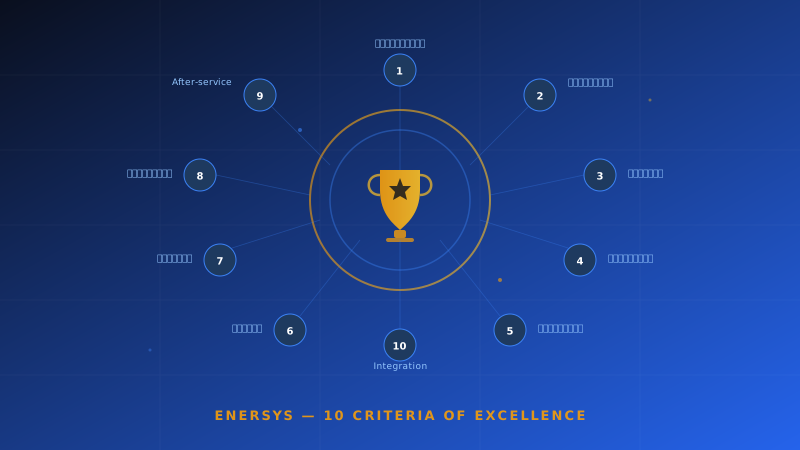
Read more about what makes a strong software company stand out: What Makes a Great Software Company? 10 Criteria You Need to Know
FAQ — Frequently Asked Questions About Software Houses
Is a Software House different from a Software Company?
In practice, they mean the same thing — both refer to a company that provides software development services. “Software House” is more common in Europe and Asia, while “Software Company” is more widely used in the US. In Thailand, both terms are used interchangeably, along with “software company” and “software development company.”
How much does it cost to hire a Software House?
It depends on complexity — from a few hundred thousand baht to tens of millions. As a rough guide:
| Project Type |
Estimated Price |
Timeline |
| Corporate website + CMS |
THB 100,000–500,000 |
1–3 months |
| Mobile App (iOS + Android) |
THB 500,000–3,000,000 |
3–6 months |
| Mid-size Web Application |
THB 1,000,000–5,000,000 |
4–8 months |
| ERP for SMEs |
THB 500,000–3,000,000 |
3–9 months |
| Large Enterprise System |
THB 5,000,000–30,000,000+ |
6–18 months |
Note: These are only broad estimates for the Thai market. Actual pricing depends on scope, complexity, and project-specific requirements.
How long does software development usually take?
Typically 3–12 months, depending on size and complexity. But a good Software House will use Agile methods to deliver an MVP (Minimum Viable Product) within the first 2–3 months, so the client can start using it and giving feedback early, instead of waiting 12 months just to see the first version.
What should we prepare before hiring a Software House?
At a minimum, you should prepare:
- The problem you want to solve — explain it in business terms, not technical terms
- An approximate budget — even if it’s not final, it helps the Software House propose a realistic solution
- Your desired timeline — when do you need the system?
- Decision-makers — who approves the project and who will be the key contact?
- Current system information — what systems are you using now, and what needs to be integrated?
Thai Software House vs overseas vendor — which is better?
Advantages of a Thai Software House:
- Easier communication — both language and cultural context
- Better understanding of Thai business realities — laws, taxes, PDPA, Thai accounting systems
- Same time zone — no waiting overnight for responses
- Tax benefits — 200% deduction if you choose a depa-registered provider
- Easier post-go-live support — face-to-face meetings are possible
Advantages of an overseas Software House:
- Larger talent pool — especially for niche technologies
- Potentially lower prices if hiring from lower-cost countries
For most Thai SMEs: A Thai Software House is usually the better choice, because communication, local context, and tax benefits often outweigh any price advantage from overseas vendors.
If we hire a Software House, do we still need an internal IT team?
It’s recommended to have at least one person internally acting as an IT Coordinator or Product Owner, responsible for:
- Bridging communication between the business team and the Software House
- Testing the system before go-live (UAT)
- Managing data migration
- Serving as the main contact point when issues arise
But you do not need a full internal development team if you are working with a strong Software House — that is exactly what you are hiring them for.
Conclusion — How to Choose the Right Software Company Without Costly Mistakes
Choosing a Software House or software company is not just about price — it’s about choosing a business partner that may work with you for 1–5 years or more.
Use the 8 criteria in this article as your checklist:
- Real portfolio, not just logos
- The actual team assigned to your project
- A clear development process
- Modern technology capability
- Transparent communication
- Fair contract terms
- A post-go-live support plan
- Reasonable pricing
Combine that with the 5 vendor questions above, and you can eliminate more than 80% of the companies that are not the right fit for you.
And don’t forget to check the 200% tax deduction from depa — it could save you anywhere from hundreds of thousands to millions of baht.
Investing in the right software is investing in your organization’s future. Choose well, and the return can be many times over.