If you think hackers do not care about small businesses — think again
Picture this: you have been running your company for 8 years. You have 40 employees, annual revenue in the tens of millions of baht, and everything is going well. Then one morning, every system locks up. A message appears on screen demanding 500,000 baht within 72 hours, or all customer and financial data will be leaked publicly.
This is not a hypothetical scenario. And what is even more alarming is this — a business your size is the number one target for hackers in 2026.
Many people still believe hackers only go after large corporations, banks, or national organizations. But the data shows the opposite. SMEs have become the “ideal victim” for cybercriminals because they are easier to access, less protected, and still hold enough valuable assets and data to make attacks profitable.
The numbers do not lie — SMEs are the main target, not collateral damage
Data from 2025–2026 across multiple research sources points in the same direction, and the figures are more alarming than most people expect.
The attack landscape has changed for good
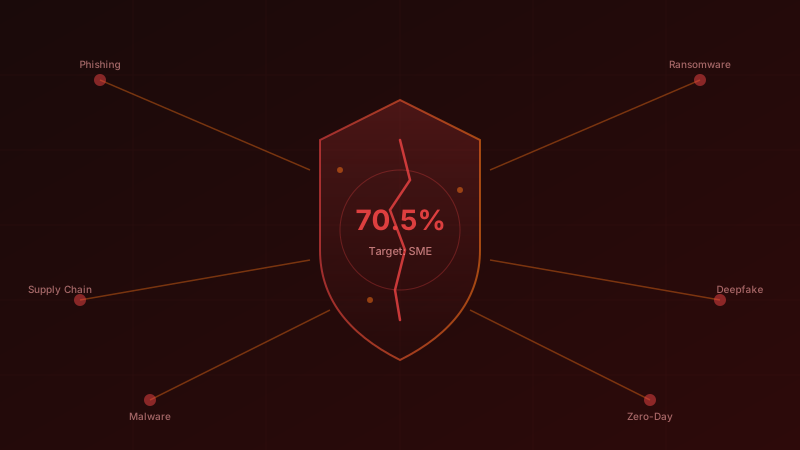
70.5% of all data breaches in 2025 targeted SMEs — not large enterprises, not governments, but the small and mid-sized businesses operating every day just like yours.
This figure comes from analysis of real-world global attack data, and it tells us something very clearly: hackers are not accidentally hitting SMEs. They are deliberately choosing SMEs as their primary target.
Even more striking are the ransomware numbers. Ransomware attacks — where malware locks systems and encrypts data — show that 88% of ransomware incidents worldwide hit small businesses, not giant organizations.
The UK situation — an early warning sign for Thailand
Data from the United Kingdom, which often reflects trends that spread into Southeast Asia within 1–2 years, shows that:
- 67% of SMEs in the UK experienced cyberattacks in 2025 — up from 50% in 2024
- That is a 34% increase in just one year
- The average cost per SME incident reached £6,400, or about 285,000 baht — up 52% from the previous year
To put it plainly — if this trend reaches Thailand, which is a matter of “when,” not “if,” unprepared Thai SMEs will face a level of risk they have never seen before.
Why hackers prefer SMEs over large companies
This question matters, because if you understand the motivation, you will understand how to defend yourself.
SMEs are the cybercriminal “sweet spot”
Large enterprises have full-time IT security teams, multi-million-baht security budgets, and complex detection systems. Attacking them is difficult, time-consuming, and more likely to fail.
At the other extreme, individuals or very small businesses are often not worth the effort because they do not hold enough assets to justify the attack.
But SMEs sit right in the middle — they have customer data, financial records, intellectual property, and meaningful revenue, yet their defenses are often far weaker than those of large companies.
The numbers show SMEs are underprotected
These figures help explain why hackers choose SMEs:
- 51% of SMEs have no cybersecurity systems or protective measures at all — more than half do not even have basic security in place
- Only 17% use Multi-Factor Authentication (MFA) — one of the most effective ways to prevent account compromise
- Only 17% have cyber insurance — meaning if they are attacked, the full financial impact falls directly on the business
Think of it this way: your house is full of valuables, but the doors are unlocked. Next door, a much bigger house has CCTV, alarms, and security guards. Which house will a thief choose? The answer is obvious.
The vulnerabilities hackers use most often against SMEs
Phishing is the number one attack method — involved in 83% of all incidents
Phishing means fake emails or messages designed to trick employees into clicking links or entering credentials. This works especially well against SMEs because employees are often not trained to spot fraudulent messages, and the organization may not have strong enough email filtering in place.
Even more concerning is the rise of supply chain attacks, which doubled in one year — from 9% to 18%
A supply chain attack means hackers do not attack your business directly. Instead, they target a software provider or service vendor you already use, then use that trusted channel to reach you. That is why even companies that manage their own systems reasonably well can still be compromised.
The real impact — not just numbers on paper
Financial loss figures do not tell the whole story. The damage SMEs suffer from cyberattacks comes in several forms, and all of them matter.
The costs you can measure in money
An average loss of 285,000 baht per incident for a mid-sized SME may sound manageable, but that is only the average. Many cases are far more severe. The actual costs can include:
- Hiring specialists to investigate, recover, and restore systems
- Lost revenue while operations are disrupted
- Penalties under personal data protection laws such as Thailand’s PDPA
- Customer notification costs and reputation management expenses
- Ransom payments, if the company chooses to pay
Why ransom payments are so worrying
29% of SMEs hit by ransomware chose to pay in 2025 — up from 18% the year before
That means more businesses are reaching the point where they feel they have no other option. They pay in hopes of getting their data back. But even after payment, there is no guarantee the data will be restored, or that the attackers will not return again later.
The damage you cannot easily quantify
To be direct — sometimes reputational damage is worse than the financial loss itself. When customers find out that their personal data was leaked by a company they trusted, they do not just cancel contracts — they tell others. In the age of social media, one bad incident can destroy what took 8 years to build almost overnight.
The most alarming statistic of all
75% of SMEs cannot continue operating after a ransomware attack
Three out of four small and mid-sized businesses will either shut down or suffer long-term disruption after a serious ransomware incident. This is not a scare tactic. It is a real statistic based on actual cases that have already happened.
Practical protection steps SMEs can start now
The good news is that once the problem is clear, the path forward becomes clearer too. Cybersecurity for SMEs does not require a massive budget or a large IT team — but it does require the right understanding and consistent action.
Layer 1 — The essentials every SME must have
These are the minimum protections every SME should implement:
- Enable MFA on every important account — email, accounting systems, sales platforms, and anything that accesses critical data should require two-step verification. Remember, only 17% of SMEs do this. Just taking this one step already makes you safer than most of the market.
- Back up data using the 3-2-1 rule — keep 3 copies of your data, on 2 different media types, with 1 copy stored offsite. If ransomware strikes but your backup is intact, the damage can be dramatically reduced.
- Update software regularly — most attacks exploit vulnerabilities that software vendors already know about and have already patched, but companies simply have not updated.
- Set a strong password policy — do not reuse passwords, use a password manager, and reset credentials whenever an employee leaves.
Layer 2 — Real-world employee training
Because 83% of attacks start with phishing, the weakest point is often people, not technology.
Training that actually works is not a once-a-year PowerPoint session. It includes:
- Simulated phishing tests — send mock phishing emails to see who clicks, then provide focused training where it is needed
- A reporting culture — employees need to feel safe reporting that they may have made a mistake, instead of hiding it. Fast reporting can significantly reduce damage.
- Clear emergency procedures — employees should know what to do first, who to contact, and what not to do if they suspect an attack
Layer 3 — Manage supply chain risk
With supply chain attacks doubling, looking only at your internal systems is no longer enough.
- Assess vendors and service providers — ask what security measures they have and request evidence
- Limit access rights — not everyone needs access to everything. Follow the principle of least privilege and grant only what is necessary.
- Prepare for vendor compromise — if a software provider you rely on is hacked, how will you know, and what will you do?
Layer 4 — Plan for response and recovery
The difference between SMEs that survive and those that do not often comes down to one thing: whether there is a response plan in place.
- Incident Response Plan — a document that clearly states who does what during an incident, who decides whether to pay a ransom, who contacts customers, and who notifies regulators
- Business Continuity Plan — if your core systems go down completely, how will the business continue operating? Are there fallback channels?
- Regular plan testing — an untested plan is not a plan you can trust on the day you actually need it
The role of ERP and digital infrastructure in SMEs
Thai SMEs that are currently digitizing their businesses face a layered challenge. Digital transformation increases the value of data, but if it happens without a strong security foundation, it also increases the value of what can be stolen.
Imagine this: before, company data was scattered across paper files and Excel sheets in each department. Now, everything is centralized in one ERP system — customer records, financial data, inventory, employee data, all in one place. If that system is breached, the damage affects the entire organization, not just one department.
This is not a reason to avoid digital transformation. It is a reason to do it properly. Security must be built into the system from the beginning, not treated as something to think about later after problems appear.
Warning signs Thai SMEs should watch for
There are several signs that indicate an organization is at high risk:
System and technology risks:
- Using software or operating systems that are no longer supported
- No automatic data backup, or backups have never been tested to confirm they can actually be restored
- Reusing the same password across multiple accounts, or using weak passwords
- No system in place to detect unusual access activity
People and process risks:
- Employees do not know how to identify phishing emails
- There is no clear procedure for what to do when an attack is suspected
- Former employees still retain access after leaving the company
- There is no review of who has access to what data
Risk management gaps:
- No formal cybersecurity risk assessment has ever been conducted
- No dedicated budget exists for cybersecurity
- Leadership sees security as only an IT issue, not a business issue
The executive view — why this belongs at board level
To be direct with SME executives: cybersecurity is not something that should be left solely to the IT team, because the impact of an attack affects every part of the business.
Ask yourself:
- If the business had to stop operating for 2 weeks, could you cover fixed costs?
- If all customer data were leaked, how would you take responsibility?
- If you had to pay PDPA penalties after a data breach, is the budget ready?
- If a competitor attacked through hired hackers — which does happen in real markets — would you have a way to detect it?
These are business-level questions, not IT-level questions.
What to do in the next 90 days
For SMEs that have read this far and want to take action, here is a realistic 3-month framework:
Month 1 — Assess and close urgent gaps
- Create an inventory of all systems and software currently in use
- Enable MFA on all critical accounts
- Verify that backups are working and can actually be restored
- Remove access rights for employees who have already left
Month 2 — Build awareness and process
- Run phishing awareness training for all employees
- Write an incident response procedure, even if it is short
- Define a password policy and enforce it
- Review the security posture of key vendors
Month 3 — Build for the long term
- Consider investing in security monitoring systems
- Evaluate whether cyber insurance is appropriate
- Create a basic business continuity plan
- Set an annual schedule for security reviews
Conclusion — act before it is too late
The numbers do not lie — 70.5% of data breaches hit SMEs, 75% do not survive ransomware, and 51% have no protection at all. These figures are not meant to create fear. They are meant to help businesses make decisions based on reality.
The SMEs that survive in 2026 will not only be the ones with strong sales or good marketing. They will be the ones that understand protecting data and digital systems is part of running the business, not an optional extra cost.
So the real question is this — will you wait until an incident happens before taking it seriously, or will you be part of the 49% that has protective systems in place and knows the business is safer?
If you want to start planning your business protection more systematically, or want to understand how to digitize your business without compromising security, talk to the Enersys team — we have helped Thai SMEs build strong and secure digital foundations for years.
References
- Amvia Research — UK SME Cybersecurity Statistics 2026: https://www.amvia.co.uk/research/uk-sme-cybersecurity-2026
- StrongDM — Small Business Cyber Security Statistics: https://www.strongdm.com/blog/small-business-cyber-security-statistics
- BlackFog — Enterprise Cybersecurity 2026: Strategies & Trends: https://www.blackfog.com/enterprise-cybersecurity-2026-strategies-trends/
- ITS — 2026 Cybersecurity Threats Overview: https://www.itsnyc.com/2025/12/31/2026-cybersecurity-threats/
- Industrial Cyber — M-Trends 2026: Threat Landscape Report: https://industrialcyber.co/reports/m-trends-2026-reveals-threat-landscape-shaped-by-faster-coordinated-and-industrialized-cyberattacks/