Introduction — Electricity That’s Smarter Than Its Operators
Imagine a power system that doesn’t have to wait for a technician to call in a problem, and doesn’t have to wait for a blackout before people start complaining — but instead knows in advance which transformer is about to fail, then reroutes electricity in milliseconds before anyone even realizes there was almost an outage.
This isn’t a vision for 20 years from now — it’s happening right now.
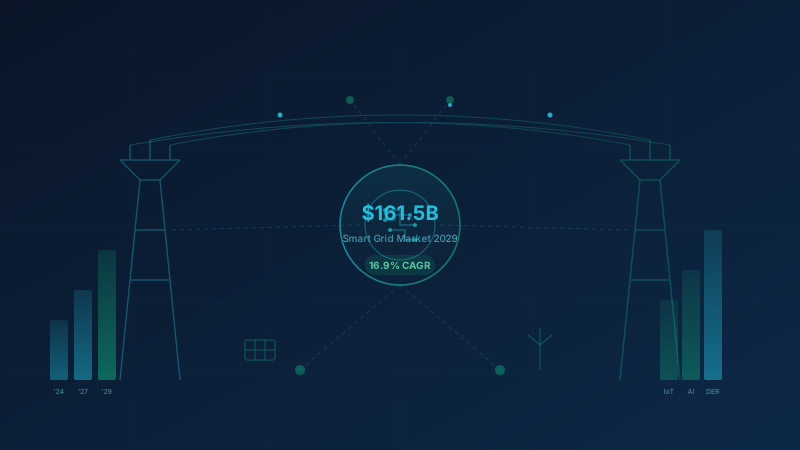
A MarketsandMarkets report published in March 2026 makes it clear that the global Smart Grid market is accelerating from $73.8 billion (2024) to $161.5 billion (2029) at a 16.9% CAGR — faster than many mainstream software markets.
But the number itself isn’t the real story. The real story is that AI is changing the DNA of power systems worldwide — from “dumb networks that send electricity from point A to point B” into “intelligent systems that manage energy in real time across the entire grid.”
And for Thailand? We are at the biggest turning point in the energy industry in the last 50 years.
Why Is Smart Grid Growing So Fast?
To understand why the $161.5 billion figure is more than just “a growing market” — and is really an infrastructure revolution — we need to look at the 3 forces pushing traditional power systems to their limits:
1. Renewable Energy Is Throwing Old Grids Into Chaos
Traditional power systems were built for one-way flow: generate electricity at large power plants, send it through transmission lines, distribute it to homes and businesses — done.
But that’s not how the world works in 2026.
The Distributed Energy Generation market was worth $360 billion in 2023 and is projected to reach $1.4 trillion by 2033 (14.6% CAGR), with Solar PV growing fastest at 17.6% CAGR.
What does that mean? It means every home, factory, and commercial building is increasingly becoming both an electricity “consumer” and a “producer” at the same time. Power no longer flows in one direction — it moves back and forth like traffic at rush hour.
Legacy grids were never designed to handle this. That is exactly why Smart Grid is no longer optional.
2. Electricity Demand Is Surging Because of AI and Data Centers
According to the IEA (International Energy Agency), data centers consumed around 1.5% of global electricity (415 TWh) in 2024, and that figure is expected to more than double to 945 TWh by 2030.
AI is a major driver — electricity demand from AI-optimized data centers is expected to increase more than fourfold by 2030.
Think about it: we are using AI to manage energy, while AI itself consumes massive amounts of energy. It’s a paradox — and Smart Grid is what helps solve it.
3. Aging Transmission Infrastructure Is Breaking Down
The IEA also notes that building new transmission lines in developed countries now takes 4–8 years, while wait times for critical equipment such as transformers and cables have doubled over the past 3 years.
If this problem isn’t addressed, the IEA estimates that 20% of planned data center projects may be delayed because the grid simply can’t support them.
There’s no real alternative — Smart Grid is the only viable path forward.
What Does AI Actually Do for Smart Grids? The Things Humans Can’t
In simple terms, AI gives the power system a “brain.” But in practical terms, it enables 4 game-changing capabilities:
1. Predicting Future Electricity Demand
Traditional power systems operate on forecasts and approximations — they look at historical data and estimate tomorrow’s demand. If the estimate is wrong, utilities either fire up expensive backup generation or waste surplus power.
AI changes that completely.
By analyzing data from millions of sensors, weather conditions, usage behavior, and even city event schedules, AI can forecast demand with a level of accuracy humans simply can’t match.
The result? Lower overgeneration, lower fuel costs, and lower CO2 emissions — all at the same time.
2. The “Self-Healing Grid”
This is where things get truly remarkable.
When a power system problem occurs — whether it’s a transformer explosion, a tree falling on a line, or a storm damaging transmission infrastructure — AI can detect the anomaly, analyze the cause, and reroute electricity automatically within milliseconds, without waiting for human intervention.
Research published in Spectrum of Engineering Sciences shows that AI-optimized self-healing networks combine multiple techniques, from automatic fault classification and anomaly detection for previously unseen issues to real-time grid topology reconfiguration.
The outcome is clear: fewer outages, faster recovery, and significantly lower damage.
3. Predictive Maintenance — Knowing Before It Breaks
Instead of waiting for equipment to fail (reactive maintenance) or servicing it on a fixed schedule (preventive maintenance), AI enables predictive maintenance — analyzing real-time sensor data to identify which assets are starting to degrade.
According to figures from the U.S. Argonne National Laboratory, using AI for predictive maintenance can reduce total maintenance costs by 43–56% and cut unnecessary field technician dispatches by 60–66%.
At the scale of a large utility, that means saving billions of baht per year.
4. Smarter Renewable Energy Integration
The biggest challenge with solar and wind is intermittency — sunshine comes and goes, wind rises and falls. Traditional grids struggle to handle that variability.
AI addresses this by analyzing satellite imagery, LiDAR data, and weather models to predict renewable power generation with up to 95% accuracy, then optimizing when batteries should charge or discharge.
The result is lower energy curtailment — where clean energy is wasted because the grid can’t absorb it — and a higher share of renewables on the grid without requiring immediate new transmission buildout.
Market Overview — Who’s Growing, and Where the Heat Is
Asia-Pacific: The Growth Champion
According to MarketsandMarkets, Asia-Pacific is the fastest-growing Smart Grid region, driven mainly by India and China, fueled by rapid industrial expansion and environmental regulations.
But for ASEAN, the more interesting story is that Thailand is now entering this race in a serious way.
North America: The Largest Market
North America remains the largest market, supported by:
- Widespread renewable energy adoption
- Expanding electric vehicle (EV) infrastructure
- Growing pressure to respond to outages caused by increasingly severe storms and natural disasters
Fastest-Growing Segment: Transmission
Among all segments — Generation, Transmission, Distribution, and Consumption — Transmission is growing the fastest because it is the backbone of the entire system. If transmission isn’t smart, the rest of the grid can’t be smart either.
Thailand: A $1.8 Billion Opportunity and a Golden Age of Grid Modernization
Now for the part that should matter most to Thai businesses: Thailand is not just “following the Smart Grid trend” — it is moving to lead within ASEAN.
A Historic $1.8 Billion Deal
In 2025, Thailand signed a $1.8 billion agreement (around THB 63 billion) for the largest Smart Grid and AI-powered energy transformation project the country has ever seen — a 15-year program aimed at overhauling electricity distribution, improving grid resilience, and boosting efficiency with AI at a scale the region has never seen before.
Tangible revenue impact is expected to begin appearing in 2026–2027, as AI-driven infrastructure starts operating at scale.
EGAT and Grid Modernization
The Electricity Generating Authority of Thailand (EGAT) is actively pushing grid modernization through multiple initiatives:
- Renewable Energy Forecast Center (REFC) — an AI-powered renewable forecasting center
- Demand Response Control Center (DRCC) — a demand response management center
- Drones and robots for transmission line inspection
- Smart sensors and IoT for real-time monitoring
- 1,531 MW of pumped-storage reserve capacity to handle variability
Together, these efforts are central to the National AI Action Plan, which aims to position Thailand as a regional AI hub by 2027.
PEA and the Push for Microgrids and Solar Integration
The Provincial Electricity Authority (PEA) has a Microgrid Development Plan that will:
- Replace peaking power plants with renewable energy + battery storage
- Reduce distribution losses
- Support nationwide Solar PV growth
Real-world examples already in operation include:
- Mae Sariang Microgrid — 8 MW (Solar PV 4 MW + Hydropower 1.2 MW + Diesel 5 MW + Battery 3 MW)
- Betong Microgrid — 10 MW (Solar PV 3 MW + Diesel 5 MW + Battery 4 MW)
Thailand’s Energy Landscape: The Numbers Pointing to the Future
Data from Krungsri Research paints a very clear picture of where renewable energy in Thailand is heading:
| Indicator |
Figure |
| Cumulative solar capacity (Jul 2025) |
6,510 MW (up 92.5% from end-2024) |
| Total renewable capacity |
13,016 MW (49.1% of the 2037 target) |
| Renewable share in the grid |
10% (double the 2015 level) |
| Renewable energy target (PDP 2024) |
51% by 2037 |
| Solar generation cost |
THB 2.17/kWh (lowest among RE sources) |
| Solar panel price (2024) |
THB 0.26/watt (down 42% from 2019) |
| Battery cost |
$100/unit (down 36% from 2019) |
| Data center investment in Thailand |
THB 200+ billion |
What do these numbers tell us?
Thailand is reaching the point where Solar PV + Battery Storage is cost-competitive enough to seriously challenge fossil-based power. And with a target of 51% renewable energy by 2037, Smart Grid is no longer a “nice to have” — it is a must-have for absorbing the wave of clean energy entering the system.
What This Means for Thai Businesses — Opportunities and Challenges
The Opportunities
1. Lower and more stable electricity costs
Smart Grid plus AI optimization means better balancing of demand and supply, lower system losses, and reduced dependence on imported fuels — all of which can help make electricity prices more stable, especially for industrial users.
2. Direct PPA — buying clean power directly from producers
The government has recently launched a pilot Direct Power Purchase Agreement (Direct PPA) program covering 2,000 MW for 10–25 year contracts, alongside the Utility Green Tariff (UGT).
This is a major opportunity for manufacturers that need to report carbon footprints under the EU CBAM and for companies pursuing Net Zero targets — because they can now directly procure certified clean electricity.
3. EV infrastructure
With Thailand targeting 30% of vehicles produced domestically to be zero-emission by 2030, Smart Grid is essential for managing the rapidly expanding charging infrastructure.
4. The data center boom
Thailand’s THB 200+ billion in data center investment will require power availability at the 99.99% reliability level — which is extremely difficult to achieve without Smart Grid capabilities.
The Challenges
1. The Power Development Plan (PDP) is still delayed
The latest PDP remains under review (as of December 2025), creating uncertainty for investors.
2. Legacy grid infrastructure still needs major upgrades
Even with the $1.8 billion investment, modernizing an entire national power system requires much more time and capital.
3. Talent shortages
Smart Grid requires people who understand power systems + AI + IoT + cybersecurity together — a combination that is still rare in Thailand’s labor market.
The Global Players Shaping the Market
MarketsandMarkets identifies several major players setting the direction of Smart Grid technology:
- General Electric (U.S.) — leader in grid analytics
- ABB (Switzerland) — specialist in power automation
- Siemens (Germany) — digital grid solutions
- Schneider Electric (France) — energy management
- Cisco (U.S.) — networking infrastructure for IoT grids
- Oracle (U.S.) — utility data analytics
- Itron (U.S.) — smart metering
- Mitsubishi Electric (Japan) — power electronics
What’s especially worth watching is that many of these companies are expanding their investment across Southeast Asia, including Thailand.
Enersys Perspective: Why Data Is the Heart of Smart Grid
From our experience working with large organizations on Digital Transformation and AI Integration, one thing is very clear:
Smart Grid is not a hardware project — it is a data project.
No matter how advanced your sensors, smart meters, or IoT devices are, if you don’t have strong data management, reliable data pipelines, and AI models trained on real operational data, then all of that technology becomes little more than expensive equipment that never delivers full value.
The most common mistakes we see organizations make:
- They invest in hardware first and think about data later — resulting in sites full of sensors, but no actual data-driven decision-making
- Data silos — each department stores data separately, making it impossible for AI to analyze the full picture
- No governance — poor-quality data leads to poor AI outcomes
- A lack of people who understand both the domain and the technology — organizations need people who understand both electrical systems and AI, not just one side
The right way to think about it:
Start with the problem you want to solve → design the data architecture → choose the AI/ML approach → then scale.
Not the other way around.
The Next 3 Years: What Will Change?
Based on the trends above, here’s what we expect to see by 2029:
1. Grid autonomy levels will rise dramatically
Just as self-driving cars are measured from Level 1 to Level 5, power grids are moving from “humans control everything” toward “AI manages most operations while humans supervise.” We expect most grids in developed countries to reach Level 3–4, where AI can make decisions independently in normal situations and humans step in mainly for exceptions.
2. Virtual Power Plants will become normal
The concept of the Virtual Power Plant (VPP) — using AI to aggregate distributed resources such as solar, batteries, and EVs into a coordinated, plant-like system — will go mainstream, not remain limited to pilot projects.
3. Digital twins of the power grid
AI will create full digital twins of power systems, enabling operators to simulate scenarios with what-if analysis before real-world events occur. For example: if a Category 5 storm is approaching, which nodes are likely to fail, and how should the system prepare?
4. Electricity pricing will align more closely with the “real” cost of energy
Real-time pricing based on actual supply and demand will gradually replace flat-rate pricing — which will benefit businesses that use AI to optimize energy consumption intelligently.
5. Cybersecurity will become a high-stakes issue
The smarter and more connected the grid becomes, the greater the cybersecurity risk. Power systems are critical infrastructure — if they are hacked, the consequences affect the entire country.
Conclusion: Smart Grid Is Not the Future — It’s the Present
The $161.5 billion market is not just another impressive figure in a report — it is a signal that the electrical system we have relied on for the last 100 years is being fundamentally rewritten by AI.
For Thai businesses, the question is no longer “When will Smart Grid arrive?” Instead, the real questions are:
- Are you ready for electricity pricing that changes in real time?
- Can your factory’s ERP and IoT systems connect to Smart Grid infrastructure?
- Do you have the data infrastructure needed to support AI-driven energy management?
- Does your team actually have the capability to analyze energy data and reduce costs?
If the answer is “not yet,” then now is the best time to start.
Ready to Prepare Your Organization for the Smart Grid Era?
At Enersys, we help Thai organizations build Digital Transformation roadmaps that connect AI, Data Infrastructure, and Business Strategy — not just by selling technology, but by helping you think all the way from “the real problem that needs solving” to “measurable business outcomes.”
Talk to the Enersys team — we’re ready to help you prepare for the era of intelligent energy.
References
MarketsandMarkets — Smart Grid Market to Reach $161.5 Billion by 2029: https://www.globenewswire.com/news-release/2026/03/10/3253021/0/en/Smart-Grid-Market-to-Reach-161-5-Billion-at-a-16-9-CAGR-by-2029-MarketsandMarkets.html
AltEnergyMag — Distributed Energy Generation Market Trends Accelerate with Solar PV and Smart Grid Growth: https://www.altenergymag.com/news/2026/03/12/distributed-energy-generation-market-trends-accelerate-with-solar-pv-and-smart-grid-growth/46897/
Gorilla Technology / Enlit World — Thailand Set for $1.8 Billion Smart Grid and AI Energy Transformation: https://investors.gorilla-technology.com/gorilla-technology-secures-landmark-1-8-billion-agreement-to-drive-thailands-largest-smart-grid-and-ai-powered-energy-transformation/
IEA — Energy and AI Report 2025: https://www.iea.org/reports/energy-and-ai
Krungsri Research — Industry Outlook 2026-2028: Renewable Energy: https://www.krungsri.com/en/research/industry/industry-outlook/energy-utilities/renewable-energy/io/renewable-energy-2026-2028
EGAT — EGAT and INNOPOWER Join Forces for Grid Modernization: https://www.egat.co.th/home/en/20230829e/
Spectrum of Engineering Sciences — Grid Modernization: From Traditional to AI-Optimized Self-Healing Networks: https://thesesjournal.com/index.php/1/article/view/2059
Microgrid Knowledge — Thailand's Microgrid Plans Take Shape: https://www.microgridknowledge.com/google-news-feed/article/11427687/thailand8217s-microgrid-plans-take-shape