Introduction — DevOps Is No Longer What It Used to Be
If you still think DevOps means “build a pipeline and you’re done,” the bad news is: the world has moved on.
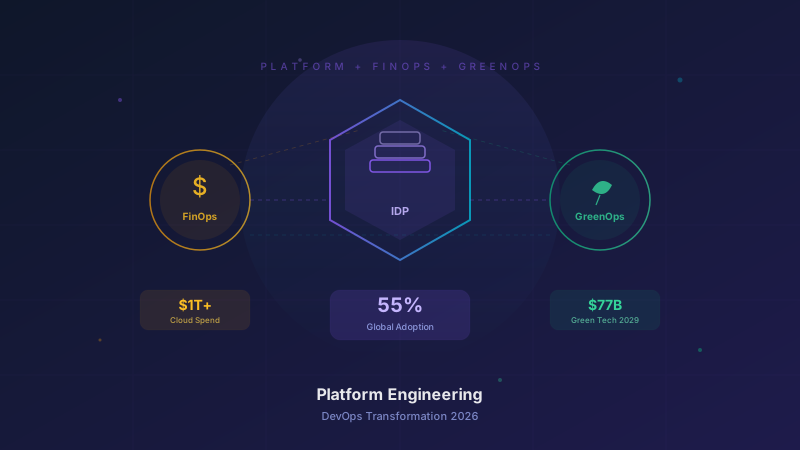
Google Cloud surveyed more than 900 organizations worldwide and uncovered a striking figure: 55% of them have already adopted Platform Engineering. Not as an experiment, but as a real operating model. Even more importantly, 90% of those already using it are expanding it to other teams across the organization.
But Platform Engineering is not arriving alone. It comes with FinOps—a structured approach to managing cloud costs—and GreenOps—a way to make cloud operations more energy-efficient and lower in carbon. Together, these three forces are turning DevOps into something far broader and more strategic than it used to be.
In this article, we’ll break down all three trends in depth, look at the real numbers behind them, explore what they mean for Thai businesses, and explain why even SMEs should not ignore them.
What Is Platform Engineering? — And Why It’s More Than “DevOps Evolved”
Imagine a software developer trying to deploy a new application. In the old world, they had to:
- Request a server from the infrastructure team
- Set up the database themselves
- Build a pipeline from scratch
- Configure monitoring on their own
- Solve security issues they were never trained for
The result? Weeks of delay before they can even start focusing on real business logic.
Platform Engineering solves this by creating an Internal Developer Platform (IDP). Think of it as a ready-built highway: the platform team lays the road, so developers can move from idea to production much faster—without having to pave that road themselves.
But it’s not just about speed
What makes Platform Engineering different from simply “doing DevOps better” is that it changes how the entire organization thinks:
- From “every team builds its own way” → to “a central team provides tools everyone can share”
- From “chaotic freedom” → to “freedom built on strong foundations”
- From “ticket-based requests” → to “well-designed self-service”
That is why Gartner predicts that by 2026, 80% of large software organizations will have established platform teams as internal service providers—up from just 45% in 2022.
The Numbers You Can’t Ignore — Why 55% Is a Turning Point
That 55% figure from Google Cloud is more than just a statistic—it’s a clear signal that the market has passed the tipping point.
Here are some of the key numbers from the report:
Adoption:
- 55% of organizations worldwide have already adopted Platform Engineering
- 90% of current users are expanding it to other teams, meaning once teams adopt it, they rarely go back
- 85% say their developers now “depend on the platform to get work done”
Business impact:
- 71% of platform engineering leaders report a significant improvement in time-to-market—compared with only 28% among beginners
- 86% believe platform engineering is essential to unlocking business value from AI
- 92% of CIOs plan to integrate AI into their platforms
Developer experience:
- Teams with high platform maturity report a 40–50% reduction in cognitive load
- Developer productivity increases by 40–50% in teams that adapt successfully
These numbers tell us one thing clearly: Platform Engineering is no longer a “nice to have.” It is becoming a core capability for organizations that want to stay competitive.
Internal Developer Platform (IDP) — The Heart of Platform Engineering
If Platform Engineering is the concept, then the IDP is the actual engine that makes it work.
An IDP brings tools and services together into one unified system so developers can:
- Create new environments in minutes instead of days
- See system health from one place instead of checking 10 dashboards
- Deploy automatically according to company standards without being infrastructure experts
- Manage security and compliance as built-in features, not afterthoughts
Why does Gartner believe IDPs will dominate?
According to Gartner, by 2028, 85% of organizations with platform engineering teams will have an Internal Developer Portal, up from 60% in 2025.
Why is this growing so fast? Because organizations are starting to understand that not having an IDP comes at a real cost:
- Developers waste 30–40% of their time on work unrelated to business logic
- Each team builds its own “wheel,” creating duplication and inconsistency
- Critical knowledge lives in people’s heads instead of in systems
- Onboarding new developers takes far too long
96% of surveyed organizations use open-source tools as part of their platform, and 84% work with external partners to operate it. In other words, no one has to build everything alone—not even large enterprises.
FinOps — When “Spend Whatever You Want on Cloud” Is No Longer Acceptable
Global cloud spending is expected to exceed $1 trillion in 2026. At that scale, even Fortune 500 companies are being forced to ask a basic question: is every dollar delivering real value?
FinOps, or Financial Operations, is the practice of applying financial discipline to cloud usage in a structured way. It is not just about cutting costs—it is about maximizing the value of every dollar spent.
State of FinOps 2026 — The Numbers Are Eye-Opening
From the State of FinOps 2026 report by the FinOps Foundation:
- 78% of FinOps teams now report directly to the CTO or CIO—up 18% from 2023. FinOps is no longer a finance-only concern; it is now a technology leadership issue
- 98% of organizations are managing AI costs in some form—up from just 31% in 2024 and 63% in 2025
- 90% manage SaaS costs alongside cloud costs
- 60% use a centralized enablement model, with a core team providing knowledge and tools
Why does FinOps matter for Thai companies?
Many Thai businesses moved to the cloud over the last 2–3 years, and they often run into the same issues:
- Bill shock — the first month seems manageable, but by month three the bill is 3x higher
- Zombie resources — servers left running that no one uses
- Over-provisioning — buying far too much capacity “just in case” traffic spikes, even when it never does
- No clear ownership — developers create resources, finance sees the bill, operations has no visibility
FinOps addresses these problems by building a culture where everyone shares responsibility for cost, rather than leaving it all to the finance team.
GreenOps — The Third Pillar Changing the Game
If DevOps is about “how to move faster,” and FinOps is about “how to spend wisely,” then GreenOps is about “how to operate sustainably.”
GreenOps is the practice of reducing the carbon footprint of cloud workloads by choosing cleaner energy regions, optimizing code to use less CPU, scheduling workloads when clean energy is more available, and removing “dark data” that is stored but never used.
Why GreenOps Is No Longer Just “Nice to Do”
- 70% of executives focused on sustainability are expected to look to public cloud as a key tool by 2026
- 73% of large organizations say ESG reporting requirements are a major driver behind adopting green coding practices
- The Green Technology market is expected to grow from $30 billion in 2025 to $77 billion by 2029
- 41 Fortune 100 companies are already actively tracking AI energy consumption
For Thailand, GreenOps matters more than most realize
Thailand is becoming a data center hub for ASEAN, with more than $16 billion in investment announced over the past six months. But that growth comes with challenges:
- The country’s hot and humid climate means cooling can account for 30–40% of total energy use
- ESG pressure is rising from both foreign investors and sustainability requirements
- Large enterprise customers are beginning to require vendors to report carbon footprints, including IT operations
GreenOps is no longer just about being environmentally conscious. It is becoming a business requirement that Thai companies need to prepare for.
Where the Three Trends Converge
What’s most interesting is not each trend on its own—it’s what happens when all three come together. That’s where the real multiplier effect appears.
Platform Engineering + FinOps = Cost-Efficient Golden Paths
When an IDP is built with FinOps embedded, every environment a developer creates can:
- Include cost guardrails from day one
- Automatically choose the right instance size
- Alert teams when spending crosses thresholds
- Scale down automatically when workloads are idle
Instead of trying to teach every individual about cloud cost management, the platform handles it by design.
Platform Engineering + GreenOps = Green by Default
A platform can also:
- Default to regions powered by cleaner energy
- Measure carbon footprint automatically for every deployment
- Set resource limits that balance performance with sustainability
- Report ESG metrics to leadership without asking developers to do extra work
FinOps + GreenOps = Two Goals, One Path
This is where Forrester makes an especially important point: FinOps and GreenOps are often two sides of the same practice.
- Reducing unnecessary resources = lower cost + lower carbon
- Optimizing code for efficiency = less compute + less energy
- Eliminating dark data = lower storage cost + lower emissions from storing unused data
When you do FinOps well, you’re often doing GreenOps at the same time—and a strong platform helps make both happen automatically.
The Impact on Thai Software Teams — Not Just a Big Enterprise Story
Many people still assume that “Platform Engineering is for Google, Netflix, or Spotify.” But the numbers suggest otherwise.
Why Thai SMEs should care too
1. Thailand has a serious developer shortage
Skilled developers are already hard to hire. So why let them spend 30–40% of their time on infrastructure work that adds little business value? Platform Engineering helps free developers to focus on business logic, increasing output by 40–50% without necessarily hiring more people.
2. Cloud bills are becoming one of the biggest operating costs
For startups and SMEs moving to the cloud, spending may look small at first. But as they scale, cloud can quickly become 20–30% of total costs. FinOps provides visibility and control before the problem grows too large.
3. International customers are starting to ask about ESG
Thai companies working as outsourcing partners or vendors for international firms are increasingly being asked, “What is the carbon footprint of your IT operations?” If they cannot answer, they may lose business opportunities.
4. You do not need to build everything yourself
As mentioned earlier, 96% of organizations practicing Platform Engineering rely on open-source tools, and 84% work with external partners. You do not need a 20-person platform team to get started—you just need the right partner with the right expertise.
AI and Platform Engineering — A Pair That Can’t Be Separated
Another major dimension is the relationship between AI and Platform Engineering.
According to Google Cloud research:
- 86% of organizations believe platform engineering is necessary to unlock AI’s business value
- 92% of CIOs plan to integrate AI into the developer platform
- 76% of DevOps teams have already integrated AI into their CI/CD pipelines
How AI improves Platform Engineering
- Automated anomaly detection — reducing mean time to resolution (MTTR) by 30–40%
- Cost prediction — AI can forecast cloud costs more accurately than manual estimation
- Self-healing infrastructure — systems can detect and resolve issues without waiting for human intervention
- Smart resource allocation — compute resources can be allocated based on real workload patterns instead of overprovisioning “just in case”
And the reverse is also true: Platform Engineering increases the odds that AI initiatives actually succeed.
Many organizations struggle with AI not because the models are weak, but because their infrastructure is not ready. An IDP gives data science teams production-ready environments from the start, without forcing them to manually set up GPU clusters or configure model serving infrastructure.
GitOps — The Artery That Connects Everything
One of the key practices that makes Platform Engineering, FinOps, and GreenOps work together smoothly is GitOps—the approach of using Git as the single source of truth for everything.
Key figures from 2025–2026:
- 93% of organizations plan to maintain or expand their GitOps usage
- Two-thirds of organizations had adopted GitOps by mid-2025
- 80% of users report improved reliability and faster rollback
- Deployment errors drop by 70–80% in multi-cluster environments
When every change—whether it affects infrastructure, applications, cost policy, or carbon budgets—flows through Git, organizations gain a complete audit trail and make everything reproducible.
A Roadmap for Thai Organizations — Where to Start
If you’ve made it this far and are thinking, “This sounds important, but where do we begin?” here is the roadmap we recommend:
Phase 1: Foundation (Months 1–3)
- Assess your current state — how much time do developers spend on infrastructure versus business logic?
- Start with FinOps first — this often delivers the fastest ROI. Simply tracking cloud spending by team or project can already create impact
- Set measurable KPIs — deployment frequency, lead time for changes, MTTR, and cloud cost per transaction
Phase 2: Platform Building (Months 3–6)
- Start with the first golden path — do not try to build the whole platform at once. Begin with the most painful use case
- Measure developer satisfaction — if developers do not want to use the platform, it has failed no matter how advanced it is
- Embed cost guardrails — every golden path should include FinOps by design
Phase 3: Scale & Sustain (Months 6–12)
- Expand to other teams — 90% of successful adopters do this
- Add GreenOps metrics — start measuring the carbon footprint of workloads
- Bring in AI support — anomaly detection, cost prediction, and auto-scaling
- Create a feedback loop — measure, improve, and measure again
What Will Happen Over the Next Two Years
Based on the data and the direction of the market, here is what we expect to happen next:
1. Platform Engineering will become the default, not the option
Just like DevOps once felt optional but eventually became standard, Platform Engineering is heading down the same path. By 2028, organizations without a platform team will be the exception.
2. FinOps will become part of the CFO dashboard
With global cloud spending surpassing $1 trillion, cloud economics will move from the server room into the boardroom.
3. GreenOps will be driven by regulation
The EU has already begun enforcing ESG reporting, and Thailand’s own sustainability frameworks are also tightening. Companies that prepare early will have an advantage.
4. AI will become the real platform manager
Today, AI helps DevOps teams. In the near future, AI will increasingly run the platform itself, making decisions about scaling, cost, and sustainability with minimal human intervention.
Conclusion — The Time to Start Is Now
Platform Engineering, FinOps, and GreenOps are not three isolated trends. They are three facets of the same shift redefining DevOps in the AI era.
The 55% adoption rate identified by Google Cloud tells us something important: the market has already crossed the turning point. The question is no longer “Should we do this?” but “When do we start?”
For Thai organizations—whether startup, SME, or enterprise—the first step does not need to be massive. Just start measuring, build your first golden path, and begin thinking about cost in a structured way. That alone can put you ahead of much of the competition.
And if you need a partner who understands Platform Engineering, FinOps, and GreenOps — talk to the Enersys team. We can help you build a DevOps foundation that’s ready for the future.
References
- New Platform Engineering Research Report — Google Cloud Blog
- Platform Engineering in 2026: The Numbers Behind the Boom — DEV Community
- The State of FinOps 2026: Recap & Key Takeaways — nOps
- State of FinOps 2026 Report — FinOps Foundation
- GreenOps, FinOps, And The Sustainable Cloud — Forrester
- Cloud Computing and the Journey to Net Zero: Why GreenOps Is Key — TechUK
- Gartner Identifies the Top Strategic Technology Trends for 2026
- The Carbon-Efficient Developer: Why GreenOps is the New Standard for 2026 — Medium