Why Odoo Matters — in a Market Dominated by SAP and Oracle
If you ask 100 executives, “What’s the best ERP?” around 80 of them will probably say SAP or Oracle. And that’s fair — both are proven giants with decades of track record.
But there’s a more interesting question: “Which ERP actually makes AI useful in day-to-day operations?”
That question changes everything.
SAP has been selling its AI copilot, Joule, since late 2024, but many customers are still stuck in implementations that take 12–18 months. Oracle has AI in Fusion Cloud too, but licensing starts at $200+ per user per month. For an SME with 50 employees, that means $10,000+ per month just for ERP — before implementation costs.
Odoo takes a completely different approach: starting at around $30/user/month, then letting businesses add modules gradually based on actual needs. No need to buy the full suite on day one. And most importantly, AI in Odoo 18 is not just a “demo feature” — it works in practice, with numbers to prove it.
That’s not to say Odoo beats SAP in every area. But when it comes to AI you can use right away, at a price SMEs can actually afford — Odoo is winning right now.
Document AI — From 37 Hours Down to 4.5
Picture this: your accounting team spends 37 hours per month receiving supplier invoices, checking details, entering invoice numbers, dates, amounts, taxes, and posting everything into the system.
That’s almost a full work week every month lost to data entry that adds zero real value to the business.
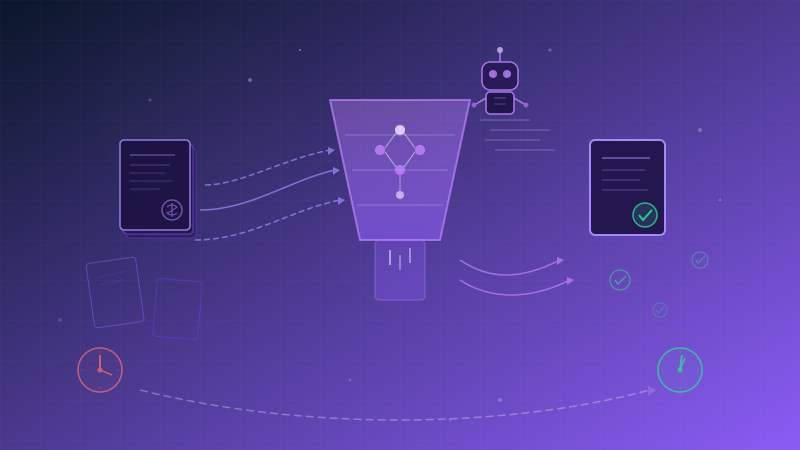
Odoo 18 Document AI changes that with OCR (Optical Character Recognition) that reaches up to 98% accuracy. The system can:
- Scan and read invoices automatically — whether they are PDFs, photos, or scanned files
- Extract key information on its own — vendor name, invoice number, date, amount, tax rate
- Match invoices against purchase orders (POs) already in the system
- Suggest accounting entries and GL codes for review before approval
The result? 37 hours reduced to 4.5 hours — an 88% drop.
At a labor cost of $65/hour (roughly the average rate for accounting staff in the US), that means $2,112.50 saved per month, or more than $25,000 per year — from just one module.
For Thai SMEs, wages may be lower, but the time savings are exactly the same. Instead of drowning in manual entry, the accounting team can spend that time on cost analysis, cash flow planning, and work that actually moves the business forward.
And one important point: 98% accuracy does not mean you can eliminate humans entirely. It means staff move from entering data to reviewing data — which is much faster.
AI Copilot Goes Beyond Invoices — It’s Built Across the System
What makes Odoo AI different from competitors is that AI is not confined to one module. It’s embedded across the entire platform.
CRM — Sell Smarter, Not Harder
In Odoo CRM, AI handles automatic lead scoring. No more guessing which prospects are most likely to convert. The system analyzes interaction history, website behavior, and company data, then ranks leads accordingly.
The sentiment analysis feature helps teams understand the tone of customer emails and messages — whether a prospect is interested, hesitant, or about to switch to a competitor.
And one feature sales teams love is one-click company enrichment. Enter the company name, and the system automatically pulls in industry, company size, location, and other public information. No more manual Googling.
AI can also generate follow-up sequences automatically — drafting emails tailored to each stage of the pipeline. The sales team just reviews and sends.
Accounting — AI Suggests the Right GL Category
Beyond Document AI for invoice handling, the accounting system also includes AI classification for GL (General Ledger) codes. When a new transaction comes in, AI suggests the most appropriate account category by learning from past entries.
Bank reconciliation is also AI-assisted, automatically matching bank transactions with entries in the system and cutting several more hours from month-end closing.
Supply Chain — Better Demand Forecasting, Less Excess Inventory
The demand forecasting feature analyzes historical sales data, seasonality, and trends to predict which products will sell well and which items should be reordered.
For businesses with inventory worth $5 million or more, demand forecasting can reduce excess inventory carrying costs by $23,000–$41,000 per year. That matters even more in a high-interest environment where warehousing costs keep rising.
BoM (Bill of Materials) lead-time optimization helps identify which components have long lead times and how far in advance they should be ordered, reducing the risk of production delays caused by late materials.
A Copilot That Lets You Choose the AI Model
Another strength of Odoo Copilot is that it isn’t tied to a single AI vendor. It supports GPT-4, Claude, and Mixtral, so businesses can choose based on the task and budget. That’s very different from SAP, which is more dependent on specific partners, or Oracle, which pushes its own AI ecosystem.