The Short Version
On April 5, 2026, ScienceDaily published a story about a Tufts University research team that is quietly shaking the entire AI industry.
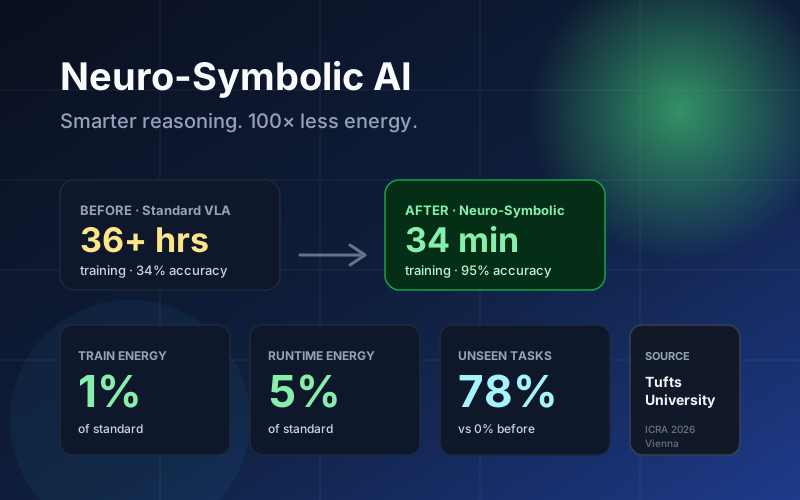
Led by Prof. Matthias Scheutz, the team proposes a new direction called neuro-symbolic AI — a hybrid that combines neural networks with symbolic reasoning (logical thinking). The results:
- Training energy: 1% of standard systems
- Runtime energy: 5% of conventional approaches
- Training time: 34 minutes versus 36+ hours for traditional models
- Tower of Hanoi accuracy: 95% versus 34% for standard systems
- Generalization to unseen problems: 78% versus 0% for conventional models
These are not cherry-picked benchmarks — they come from a peer-reviewed paper that will be presented at ICRA 2026 (International Conference on Robotics and Automation) in Vienna in May.
And for businesses in Thailand and Southeast Asia, this is arguably the most important AI news of the week.
Here is why.
"AI Must Be Expensive" — The Equation That Has Dominated the Market for Three Years
Since ChatGPT launched in late 2022, anyone wanting to use AI in their business has hit the same wall:
- Good models are large
- Large models need expensive GPUs
- Expensive GPUs consume massive power
- Massive power means high electricity bills, more heat, and dependency on overseas clouds
The result: most Thai SMEs have been spectators — because the math simply does not work. API fees run into the tens of thousands of baht per month, before you even count people, infrastructure, RAG, and vector databases.
The problem of "Energy vs. AI" is not abstract — it directly drives the total cost of ownership for every AI project your team might plan, and feeds straight into the TCO of any ERP that has AI wired into it.
The Tufts research proposes a solution that does not require building more power plants — it requires making AI need 100× less power in the first place.
What Is Neuro-Symbolic AI — Explained Without a PhD
Imagine how a child learns arithmetic.
Approach 1 (Today's Neural Networks): Show the child ten million addition problems and hope that they "feel" that 2+2=4. It works, but it requires enormous data, and if the problem looks even slightly unusual, the child gets it wrong.
Approach 2 (1980s Symbolic Reasoning): Teach the child the rules of arithmetic directly — "addition is combining," "multiplication is repeated addition." The child becomes excellent within the rules, but stumbles when facing situations outside the rulebook.
Approach 3 (Neuro-Symbolic — the Tufts approach): Combine both. The neural network perceives and interprets the world, then hands the result to a symbolic engine that reasons logically. It is like a person with both intuition and discipline.
The outcome is a model that:
- Learns from far fewer examples
- Solves problems it has never seen before
- Explains its reasoning — not "it just came out this way"
- Consumes dramatically less power, because the "thinking" part uses logic, not matrix multiplication
This is not a new idea — but for several years, while everyone was mesmerized by scaling neural networks ever larger, the neuro-symbolic direction was nearly forgotten.
Why the 100× Number Is a Big Deal
Let's break it down.
Before: Standard Visual-Language-Action (VLA) Systems
- Training: 36+ hours on GPU clusters
- Training cost: thousands of dollars in electricity per model
- Requires datasets of millions of examples
- When deployed, every decision burns significant energy
- Given a previously unseen problem? 0% accuracy
After: Tufts Neuro-Symbolic
- Training: 34 minutes on significantly smaller hardware
- Training energy: about 1% of before
- Runtime energy: 5% of before
- Previously unseen problems? 78% correct
- Tower of Hanoi (a classic reasoning benchmark): 95% vs. 34%
The shocking part is not that it saves energy — it is that it saves energy AND delivers higher accuracy at the same time.
In engineering, you normally trade off: save money by sacrificing quality, or maximize quality at higher cost. This research tells us that trade-off is false once you change the underlying architecture.
Impact for Businesses in Thailand — Five Things to Prepare For
1. AI Costs Will Drop Significantly (But Not Today)
Research is not production. Expect 12–24 months before framework-level tooling is ready for enterprise use.
But if you are planning an AI roadmap covering three to five years, this is a clear signal: the cost assumptions you are working with today will not hold in the near future.
Do not lock in long-term infrastructure commitments assuming current compute prices will remain constant.
2. Edge AI Will Become the Default, Not the Option
If AI uses 5% of today's power, it fits comfortably on mobile phones, IoT devices, and factory machines.
Thai businesses with network constraints — stores in remote areas, factories in industrial estates with limited bandwidth — stand to benefit directly. On-device AI is already trending (see our Gemma 4 Complete Guide); neuro-symbolic will accelerate the trend.
3. The Data You Already Have Becomes More Valuable
Neural-only systems are data-hungry to the point where most Thai SMEs simply do not have enough to train meaningfully.
Neuro-symbolic uses far less data, because the "thinking" part relies on logic, not pattern matching.
Which means: businesses with clear, structured processes (ERP, accounting, manufacturing) will have an advantage — these domains already have explicit rules that a symbolic engine can consume directly.
4. Green IT Stops Being "Nice to Have"
Thai companies reporting ESG and Scope 2/3 emissions will have a new option.
Instead of offsetting AI usage with carbon credits, you will be able to choose AI that uses less power from the start.
This matters significantly for industries exporting to the EU under CBAM, which becomes fully binding in 2026.
5. The Next Winners Will Not Be Those With the Most GPUs
The "whoever has more chips wins" trend that Nvidia and the hyperscalers currently dominate — may not be the end state.
The next game is "who can reason most effectively with the fewest resources."
For countries that are neither the United States nor China — including Thailand — this is good news. We do not have to compete on GPU count anymore.
So What Should You Actually Do?
To be direct: do not change your AI plan today.
Research ≠ production. Jumping to a technology that has no ecosystem yet is a trap that software houses fall into frequently.
But here are four recommendations:
1. Avoid Long-Term Lock-In to Current Architecture
If you are about to sign a three-year cloud GPU contract to run today's models, try to negotiate down to one year or choose pay-as-you-go.
2. Audit Which of Your AI Use Cases Actually Need Reasoning
Use cases that truly need reasoning (understanding "if A then B") will benefit from neuro-symbolic many times more than general chatbots.
Examples: ERP workflow, compliance checks, manufacturing logic, diagnostic systems.
3. Build Your Structured Knowledge Base Now
For symbolic engines to work well in the future, they need clear domain rules and knowledge.
Start documenting your workflows as rules and decision trees today — it will become a highly valuable asset in two years.
4. Watch Open Source Projects Implementing Neuro-Symbolic
Several research teams have begun releasing frameworks combining symbolic and neural approaches — IBM Neuro-Symbolic AI, Microsoft Logical Neural Networks, and others.
Production-ready frameworks are likely within the next year. Don't miss them.
For Our Team at Enersys — What We Are Preparing
For clarity: Enersys is not an energy company — despite the name. We are a Software House specializing in Odoo ERP, Enterprise AI, and Data Privacy (PDPA). We are interested in this news not from an "energy industry" angle but because AI that is efficient, explainable, and runs at the edge will change how we deliver solutions to our clients.
We will not publish our full roadmap here (trade secrets), but we can share this much:
- Our philosophy has been clear from the start: we prefer systems that can explain their reasoning over systems that "look smart but cannot be audited" — because ERP clients need auditability, not black boxes
- Every AI project we deliver is designed so the model backend can be swapped without rewriting business logic — the moment a neuro-symbolic framework becomes production-ready, we can switch
- For Odoo clients, we help structure workflows and business rules from day one — a well-structured Odoo business process will become a ready-to-use symbolic knowledge base in the future
- For privacy and PDPA work, edge AI that runs on low power means customer data does not need to leave the device — compliance teams love this because it naturally reduces data-transfer risk and cross-border processing exposure
Our view: chasing trends is not a strategy. Designing flexible architectures that can accommodate multiple directions is the real strategy.
Summary
This research may sound like a remote technical story, but strategically:
- AI costs are about to drop significantly — not because of economies of scale, but because of an architectural shift
- Edge AI on phones, IoT, and machinery will become the default within two years
- Less data + clearer rules will beat more data + no structure
- Businesses that prepare now will have a 12–24 month lead when the frameworks arrive
News like this is not meant to excite you — it is meant to help you prepare.
If you want to discuss how to plan an AI roadmap that works both in today's reality and in a world where neuro-symbolic AI has arrived, our team is happy to talk.
Sources
This article is an analysis of the research's impact on Thai businesses by the Enersys team — all figures and facts are sourced from the references above.