Introduction — 2026 Is Shifting the Direction of Mobile Apps
If you’re the person responsible for deciding “what should we build our app with?” — 2026 may be the hardest year in a decade.
Not because there are fewer options, but because the good options are multiplying fast — exciting, and a little overwhelming at the same time.
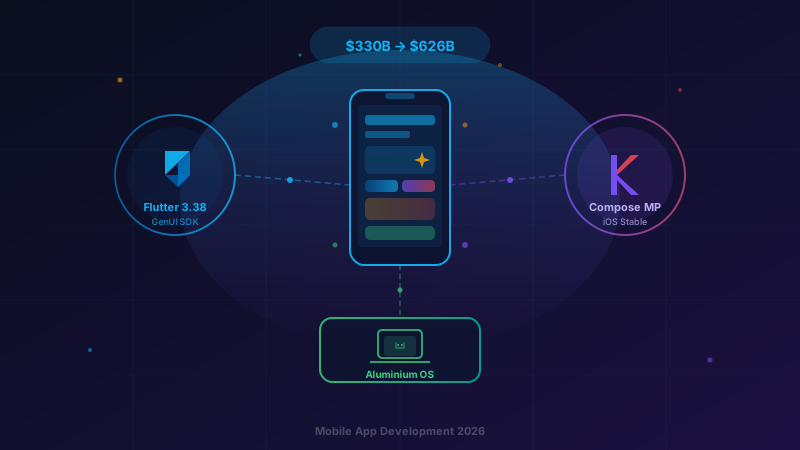
Flutter, which has dominated the cross-platform market for years, is not standing still — it has just released the GenUI SDK, which uses AI to generate dynamic UI based on user intent. Compose Multiplatform from JetBrains, once seen as “not ready yet” for iOS, has now reached production-stable maturity, becoming a legitimate third option. And Google has announced it will merge Android and ChromeOS into Aluminium OS — a move that could reshape the entire device landscape.
The global mobile app market is expected to reach $330 billion in 2026 and grow to $626 billion by 2030, with a CAGR of 14.3% — numbers that make one thing clear: choosing the right technology is no small decision.
In this article, we’ll break down the three major trends shaking up Mobile App Development in 2026, along with practical guidance for Thai businesses making strategic decisions.
Flutter 3.38 GenUI SDK — When AI Designs UI for You in Real Time
Flutter captured 46% of the cross-platform market in 2025 — and Flutter 3.38, released alongside Dart 3.10, introduced something that could permanently change how apps are built: the GenUI SDK.
What is GenUI?
Imagine a user types, “Help me book a flight to Chiang Mai this Friday.” Instead of getting a plain text response, your app instantly generates a UI — a booking form with a date picker, seat options, and a confirmation button. None of it was hardcoded in advance. It is created dynamically by AI.
That is what GenUI SDK does.
GenUI is an orchestration layer that coordinates three parts:
- The user — the person expressing a need
- The AI agent — which understands intent and decides what to display
- The widget catalog — the set of UI components your team has already designed
The AI generates instructions in JSON that specify which widgets should be assembled, and Flutter renders that UI in real time for the user — creating a high-bandwidth feedback loop between humans and AI that goes far beyond what a text-only chatbot can offer.
Why This Is a Game-Changer
In the past, building “AI-powered UI” required highly specialized teams, complex state management, and endless handling of edge cases. The GenUI SDK dramatically reduces that complexity.
Clear use cases include:
- E-commerce — A user says, “I want a blue shirt with a budget of 500 baht,” and the UI shows a product carousel with matching items and buy buttons
- Banking — “Transfer 3,000 to my mom,” and the app displays a confirmation form with the destination account details
- Healthcare — “Book a dermatologist appointment Wednesday afternoon,” and the app shows a calendar with available time slots
The important thing is that GenUI is still in the alpha stage — but the direction is very clear. Google is pushing Flutter’s AI Toolkit together with Gemini aggressively, and the 2026 roadmap suggests GenUI will move into beta soon.
Compose Multiplatform for iOS — The Third Option Is Finally Real
If Flutter has been the “king” of cross-platform for years, it now has a serious challenger.
Compose Multiplatform 1.8.0 from JetBrains delivers what many teams have been waiting for: stable support for iOS. That means you can write a single UI layer with Jetpack Compose and run it across Android, iOS, Desktop, and Web with production-grade stability.
Why This Matters
Previously, teams using Kotlin Multiplatform (KMP) could share business logic across platforms, but the UI still had to be built separately — Jetpack Compose for Android, SwiftUI for iOS. In practice, that still meant maintaining two UI teams.
Now, Compose Multiplatform closes that gap with:
- Feature parity with Jetpack Compose for core use cases
- Type-safe navigation with deep linking support
- Accessibility support for VoiceOver, AssistiveTouch, and Full Keyboard Access
- Flexible resource management across platforms
The Numbers Say a Lot
KMP grew from 7% to 23% market share in just 18 months — an impressive leap. Major global companies like Netflix, McDonald’s, and Cash App have also been using KMP in production for years.
At KotlinConf 2026 in Munich (May 20–22), 21 out of 80 talks are dedicated specifically to Compose Multiplatform — a striking share that shows just how strongly the community is leaning in.
Flutter vs. Compose Multiplatform — Which Should You Choose?
These two frameworks have very different philosophies:
Flutter — “UI-first.” Everything is a widget, and Flutter controls every pixel on the screen. It uses Dart, a language built specifically with Flutter in mind. Its biggest strength is consistent UI across platforms.
Compose Multiplatform — “Logic-first.” It starts with shared business logic in Kotlin, then extends into shared UI. Its advantage is deeper native feel and the fact that Kotlin is already Android’s primary language.
| Criteria |
Flutter |
Compose Multiplatform |
| Language |
Dart |
Kotlin |
| UI consistency |
Very high (renders its own) |
High (with more flexibility) |
| Native integration |
Good, but via channels |
Excellent (native Kotlin) |
| Community size |
Larger (46% market share) |
Growing fast (23% and rising) |
| AI features |
GenUI SDK (alpha) |
Koog + MCP integration |
| Best suited for |
Startups, MVPs, UI-heavy apps |
Enterprise, native-heavy apps |
The truth is that in 2026, there is no universal right answer. Smart teams will choose based on context: if you already have an Android team, Compose Multiplatform may offer an easier transition. If you’re starting from scratch and want rapid prototyping, Flutter remains a very strong choice.
Aluminium OS — When Google Unifies Android and ChromeOS
This may be the most disruptive announcement in the industry in 2026.
Google officially confirmed at the Qualcomm Snapdragon Summit that it will merge Android and ChromeOS under a project code-named “Aluminium OS”, with a launch target set for 2026.
What Is Aluminium OS?
Aluminium OS is a new operating system built on Android, but with AI at its core. It is designed to support devices ranging from phones to laptops through a tiered approach:
- AL Entry — entry-level devices
- AL Mass Premium — mid-range devices
- AL Premium — high-end devices that compete directly with MacBooks
Why This Matters for Developers
1. Your Android app will run on laptops directly
The awkward old ChromeOS model of “it can sort of run Android apps” will be replaced by a system where Android apps are first-class desktop citizens — with proper window management, multi-window support, keyboard shortcuts, and more.
2. The device market gets much bigger
Apps that previously ran only on phones will be able to fully reach more than 40 million Chromebooks worldwide — without needing a full port.
3. On-device AI capabilities
Aluminium OS comes with on-device AI processing. New Chromebook models with NPUs delivering up to 50 TOPS can generate images, summarize text, and organize tasks automatically without relying on the cloud.
But... When Will ChromeOS Actually Disappear?
Documents Google submitted in U.S. court indicate that ChromeOS will gradually be phased down through 2034, because Google still has to honor 10-year update commitments for Chromebooks already sold. That means the transition period will likely last around eight years.
For developers, this means one thing very clearly: it’s time to take responsive design for Android apps seriously — because your app will no longer live only on 6-inch screens.
What This Means for Thai Businesses — How to Adapt
Thai businesses will be directly affected by all three of these trends:
1. Development costs are changing
Cross-platform app development with Flutter is often 30–50% cheaper than building natively. But now that Compose Multiplatform is stable, teams that already have Kotlin developers can potentially reduce costs even further without learning a new language.
More importantly, the GenUI SDK could change the personalization game by dramatically reducing the amount of time needed to design UI for every possible user journey.
2. Device strategy needs a rethink
If your app is used in schools, offices, or factories, Aluminium OS opens new opportunities. Chromebooks are already popular in education and in organizations that need centralized device management.
3. AI-first mobile experiences
Flutter GenUI, Compose Multiplatform + Koog, and Aluminium OS all share one thing: AI at the center. Businesses that begin designing AI-driven UX today will have a real advantage.
4. Development teams need broader skills
Being good at Flutter alone may no longer be enough. Teams will also need to understand AI orchestration, adaptive UI, and responsive design for multi-form-factor devices.
How to Choose the Right Framework in 2026
Based on our experience working with businesses of many sizes, here is the decision framework we recommend:
Choose Flutter if:
- You need an MVP quickly within 2–3 months
- Your team is starting fresh without a strong language background
- Your app prioritizes beautiful, consistent UI/UX across platforms
- You want to use the GenUI SDK for AI-powered experiences
- You have limited budget and need the fastest possible time-to-market
Choose Compose Multiplatform if:
- Your team already has Android/Kotlin developers
- You need deep native integration with each platform
- Your app has complex business logic and you want to share the logic layer before the UI layer
- Your organization already uses the Kotlin ecosystem (such as a Spring Boot backend)
- You’re planning for long-term maintainability over many years
Choose Native (SwiftUI + Jetpack Compose) if:
- Your app needs specialized hardware access (AR, advanced camera, specific sensors)
- You want the highest possible performance with no extra overhead
- You have enough budget for two full teams
- The app is a core product that creates competitive advantage through UX
A hybrid approach:
A trend we are seeing more often in 2026 is the hybrid approach — using cross-platform for 80% of the app, then building native only for the parts that need top-tier performance or specialized integration. Both Flutter (via Platform Channels) and Compose Multiplatform (via expect/actual) support this strategy well.
The Next Two Years
Looking at these trends together, here’s what we believe will happen:
1. GenUI will become a standard, not a novelty
Once GenUI moves beyond alpha, any app that still forces users through five layers of menus will feel outdated. AI-generated UI will become a baseline expectation.
2. Compose Multiplatform will challenge Flutter seriously
With stable iOS support and Kotlin already established as Android’s main language, CMP’s market share could rise from 23% to 30%+ by the end of 2027.
3. Aluminium OS will create a new form factor reality for Android
Developers will need to think about responsive Android apps the same way web developers have long thought about responsive websites. Apps that work well on phones but break on laptops will lose users.
4. AI will exist in every layer of the mobile stack
From UI generation (GenUI), to business logic (AI agents), to testing (AI-powered QA), all the way down to the OS layer (Aluminium OS on-device AI) — there is no part of the stack AI won’t touch.
Conclusion — The Best Time to Build a Mobile App
2026 may be a “hard” year for choosing the right technology — but it is also the best year in history to build mobile apps.
Every tool is getting better. Every framework is becoming more capable. AI is making more things possible. The question is no longer “can we build it?” but “are we building it with the right strategy?”
A $330 billion market on its way to $626 billion is waiting for companies that choose technology with vision — not just by following hype.
If you’re planning a mobile app project, or want to upgrade an existing app to align with new trends — talk to the Enersys team. We help Thai businesses choose the right technology and deliver real business results.
References
- Announcing Flutter 3.38 & Dart 3.10: Building the Future of Apps — Flutter Blog
- GenUI SDK for Flutter — Flutter Documentation
- Compose Multiplatform 1.8.0 Released: Compose Multiplatform for iOS Is Stable and Production-Ready — JetBrains Blog
- KotlinConf 2026: Talks to Help You Navigate the Schedule — JetBrains Blog
- Google Aluminium OS: Android-ChromeOS Merge Set for 2026 — Gadget Hacks
- Google's New "Aluminium" Project Is the Android-Based Future of ChromeOS — Chrome Unboxed
- Mobile Application Market Size, Share & Growth Report 2030 — Grand View Research
- Kotlin Multiplatform vs. Flutter vs. React Native: The 2026 Cross-Platform Reality — Java Code Geeks