$2.52 Trillion — Proof That AI Is No Longer Just a Trend
In January 2026, Gartner published a forecast that sent shockwaves across the technology industry: worldwide AI spending in 2026 is expected to reach $2.52 trillion (2.52 trillion USD), up 44% from 2025, when spending stood at $1.75 trillion. This figure includes AI-related hardware, software, services, and cloud infrastructure.
To put that in perspective, $2.52 trillion is larger than the entire GDP of Italy and nearly five times Thailand’s GDP. This is not just an impressive forecast figure — it is a signal that AI is shifting from a "technology trend" to the "economic infrastructure" of the modern world.
Key Numbers from Gartner’s Report
Gartner’s report includes several important data points that enterprise leaders should watch closely:
Spending by Category
- AI Infrastructure (Hardware & Cloud): Accounts for 48% of total spending, or around $1.21 trillion, up 58% YoY. This is the fastest-growing category, driven by GPU shortages pushing up prices and enterprises racing to invest in data centers.
- AI Software & Platforms: Represents 30%, or $756 billion, up 38% YoY. This includes AI development platforms, MLOps tools, and AI-powered SaaS.
- AI Services & Consulting: Represents 22%, or $554 billion, up 32% YoY, reflecting strong demand for expert support in implementing AI.
AI Adoption in Enterprises
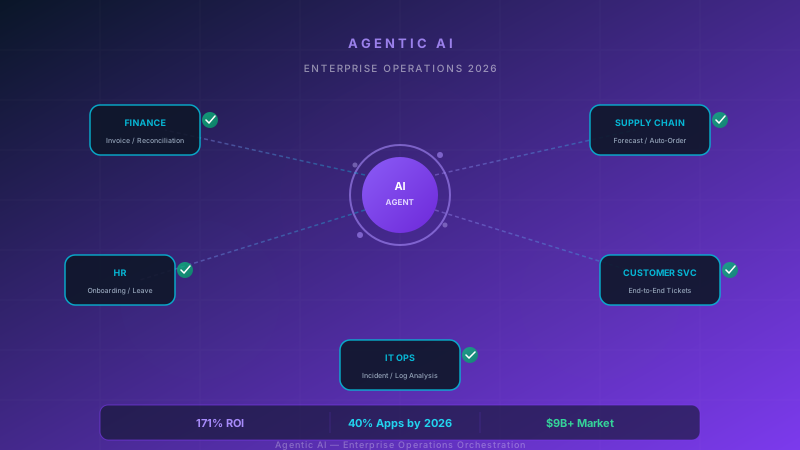
- 40% of enterprise applications will embed AI agents by the end of 2026 — up from 12% in 2025.
- 60% of the Fortune 500 have dedicated AI budgets separate from general IT budgets.
- Average AI investment by large enterprises stands at $47 million per year, up from $28 million in 2025.
40% of Agentic AI Projects Will Be Canceled — Why?
The most striking number in Gartner’s report is the forecast that 40% of agentic AI projects launched in 2026 will be canceled within 18 months, for several reasons:
1. Unrealistic Expectations: Many organizations begin agentic AI projects under the mistaken assumption that AI agents can immediately replace employees, without first investing in the process redesign and data infrastructure needed to support them.
2. Insufficient Data Quality: AI agents rely on clean, complete, and easily accessible data to perform well. Gartner found that 65% of organizations canceling AI projects cited "data not ready" as the primary reason.
3. Lack of a Governance Framework: AI agents operating autonomously across systems create compliance risks that many organizations are not prepared to manage — for example, an agent making an unlawful transaction or accessing data it should not have access to.
4. Integration Complexity: Connecting AI agents to existing legacy systems is far more complex than many organizations expect, especially for systems with no APIs or APIs not designed for agentic interaction.
5. Difficult-to-Measure ROI: Many enterprises are unable to demonstrate the ROI of AI agents within the timeframe executives expect, leading to budget cuts and project cancellations.
Infrastructure Is the Primary Driver
Gartner emphasizes that infrastructure is the real force behind the $2.52 trillion figure — not AI applications. The main reasons include:
GPUs and AI Chips: Demand for GPUs for training and inference continues to far exceed supply. NVIDIA holds an 80% share of the AI chip market, even as AMD, Intel, and Google TPU attempt to compete. Enterprise AI GPU server prices range from $300,000 to $2 million per node.
Data Centers: Hyperscalers such as AWS, Azure, and Google Cloud are expected to invest more than $180 billion combined in 2026 to build new data centers specifically designed for AI workloads. Many are being built near clean energy sources because AI training consumes enormous amounts of electricity.
Energy: Gartner estimates that AI data centers worldwide will consume a total of 85 TWh of electricity in 2026 — roughly equivalent to the annual electricity consumption of Belgium. Energy costs are becoming a critical factor in data center location decisions.
AI Spending by Region
The report breaks spending down by region:
- North America: 52% of total spending ($1.31 trillion), maintaining its leadership position
- Asia-Pacific: 25% ($630 billion), up 62% YoY, making it the fastest-growing region, led by China, Japan, and India
- Europe: 18% ($454 billion), up 35% YoY, with some slowdown due to the impact of the EU AI Act
- Rest of the World: 5% ($126 billion)
For ASEAN, Gartner estimates AI spending at around $38 billion, up 55% YoY, with Singapore leading the region, followed by Indonesia and Thailand.
Implications for Thai Enterprises
Gartner’s numbers send a clear message — organizations that are not investing in AI today are creating a gap that will only become harder to close. But investing without a clear plan also risks becoming part of the 40% of projects that get canceled.
What Thai enterprises should do:
1. Assess Readiness (AI Readiness Assessment): Before investing in AI, organizations need to understand how ready they are — across data, infrastructure, workforce skills, and governance.
2. Start with Projects That Have Measurable ROI: Focus on AI use cases where outcomes can be clearly measured, such as customer service automation, document processing, or demand forecasting.
3. Create a Dedicated AI Budget Separate from the IT Budget: Following the practice of the 60% of Fortune 500 companies that separate AI budgets from general IT budgets helps ensure AI investments have clear direction and are less likely to be cut during cost reductions.
4. Invest in Data Infrastructure First: 65% of failed AI projects stem from unprepared data. Organizing and strengthening data management should therefore be the first and most important step.
5. Build an AI Governance Framework: Define clear policies on what AI can and cannot do, and establish accountability for when AI makes incorrect decisions.
If your organization wants to identify the right starting point, Enersys AI Readiness Assessment helps evaluate enterprise readiness across six dimensions: Strategy, Data, Technology, People, Process, and Governance — enabling you to plan AI investments with greater clarity and reduce the risk of becoming part of the 40% that fail.
Sources: