TL;DR
Elon Musk is the most divisive leader in business today. Readers split sharply. One camp sees him as the rare figure who reshaped automotive, space, and energy in twenty years. The other sees him as a leader who damages company culture and exposes himself in public often enough to be embarrassing.
Both readings have supporting evidence. This piece does not judge the person. It looks at how he thinks and how he runs the engineering organisations under him, and asks what actually transfers to companies a thousand times smaller.
Three principles have been used and have produced measurable results.
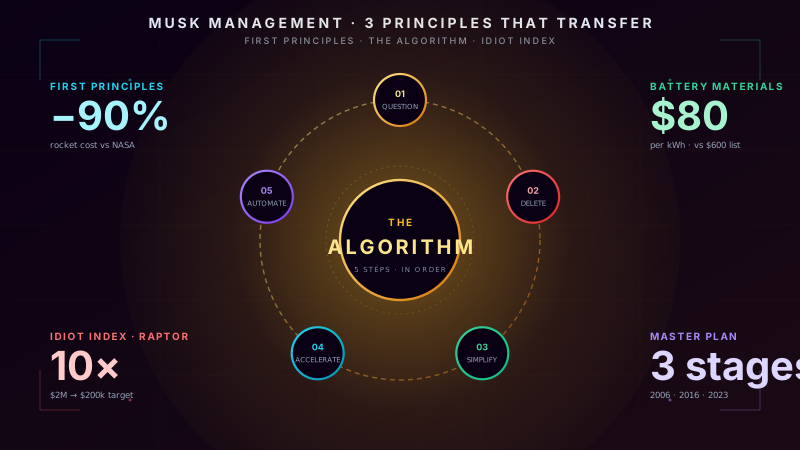
First, First Principles Thinking. Musk used it to cut rocket launch costs by roughly 90 percent against legacy aerospace, and to show Tesla that battery materials cost about one-seventh of the prevailing market price per kilowatt-hour.
Second, The Algorithm, five steps Musk codified during the Tesla Model 3 production crisis at Fremont and now applies across every company.
Third, The Idiot Index, the ratio of a finished part's price to its raw material cost. Using it, SpaceX cut Raptor engine cost from $2 million to a target of $200,000.
The piece sets out who these principles work for, and more importantly who they do not.
Why Read Musk Carefully
A common saying in management circles goes "everyone who copies Musk fails." The line is true at the surface and misses something deeper.
Musk's playbook divides into two layers.
The first layer is leadership style and workplace culture. Sixteen-to-eighteen-hour days. Public firings. Decisions made without consultation. This layer transfers poorly. Companies with deep institutional caution and tight talent markets encounter resistance heavy enough to wreck morale before any results show.
The second layer is the thinking framework and the engineering discipline. This layer transfers well. From a solo operator on a side project to a mid-sized company scaling engineering, the principles are usable.
This piece focuses on the second layer, the one Walter Isaacson, Ashlee Vance, and other journalists with up-close access have documented as in use and producing results.
First Principles Thinking
First Principles is a way of thinking that Aristotle and Descartes wrote about centuries ago. The method is to break a problem down to undeniable facts, then reason upward, rather than accepting the accumulated assumptions of those around you that may have been wrong from the source.
Musk has explained in many interviews that analogical reasoning is the practice of thinking by other people's templates. It is fast and adequate in normal cases, but if everyone reasons this way, the whole industry sits in one place. Real innovation comes from reasoning from first principles. Start from the laws of physics and ask, how would I design this again.
The Battery Cost Example
In Tesla's early years, the battery industry consensus was that a battery pack cost around $600 per kilowatt-hour and would remain there because of manufacturing limits.
Musk asked the physics question. What materials does a battery contain. Carbon, nickel, aluminium, polymers, steel. What does each cost on the commodity market. Adding up the raw materials per kilowatt-hour produced about $80.
The $520 gap is not a law of physics. It is the cost the battery supply chain carries due to how it grew up. Seeing the gap led to the Tesla Gigafactory and to Tesla bringing battery costs much closer to the raw material floor across the following decade.
The Rocket Cost Example
Before founding SpaceX, Musk tried to buy rockets from Russian suppliers. The price quoted was higher than he had estimated. He went back and asked, what is a rocket made of, and what does the material cost.
The answer. The raw material in a rocket runs about 2 percent of the typical market price. The other 98 percent is engineering, manufacturing, supply chain, and vendor margin.
SpaceX built rockets from the ground up on this insight. The launch cost dropped roughly 90 percent against NASA-era pricing. Within fifteen years, reusable Falcon 9 became the industry default.
Three Steps in Practice
First, list the assumptions everyone in the field accepts. This step sounds easy. Many people skip past assumptions buried so deep they do not register. "Salaries in this industry are at that level." "Lead times from Thai suppliers are sixty days."
Second, ask what each assumption rests on. Physics. Law. Industry habit. Assumptions that come from habit are the targets for rethinking.
Third, design from zero. Given only the physics and the legal constraints, how would you design this. Compare the result to current practice and inspect the gap.
The Trap
First Principles is powerful in the hands of someone who knows the domain deeply. Musk knew the physics of rockets and the chemistry of batteries well enough to reason from the base layer.
People who lack the domain knowledge often end up dismissing real expert knowledge as if it were habit. Reinventing drug discovery without pharmacology, for instance, tends to lead investors back to methods the industry tried and abandoned for good reason.
The discipline that works is First Principles applied where the team has domain depth, or with an expert who does. It is not for use everywhere.
The Algorithm in Five Steps
Walter Isaacson's 2023 biography records that Musk codified The Algorithm during the Model 3 production crisis at Tesla Fremont and has used it in engineering and manufacturing decisions across every company since.
The five steps, in order.
Step 1. Question Every Requirement
Every requirement must have a person's name attached. Not a department. Refuse to accept that a requirement came from "legal" or "safety." Find the person who set the requirement and question them directly, no matter how smart they are.
The reason. Requirements without owners accumulate from old policy that no one remembers the rationale for. Forcing a name on every requirement means each one passes a minimum check once.
Step 2. Delete
Delete any part or process you can. If, after deletion, less than 10 percent has to be added back, the deletion did not go far enough.
The 10 percent rule matters. It prevents over-caution. Someone deleting too little only deletes what they are "sure" is unnecessary. In practice, the truly unnecessary is rarer than people imagine. Cutting enough that some material has to come back is the signal that the call was right.
Step 3. Simplify and Optimise
This step follows steps 1 and 2 because Musk had repeatedly simplified and optimised parts that should never have existed. Engineers like to optimise because it feels productive. Optimising a part that should be deleted is wasted effort.
Step 4. Accelerate Cycle Time
Every process can be sped up. The reason this comes fourth is that accelerating an unnecessary or overcomplicated process is acceleration in the wrong direction.
Step 5. Automate
Musk stresses that automation comes last. The mistake he made at Nevada and Fremont was automating early, before questioning requirements, deleting, simplifying, and accelerating. The result was automation of processes that should not have existed, which is much harder and more expensive to unwind.
Practical Use
The five steps cannot be reordered. Musk emphasises this often. Readers of The Algorithm tend to jump to step 5 because automation feels modern. The practical outcome is technical debt in the form of automated processes.
Principles for software teams in Thailand.
Automating tests for features whose requirements are not yet stable is doing step 5 before step 1 is finished. Optimising database queries for tables that should be deleted is wasting effort at step 3 before step 2 closes. Every time a team feels "we should automate this," ask first why this thing exists at all.
The Idiot Index
Isaacson's biography names the Idiot Index as the tool Musk uses to force the finance teams at Tesla and SpaceX to track the cost of every part against the cost of the raw material it contains.
The definition. The ratio of the price actually paid for a part to the cost of the raw material in that part. If the ratio is unusually high, there is a problem in the design, the supply chain, or both.
The Raptor Engine Example
The Raptor engine at SpaceX initially cost roughly $2 million per unit. Musk set a target of $200,000, a tenfold reduction.
The first reaction inside the team was that the target was impossible. Musk answered by walking through the raw materials. Steel, nickel-based superalloy, and aluminium. Less than $50,000 in raw materials. If an engine ought to cost raw material plus a reasonable machining margin, $200,000 is a target with a physical justification, not a habit-based one.
A smaller example Isaacson records. The SpaceX team needed an actuator for Falcon. A vendor quoted $120,000. The in-house team designed and built one for $5,000. The gap was not vendor dishonesty. It was that the vendor's actuator was built for legacy aerospace use, with deep certification overhead. SpaceX needed an actuator for one specific application that did not need that certification chain.
Idiot Index Drives Vertical Integration
The long-run effect of using the Idiot Index at SpaceX and Tesla has been unusually deep vertical integration against legacy aerospace and automotive. SpaceX makes engines, avionics, software, and structures. Tesla makes seats, motors, battery cells, and the car's software.
Deep vertical integration has high upfront cost and demands management bandwidth at a scale most companies cannot supply. When it succeeds, it brings the Idiot Index on critical components down meaningfully.
For Thai SMEs, full vertical integration is not on the table. The Idiot Index is, as an analysis tool for make-versus-buy decisions on a quarterly cycle. If a part or service bought from a vendor carries an Idiot Index higher than ordinary vendor margins explain, that is a signal to consider building it in-house, sourcing elsewhere, or renegotiating.
The Master Plan as a Long-Horizon Frame
Musk first published the Tesla Master Plan in 2006 as a short blog post.
The four steps of the original Master Plan.
- Build an expensive sports car to prove the technology (Tesla Roadster)
- Use profits from the sports car to fund a mid-priced car (Model S)
- Use profits from the mid-priced car to fund a mass-market car (Model 3)
- Provide solar energy alongside (Tesla Energy)
The plan reads as obvious in retrospect. Look at what Tesla executed across the following twenty years. The plan was followed in sequence almost line by line.
Master Plan Part Deux in 2016 extended Tesla into trucking, public transit, autonomous driving, and shared fleets. Master Plan Part 3 in 2023 extended further into a global sustainable energy economy.
What Transfers to Small Business
First, sequence stages so that each one depends on the success of the previous. Tesla's stage 2 needed the profit from stage 1, not fresh investor capital each stage.
Second, publish the plan in public. The act forces follow-through and aligns stakeholders.
Third, hold the company's story consistent for ten to twenty years. Tesla was criticised at every stage, and the story never moved.
For Thai SMEs, a three-to-five-year Master Plan that names how stage 1 sets up stage 2 and stage 2 sets up stage 3 helps the team and partners see the picture. It cuts decisions that contradict each other from one quarter to the next.
Manufacturing Is the Hard Part
In many interviews Musk has stressed a principle most listeners skip. "Engineering is easy, manufacturing is hard."
In his usage, designing a prototype that works is the kind of problem a smart engineering team of five to ten people can solve. Scaling that prototype to production at hundreds of thousands of units, with consistent quality and acceptable unit cost, is an order of magnitude harder.
Tesla took a long time to scale Model 3 at Fremont. Musk slept on the factory floor for months in 2018 working through the production line problems. That experience was the seedbed for The Algorithm.
What Transfers to Software
Writing a feature that demos well is something a sprint can produce. Scaling that one feature to hundreds of thousands of users, with uptime, latency, security, observability, support, and documentation, takes between ten and a hundred times more effort than the demo.
Teams that plan resources around demo effort and ignore scaling effort ship products that are not ready.
At Enersys, the principle applies in client scoping. An Odoo customisation that demos in a meeting room is one problem. The same customisation deployed in a real environment, used by 200 people concurrently, is a scaling problem the implementation team has to plan for, not underestimate.
Limits and What Not to Copy
An honest piece on Musk has to cover this section, not only the celebrating part.
Hardcore Culture Has Real Costs
The culture Musk endorses across every company is 80-to-100-hour weeks, midnight emails, and the expectation that everyone is available at any time. The documented consequences are turnover above industry norms and routine burnout.
In companies where talent is scarce and retention is a strategic asset, this cost is too high. Musk can absorb it because SpaceX and Tesla have missions strong enough to pull top talent back in. Most companies do not.
Public Outbursts Destroy Company Value
Tweets that have moved Tesla stock down, the SEC litigation, and public disagreements with stakeholders have cost Musk billions in valuation each time. There is no evidence the public conflict has helped the businesses. It reflects personality, not strategy.
A leader who copies the habit without Musk's capital base will lose credibility with nothing to compensate.
Survivorship Bias in Musk Worship
Founders who read about Musk often forget that capital-intensive industries like rockets and EVs have dozens of competitors who used similar methods and disappeared. Musk's success is not technique alone. It is technique combined with timing, capital access, government support, and network effects specific to his position.
Some of Musk's principles travel as general practice. Others are context-specific and only work in his situation.
Iterating in Safety-Critical Contexts
Musk uses iteration aggressively at SpaceX, accepting that several rockets will explode in testing and learning from each explosion. The approach works on prototype rockets without passengers. It has been heavily criticised when extended to Autopilot on Tesla, where passengers are real.
The transferable principle is iterate quickly where failure does not hurt people. The non-transferable corollary is do not iterate quickly where failure does. Teams that fail to separate the two create legal and moral problems much larger than the gains from iteration speed.
Application for Thai SMEs
Four moves that owners and management teams of Thai SMEs can put into practice in the next quarter.
First, First Principles in areas where the team has expertise. Revisit the cost structure of a product or service the company sells. Break out raw material, labour, overhead, and margin. Compare to what the customer pays. If a gap exists that cannot be explained by physics or law, that is the first place to look for opportunity.
Second, The Algorithm on a real process. Pick one process the team spends the most time on each week. Walk through the five steps. Ask which requirements have which owners. Delete what can be deleted. Reduce the steps. Speed the cycle. Only then consider automation. Most processes shrink by half or more before any code is written.
Third, The Idiot Index on supplier decisions. Get raw material numbers for what the company buys from key vendors. Compare to actual prices paid. When the ratio is out of line for the industry, that is a signal to renegotiate, source elsewhere, or build in-house.
Fourth, A 3-to-5-year Master Plan. Write a plan with three or four stages where each stage funds the next. Publish it to the team, the board, and key partners. Review every six months.
At Enersys we have used these four since 2022, when the company entered the scaling phase from software house toward product company. They are not a silver bullet. They are a discipline that gets applied every quarter and produces results when held to.
Closing
Elon Musk is a polarising figure who is hard to read at the personality level. Some of his principles transfer well across very different company sizes.
First Principles thinking surfaces the costs underneath market prices. The Algorithm protects against optimising what should have been deleted. The Idiot Index gives supply chain decisions data rather than feel. The Master Plan gives a company a story long enough for the team to hold onto.
At the same time, the hardcore culture, the public outbursts, and the disregard for safety boundaries do not travel. They are tied to Musk's specific context, not to general best practice.
For Thai SMEs scaling over a three-to-five-year horizon, the five principles above can serve as a checklist for quarterly self-assessment. Success does not come from copying Musk whole. It comes from picking the disciplines that fit your context and repeating them, not from picking up his Twitter habit and aiming it at customers.
Sources