Everyone Is Excited About AI — But What Do the Real Numbers Say?
Deloitte’s State of AI 2026 report, released in February 2026, paints a highly revealing picture: organizations worldwide are investing seriously in AI, but the gap between "wanting to do it" and "actually being able to do it" is widening every day.
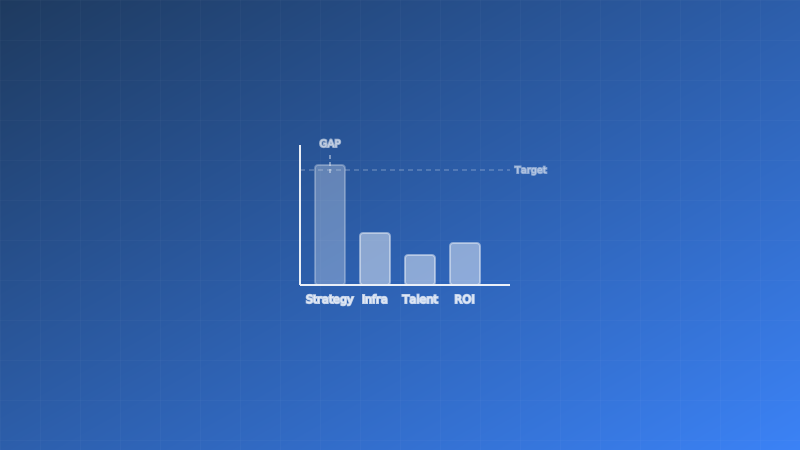
Deloitte calls this phenomenon the "Execution Gap" — most organizations have an AI strategy, but still lack the infrastructure, skilled talent, and performance measurement processes needed to turn strategy into real outcomes.
The Numbers Tell the Story
Based on a survey of more than 3,235 executives from Director level to the C-suite across 24 countries and 6 industries:
- 84% of organizations increased their AI investment budget this year, and 78% of executives report greater confidence in AI technology
- But only 43% have IT infrastructure ready to support AI at a production level
- The talent picture is even more concerning — only 20% say they have people who are ready for AI
- Only 25% have moved AI pilots into production for more than 40% of their projects
- 37% of organizations are still using AI only superficially, without transforming core business processes
The picture is clear: money and confidence are flowing into AI, but infrastructure and talent are not keeping pace.
The 3 Core Problems Behind the Execution Gap
1. IT Infrastructure Is Not Ready
AI—especially Generative AI and Agentic AI—requires compute, storage, and data pipelines that differ significantly from traditional IT systems. Organizations still relying on older on-premises servers or data warehouses that do not support real-time processing are likely to hit a bottleneck here.
2. Lack of AI-Skilled Talent
The figure showing that only 20% have sufficient talent reflects a global issue—not just a Thailand-specific one. The shortage goes beyond data scientists and includes roles such as:
- AI Engineers who can deploy models in real production environments
- Prompt Engineers who understand how to design AI agent workflows
- AI Product Managers who can bridge business and technology
3. Inability to Measure ROI
While 66% of organizations report that AI improves productivity, only 20% have been able to convert AI into actual revenue so far (while 74% expect AI to increase revenue in the future). Many organizations begin AI projects without defining baseline metrics from the outset. As a result, once the project is underway, they cannot clearly determine whether the investment is paying off.
What Sets Organizations That “Succeed” Apart?
Deloitte notes that organizations that overcome the Execution Gap tend to share several traits:
- They start with clear use cases — not "use AI everywhere," but 2–3 high-impact processes
- They invest in the data foundation first — ensuring data is clean, accessible, and secure before applying AI
- They have a governance framework — only 21% of organizations have mature AI governance, but this group clearly captures more business value from AI than others
- They measure every iteration — they do not wait until the project ends to assess results, but measure progress in every sprint
What This Means for Thai Organizations
For Thai organizations, these numbers may seem distant, but in reality, the same issues are happening locally as well:
- Many organizations have purchased AI tools but do not have people who can operate them
- Data is still stored in Excel files or legacy databases that AI cannot easily access
- Clear AI governance policies are still lacking, especially in the context of PDPA
Getting started does not have to be massive—but it does need to start in the right place: choose use cases with measurable outcomes, prepare the data properly, and have people (or partners) who can actually deploy AI into production.
What to Watch Next
Deloitte expects to see a consolidation of AI investment in the second half of 2026 — organizations that cannot measure outcomes will begin cutting AI budgets, while those that have proven ROI will increase spending even further.
The gap between AI Leaders and AI Laggards is about to widen significantly.
Source: State of AI in the Enterprise 2026 — Deloitte, Full report (PDF)