Introduction — When “Good at AI” Is Not the Answer
Every company is talking about AI, but one question few can answer is:
“If your competitor uses the same AI as you, what still makes you win?”
The answer is not the algorithm, not the model, and not even the amount of capital you can invest — it is the data moat, a defensible layer of data-driven advantage that compounds over time.
This article synthesizes insights from four leading global sources into a practical guide for surviving and growing in the age of AI agents and AGI.
Part 1: Being Good at AI ≠ Winning — Expensive Lessons
$5.3 Billion Gone to Waste
Before talking about how to build a moat, let’s first look at what happened to companies that thought they had one — but didn’t:
| Company |
AI Investment |
What Happened |
Lesson |
| IBM Watson Health |
$4B |
Recommendations matched doctors only 34% of the time |
More data ≠ better data |
| Zillow Offers |
$881M loss |
Error rate was only 1.9%, but margins were just 7–9% |
A good algorithm ≠ a good business model |
| Stitch Fix |
Stock down 96% |
Personalization could not overcome weak economics |
Strong AI ≠ customers will pay more |
| Uber ATG |
$2.5B |
Timeline was too optimistic; competitors caught up |
First-mover ≠ winner |
Numbers worth remembering:
- 78% of ML models can be replicated within 6–8 weeks
- 61% of customers now expect AI as a baseline, not an advantage (Gartner)
- Only 23% of companies using AI can charge a premium over competitors
Why AI Is Not a Moat
There are three main reasons:
1. Democratization — Open-source models like LLaMA and Mistral are freely available, cloud APIs make AI accessible to everyone, and ML developers stay at companies for only about 1.8 years on average before taking their knowledge elsewhere.
2. Rapid Reproducibility — New architectures such as Transformers and attention mechanisms spread across the industry in just a few months.
3. Diminishing Returns — The more you invest, the smaller the incremental gain. That creates room for smaller, smarter competitors to catch up.
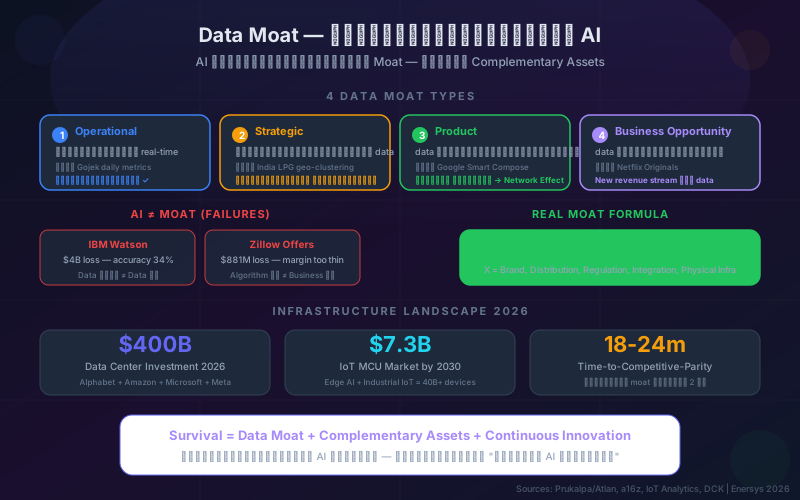
Part 2: The 4 Types of Data Moats — Prukalpa’s Framework at Atlan
Prukalpa Sankar, co-founder of Atlan, introduced the Data Advantage Matrix — a framework that divides data moats into four categories, each with three levels of maturity.
Moat #1: Operational Advantage — “Knowing What’s Happening in the Business in Real Time”
What it is: Giving decision-makers immediate access to the data they need for day-to-day decisions, so they can answer questions like, “How are today’s KPIs performing?” without waiting for reports.
Example: Gojek sent daily metric updates to its CEO every day, allowing Nadiem Makarim to build an instinct for what was breaking in the system — and make decisions faster than competitors waiting for weekly reports.
How to start: Any company can begin here. Even Google Sheets + Zapier is enough.
Moat #2: Strategic Advantage — “Making Big Decisions with Data, Not Gut Feel”
What it is: Using data to support high-impact strategic decisions that happen only a few times a year — but can shape the future of the business.
Example: The Indian government used geo-clustering to determine where LPG distribution centers should be opened. The result: 10,000 new centers placed in the highest-demand locations — decisions driven by data instead of guesswork.
For Thai businesses: Where should you open a new branch? Which product line deserves investment? Which country should you expand into? If your answers come from data instead of instinct, that is Strategic Advantage.
Moat #3: Product Advantage — “Using Data to Build Features Competitors Can’t Match”
What it is: Using data to create product capabilities that are meaningfully differentiated from the competition.
Example: Google Smart Compose — every time you type an email, Google learns from the patterns of billions of users. That makes its sentence suggestions increasingly accurate. The more people use it, the better it gets — and competitors simply cannot recreate a dataset at that scale.
The key question: Does your product get better as more people use it? If not, you do not have Product Advantage.
Moat #4: Business Opportunity — “Turning Data into an Entirely New Business”
What it is: Transforming existing data into a completely new revenue stream.
Example: Netflix does not just use data to recommend shows — it uses viewing data to produce Netflix Originals designed around what people already want to watch. The result is content that lands from day one because demand is understood in advance.
Part 3: So What Is a “Real” Moat in the AI Era?
Looking at companies that have actually succeeded — such as Tesla, Amazon, and DeepMind — the real moat is not AI itself. It is complementary assets: the surrounding strengths that AI amplifies.
What Companies with a Real AI Moat Have in Common
Tesla Autopilot:
- ✅ 8+ billion miles of fleet data (a data network effect)
- ✅ Hardware-software vertical integration
- ✅ Over-the-air update feedback loop
- ✅ Automated labeling systems
Amazon Fulfillment AI:
- ✅ Deeply embedded across operations (demand forecasting → inventory → warehouse → delivery)
- ✅ Physical infrastructure competitors cannot build fast enough
- ✅ Data flywheel: the more it sells, the more it learns, the faster it gets
DeepMind AlphaFold:
- ✅ A clearly defined problem (protein folding) plus massive computational scale
- ✅ Rare concentration of top-tier talent
- ✅ Published breakthroughs that built credibility and reduced competitors’ incentives
The Formula: AI + X = Moat
| X (Complementary Asset) |
Example |
| Distribution |
Amazon delivering to your door in one day |
| Brand Trust |
Customers trust Tesla more than an unknown startup |
| Regulation |
Medical licenses that take years to obtain |
| Network Effects |
The more people use it, the better it gets, and the more new users it attracts |
| Integration Depth |
Embedded so deeply in workflows it becomes hard to remove |
| Physical Infra |
Data centers, factories, supply chains |
Part 4: The Infrastructure Landscape — From Cloud to Edge
Data Centers: $400B of Investment in 2026
The world is building the “brain” for AI at a scale we have never seen before:
- $400 billion — projected 2026 data center capex from four tech giants: Alphabet, Amazon, Microsoft, and Meta
- Inference > Training — Deloitte estimates inference will account for two-thirds of AI compute in 2026
- Power is the bottleneck — the biggest constraint is not capital, but electricity. New data centers consume power at the scale of a small city
Edge AI: A $7B MCU Market by 2030
But not everything will live in the cloud — Edge AI is growing fast:
- IoT MCU market: $5.1B (2024) → $7.32B (2030), growing at 6.3% annually
- Global IoT devices will exceed 40 billion by 2030
- China is investing $88B in power grid infrastructure — creating major opportunities for industrial IoT
Why it matters: Edge AI generates data the cloud does not have — data from factories, stores, and real-world environments. That kind of data is where real data moats are built.
Part 5: A Two-Year Outlook — From AI Agents to AGI
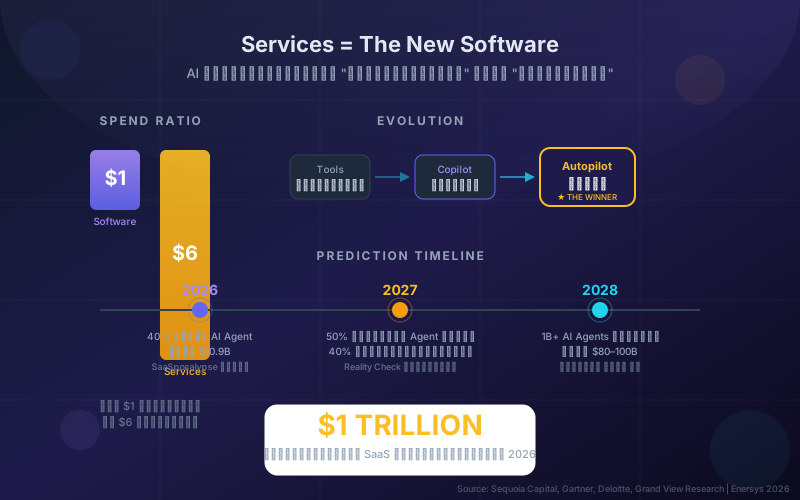
2026–2027: The Era of AI Agents
- Foundation models will consolidate: 4–6 providers will dominate the base model layer, shifting competition to the application layer
- Regulatory divergence: AI laws will differ by country, making compliance a moat
- Synthetic data revolution: competitors will be able to create comparable training data, weakening traditional data moats
- AI agent ecosystem: advantage will shift from “better models” to “deeper integration”
2027–2028: The Shadow of AGI
- 50% of organizations using GenAI will have autonomous agents (Deloitte)
- 15% of enterprise decisions will be made autonomously by AI (Gartner)
- 1 in 3 user experiences will shift from app-based interfaces to agent-based interfaces
- Many experts predict AGI-level systems could emerge by 2027–2028
Part 6: A 7-Point Guide to Survive and Grow
1. Build Operational Advantage First — The Free Win Anyone Can Start With
Start with the simplest move: make critical business data visible to your team every day. No AI required. No data scientist required. Just a dashboard that answers one question: “How is the business doing today?”
Businesses that know sooner can adapt sooner — and that is the first moat.
2. Identify Your Complementary Assets Before Investing in AI
Before asking, “Which AI should we use?” ask “What do we have that competitors do not?” It might be your brand, customer relationships, licenses, supply chain, or proprietary domain data.
The best AI is AI that amplifies what you already do well — not AI that is “smart on its own.”
3. Build a Data Flywheel — Don’t Just Collect Data
A data flywheel is a loop where more usage leads to better performance, which attracts more users, which creates more data.
Ask yourself: “Does our product get better as more people use it?” If the answer is no, you still do not have a real moat.
4. Prioritize Integration Depth, Not Features
Do not compete on “our AI feature is better.” Compete on “our system is embedded so deeply into the customer’s workflow that removing it is painful.”
Switching costs created by integration will always be stronger than switching costs created by features.
5. Capture Edge Data — The Data the Cloud Does Not Have
Real-world operational data from factories, stores, and field environments is the most valuable kind of data because:
- it does not exist on the public internet to be scraped
- it cannot be fully replaced with synthetic data
- it becomes more valuable over time (time-series advantage)
6. Prepare for Regulation as a Moat
AI regulation is coming — from the EU AI Act to Thailand’s PDPA and new AI-specific laws now being drafted. Organizations that prepare early will gain a compliance moat competitors will struggle to match.
7. Plan for the Next 18–24 Months, Not Forever
In the AI era, no advantage is permanent. Average time-to-competitive-parity is just 18–24 months. That means you must build a new moat every two years.
The winners will not be the companies with the strongest moat today — they will be the ones that can create the next moat the fastest.
Conclusion: The Survival Equation
Survival in the AI era = Data Moat + Complementary Assets + Continuous Innovation
Data Moat is the foundation — built through four forms: Operational, Strategic, Product, and Business Opportunity.
Complementary Assets are the walls — brand, distribution, regulation, integration, and physical infrastructure.
Continuous Innovation is the rhythm — every 18–24 months, you must reinvent.
In a future where AI agents increasingly act on behalf of people and AGI may become reality, the line between winners and losers will not be “who has the better AI” but “who has what AI cannot replicate” — proprietary data, customer relationships, local context, and the ability to integrate everything into one system.
If you want to assess how strong your organization’s data moat really is, or build an AI strategy that creates lasting competitive advantage, talk to the Enersys team — we can help you design a Data Advantage Matrix tailored to your business.
References