Why Most Thai Organizations Still Make Decisions Based on "Instinct"
Research from McKinsey shows that data-driven organizations are 23 times more likely to acquire new customers, 6 times better at retaining them, and 19 times more profitable than organizations that rely on traditional decision-making.
But the surprising reality is this — only 5–6% of Thai organizations have seriously adopted Generative AI. And even among companies that already “have data,” many still make decisions based more on gut feeling than evidence.
The problem is not technology — the problem is culture.
What Is Data Culture? (And Why It Matters More Than Tools)
Data Culture is not just about buying a dashboard or hiring a data analyst. It is the way an entire organization thinks and works, where everyone — from senior executives to frontline staff — uses data to support everyday decisions.
Organizations with a strong Data Culture do not ask, “What do you think?” They ask, “What does the data say?”
By 2025, McKinsey estimates that in data-driven organizations, using data to support work will become normal for almost every employee — not just IT or data teams.
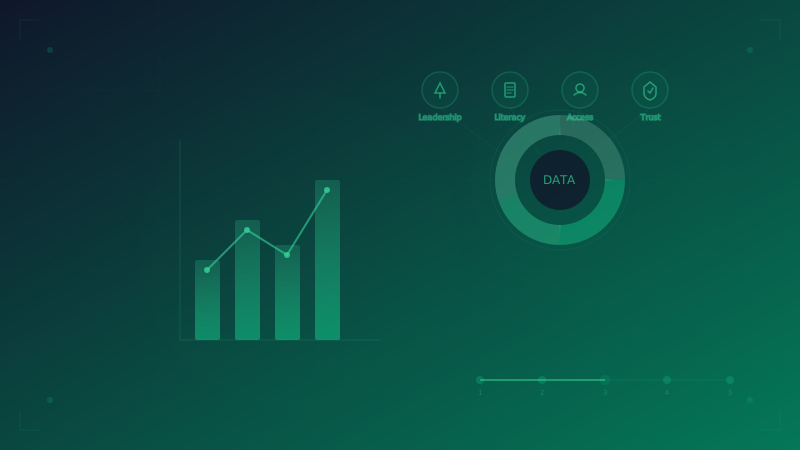
The 4 Pillars of Data Culture
Pillar 1: Leadership — Leaders Must Set the Example
Change has to start at the top. If executives still make decisions based on instinct, employees will not see why data matters.
What leaders should do:
- Ask, “What data supports this?” whenever a proposal is presented
- Share the dashboards they personally use for decision-making with their teams
- Accept when the data contradicts their intuition
- Recognize teams that use data in decision-making, even when the outcome is not ideal (because the process was right)
Pillar 2: Data Literacy — Everyone Must Be Able to Read Data
Not everyone needs to know how to code, but everyone should be able to:
- Understand graphs and dashboards
- Tell the difference between correlation and causation
- Know what questions to ask of the data
- Spot data that “looks off”
Data literacy training does not have to be a long course. Even a 2–3 hour workshop focused on real scenarios from each department can create meaningful change.
Pillar 3: Data Access — Data Must Be Easy to Reach
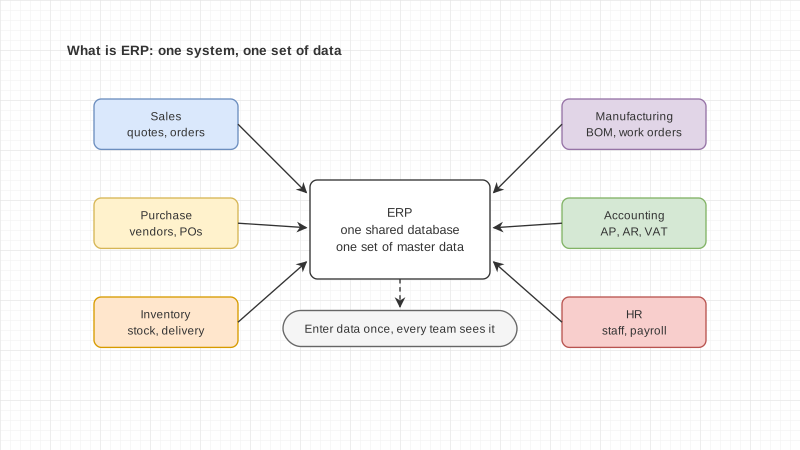
One of the most common problems in Thai organizations is data silos — sales data lives in one system, accounting data in another, and customer information sits in each person’s Excel file. No one sees the full picture.
Data democratization does not mean everyone gets access to everything. It means:
- People can access the data they need without having to ask someone every time
- Self-service dashboards allow each department to view relevant data on their own
- There is a central data source (a single source of truth) that every department can trust
Pillar 4: Data Trust — Data Must Be Reliable
If people in the organization do not trust the data, they will not use it. Data trust is built through:
- Accuracy — there are regular processes for checking data quality
- Timeliness — data is updated quickly enough to support decisions
- Consistency — metric definitions are aligned across the organization
- Transparency — everyone knows where the data comes from and how it is calculated