How Fast Does a Database Need to Be in the AI Era?
The answer: fast enough that people do not even notice there is a database behind it.
In a world where AI agents may query data dozens of times per request, chatbots must respond within a second, and users expect everything to feel instant, traditional databases hosted in a single data center are starting to fall short.
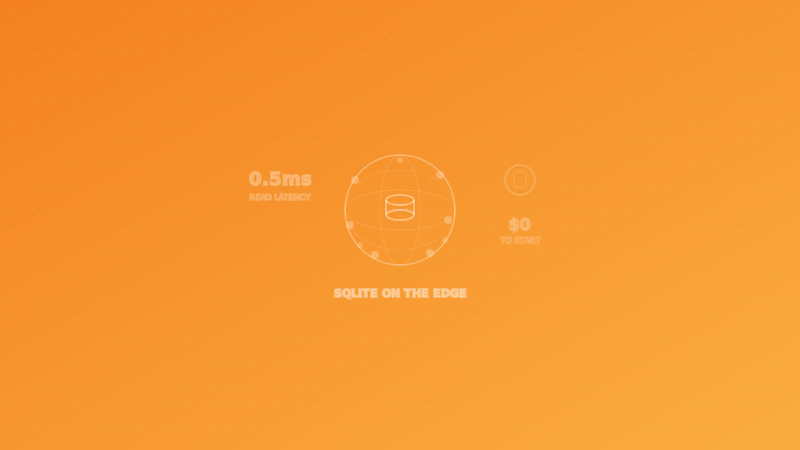
Cloudflare D1 is one of the most compelling answers in 2026: a managed SQLite database that requires no server, no connection pool management, and can serve reads from 300+ edge locations worldwide.
What Is D1 — A Non-Technical Explanation
Think of it this way:
A traditional database is like a central library. There is only one location, so anyone who wants to read a book has to go there. If they are far away, they have to wait longer.
D1 is like a library with branches in every city. The original books stay at headquarters, but copies are automatically distributed to every branch. Anyone can read from their nearest branch immediately, while anyone who needs to write or update sends those changes back to the original.
Technically:
- Reads → data is served from the location closest to the user (edge replica) → very fast (~0.5ms)
- Writes → sent to the primary database → slightly slower, but still fast
- No server setup required → no monthly server cost, pay only for actual usage
Why SQLite Is “Hot” Again in 2026
SQLite is the most widely deployed database in the world, embedded in every smartphone and every browser. In the past, however, few teams treated it as a serious production database because it was a single file and did not support many concurrent connections well.
But in 2026, that has changed.
NVMe SSDs Changed the Game
Modern SSDs can perform 500K–1M random reads per second with latency below 0.1ms, making SQLite on SSD fast enough for real production workloads.
WAL Mode Solved Concurrency Issues
Write-Ahead Logging enables unlimited concurrent reads even while writes are happening, dramatically increasing the amount of traffic SQLite can handle.
Managed Services Made It Easy to Use
- Cloudflare D1 — SQLite on the edge across 300+ locations
- Turso — Managed LibSQL with edge replicas in 30+ locations
- Litestream — continuous SQLite backup to S3
- LibSQL — a SQLite fork that adds replication and multi-writer support
The Results Are Clear
| Database |
Read Latency (p50) |
| SQLite (local) |
~0.01ms |
| Turso (embedded replica) |
~0.02ms |
| Cloudflare D1 |
~0.5ms |
| PostgreSQL (managed) |
~1-3ms |
That is a 2–6x difference — and the gap becomes even more significant when an AI application needs to make dozens of queries per request.
D1 and AI — Why They Fit So Well Together
1. Edge-Based Knowledge Graphs — No Server Required
Developers are using D1 + Vectorize (Cloudflare’s vector database) to build entire knowledge graph systems on the edge. D1 stores entities and relationships, Vectorize stores embeddings for semantic search, and KV acts as a cache.
The result? A knowledge graph that can be queried in 2 seconds for about $1 per month, compared with managed Neo4j plans that start at $65/month.
2. AI Agents Need a Database with “No Latency”
When an AI agent executes a multi-step workflow — reading user data, retrieving context from a knowledge base, querying conversation history, and generating a response — every millisecond of database latency gets multiplied by the number of queries.
If the agent makes 10 queries per request:
- PostgreSQL: 10 × 2ms = 20ms
- D1: 10 × 0.5ms = 5ms
That is a 4x difference, and users can feel it.
3. Database-per-Tenant for SaaS + AI
D1 supports up to 50,000 databases per account, making it possible to create a separate database for each customer.
For AI SaaS products that need to store each customer’s knowledge base, conversation history, and user preferences, separate databases mean no data mixing, easier backups, and easier deletion — especially important for PDPA compliance.
4. Agentic RAG — Smarter Querying with D1
Modern RAG (Retrieval-Augmented Generation) systems no longer rely on a single search method. Instead, they choose the retrieval strategy based on the type of question:
- Simple questions → keyword search (FTS5 in SQLite)
- Broad questions → vector similarity + graph traversal
- Time-based questions → time-weighted search
- “Why” questions → cause-and-effect chain retrieval
D1 includes built-in support for FTS5 (Full-Text Search) and works with Vectorize, so you do not need to set up a separate Elasticsearch stack.
When You Should Use D1 — and When You Should Not
Best suited for:
- AI chatbots / agents that need low latency
- SaaS products that require data isolation per tenant
- Read-heavy applications (blogs, e-commerce, dashboards)
- Side projects / MVPs that need to launch quickly at low cost
- Global applications with users distributed around the world
Not ideal for:
- Write-heavy workloads with many concurrent writers
- Databases larger than 10GB per partition
- Complex transactions requiring distributed commits
- Systems that depend on PostgreSQL extensions such as PostGIS or pg_vector
Through the Lens of Thai Businesses
Infrastructure Cost Is Approaching Zero
D1 offers 5GB free with unlimited reads. For startups and SMEs building AI products, that is a starting point that requires no upfront investment in database servers.
Edge Means Faster Performance for Thai Users
Cloudflare has a PoP in Bangkok, so Thai users can read data from the nearest edge location instead of reaching all the way to the US or Singapore.
AI Applications Do Not Have to Be Expensive
By combining D1 + Vectorize + Workers AI, businesses can build AI applications with a knowledge base, semantic search, and chatbot capabilities at a cost of only a few dollars per month — far lower than setting up PostgreSQL + pgvector + an API server on a conventional cloud stack.
Summary
Cloudflare D1 is not just “SQLite on the cloud.” It is a signal that AI application infrastructure is changing shape — moving from centralized servers to edge-first architectures that are faster, cheaper, and simpler.
For businesses building AI products, D1 may be the answer you did not realize you were looking for.
Sources
- Cloudflare D1 Documentation
- The SQLite Renaissance: Why SQLite Is Taking Over Production in 2026 — DEV Community
- Edge-Native Knowledge Graphs with Cloudflare D1 + Vectorize — DEV Community
- Post-PostgreSQL: Is SQLite on the Edge Production Ready? — SitePoint
- Cloudflare Upgrades D1 Database with Global Read Replication — InfoQ