Before We Compare — Start With the Right Mindset
This article is not here to tell you which cloud is "the best" — because there is no universal answer.
What does exist is the cloud that is "the best fit for your context" — depending on your workloads, your team’s skills, your budget, your existing systems, and your business roadmap.
All information in this article comes from public sources — company financial statements, official pricing pages, analyst reports, and Thai government policies. There are no unsupported opinions here.
The Cloud Market in 2025–2026 at a Glance
Industry analyst data points in the same direction:
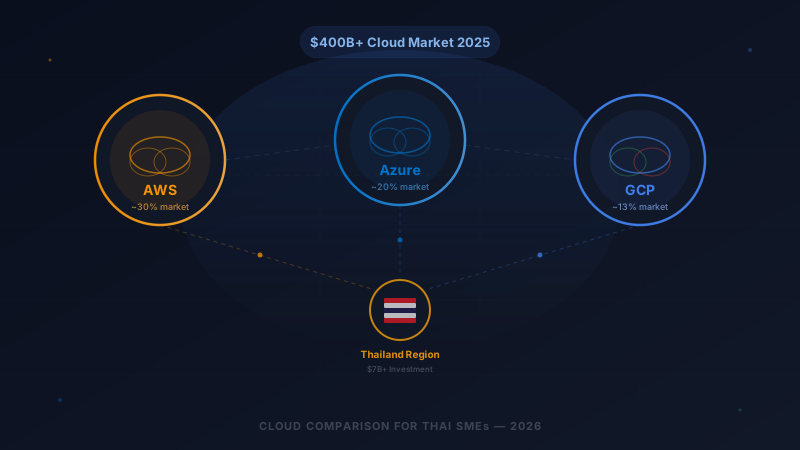
- The global cloud infrastructure market surpassed $400 billion for the first time in 2025
- In Q2 2025 alone, cloud infrastructure spending reached nearly $99 billion, up 25% YoY
- The top 3 providers together account for roughly 63% of the total market
Estimated Market Share (2025)
| Cloud Provider |
Approx. Share |
Notes |
| AWS |
~30% |
Ongoing market leader |
| Azure |
~20% |
Fastest-growing player |
| GCP |
~13% |
Strong AI-driven growth |
Source: Estimates based on Synergy Research Group and Q2 2025 data
Revenue From Public Financial Reports (Q4 2025)
Since all three are publicly listed companies, these figures are publicly available:
|
AWS |
Azure (Intelligent Cloud) |
Google Cloud |
| Q4 2025 Revenue |
$35.58B |
$30.9B* |
$17.66B |
| YoY Growth |
+24% |
+28%* |
+48% |
| Backlog |
$244B |
Not disclosed separately |
$240B |
Note: Azure is reported within Microsoft’s Intelligent Cloud segment, which includes Azure + server products + enterprise services
Source: Amazon Q4 FY2025 Earnings (CNBC), Microsoft FY26 Q1 Investor Relations, Alphabet Q4 2025 Earnings (CNBC)
A Better Way to Compare — A 6-Dimension Framework
Instead of asking "which one is cheapest" or "which one is best," we use a 6-dimension framework that covers the factors Thai SMEs actually need to evaluate:
- Pricing and billing model — your real operating cost
- Thailand data center availability — latency, data residency, compliance
- Free tier and credit programs — how easily you can get started
- Ecosystem and integration — how well it connects to your existing stack
- Team and available skills — what your people already know
- Business roadmap — how you plan to scale in the future
Let’s go through them one by one.
Dimension 1 — Pricing and Billing Models
Base VM Pricing (General Purpose, 2 vCPU / 8 GB RAM)
|
AWS |
Azure |
GCP |
| Instance type |
t3.medium |
B2s equivalent |
e2-medium |
| On-demand (US) |
~$30/month |
~$30/month |
~$24/month |
| Billing granularity |
Per second |
Per minute |
Per second |
Source: Official pricing pages from each provider, as of March 2026
Discount Models — Each Provider Works Differently
Each cloud provider approaches discounts differently — and this is where actual costs can diverge significantly from on-demand pricing.
AWS — Savings Plans / Reserved Instances
Commit for 1 or 3 years in exchange for discounts. This requires planning ahead and estimating how much capacity you’ll use. Best suited for stable, predictable workloads.
Azure — Reserved Instances + Hybrid Benefit
Similar to AWS, but with a major advantage for organizations that already own Microsoft licenses such as Windows Server or SQL Server. You can bring those existing licenses to Azure and reduce costs substantially.
GCP — Sustained Use Discounts (Automatic)
No upfront commitment required. GCP automatically applies discounts when an instance runs for more than 25% of the month. The more you use, the more you save — without needing to commit in advance. This is ideal for workloads that are still evolving.
What This Means for Thai SMEs
For SMEs just getting started with cloud:
- If your workload is still uncertain, automatic discounting reduces the need to guess usage in advance
- If your workload is stable and predictable, committing ahead of time usually saves more
- If you already own Microsoft licenses, you must calculate Azure Hybrid Benefit into the equation — it can change the outcome significantly
Dimension 2 — Data Centers in Thailand
This is a major factor for Thai SMEs, especially in terms of latency and data residency.
|
AWS |
GCP |
Azure |
| Thailand Region |
ap-southeast-7 (Bangkok) |
Bangkok |
EEC (Eastern Economic Corridor) |
| Launch status |
Jan 8, 2025 |
Jan 21, 2026 |
Announced Mar 2026 (under construction) |
| Availability Zones |
3 |
3 |
Not yet specified |
| Investment value |
$5 billion |
$1 billion |
$1+ billion |
| Current status |
Live |
Live |
Not yet open (expected 2026–2028) |
Source: Amazon Press Release (Jan 2025), Google Cloud Blog (Jan 2026), Microsoft Source Asia (Mar 2026)
Why Thailand Data Centers Matter
Latency: Websites and apps serving Thai users will perform noticeably faster when servers are hosted in Thailand instead of Singapore, which was previously the most common regional choice. Typical latency can drop from around 30–50ms to 5–10ms.
Data Residency: Some industries — such as finance, healthcare, and government — require data to stay within the country. A Thailand region makes compliance much easier.
Data Transfer Costs: Traffic within the same region is usually cheaper than cross-region traffic. If most of your users are in Thailand, hosting in Thailand can also reduce bandwidth costs.
Dimension 3 — Free Tiers and Startup/SME Credit Programs
Free Tier Comparison
|
AWS |
Azure |
GCP |
| Starting credit |
No lump-sum credit |
$200 / 30 days |
$300 / 90 days |
| 12-month free |
~60 services (750 hrs t2.micro/month, 5GB S3, etc.) |
20+ services (750 hrs B1S VM, 64GB Disk) |
Many services |
| Always Free |
Lambda 1M requests, DynamoDB 25GB |
65+ services (Functions 1M requests, Cosmos DB 5GB) |
f1-micro VM, BigQuery 1TB queries/month |
Startup/SME Credit Programs
| Program |
Max Credit |
Best For |
| AWS Activate |
Up to $100K (accelerator-backed), $300K (AI startups) |
Startups with VC/accelerator support |
| Microsoft for Startups |
$5K (unfunded), up to $100K (investor-backed) |
Startups using the Microsoft stack |
| Google for Startups |
$100K–$200K, up to $350K (AI-focused) |
AI/data-focused startups, over 2 years |
Source: Gart Solutions, CloudKompas, Cloudvisor — data as of March 2026
What This Means for Thai SMEs
- If you’re just starting out and want to experiment, larger upfront credits let you test more scenarios without immediate cost
- If you’re a VC-backed startup, all providers offer special programs, so compare carefully
- If you’re an established SME rather than a startup, the Always Free tier often matters more than one-time credits because it provides long-term value
Dimension 4 — Ecosystem and Integration
Each Cloud Has Different Strengths
AWS — The broadest service catalog (200+ services), covering nearly every use case. It also has the largest partner ecosystem in Thailand, plus the widest range of training and certification programs.
Azure — The smoothest integration with Microsoft 365 (Outlook, Teams, SharePoint). If your organization already uses Active Directory, Azure AD makes identity management much easier. Power BI, Dynamics 365, and GitHub all sit within the same ecosystem.
GCP — Strongest in Data & AI (BigQuery, Vertex AI, TensorFlow), Kubernetes (GKE is highly popular because Google created Kubernetes), and a developer experience that emphasizes simplicity.
Questions You Should Ask Yourself
| Question |
If yes → consider |
| Does your organization already use Microsoft 365 / Active Directory? |
Azure integrates most easily |
| Do you mainly process large-scale data or build AI/ML systems? |
GCP is strong in BigQuery / Vertex AI |
| Do you need a wide range of services and strong partner support in Thailand? |
AWS has the largest ecosystem |
| Is Kubernetes central to your architecture? |
GCP is the home of K8s |
| Do you run Windows workloads / SQL Server? |
Azure Hybrid Benefit is often the most cost-effective |
Dimension 5 — Your Team and Its Skills
This is one of the most important factors, and one of the most overlooked: the best cloud is the one your team can actually use well.
What to Consider
- What is your dev team already familiar with? — If your team has years of AWS experience, moving to GCP introduces a learning curve and likely short-term productivity loss
- How easy is it to hire talent? — In Thailand, AWS-certified professionals are the most common, followed by Azure and then GCP
- How much can you rely on managed services? — If your team is small (3–5 people), managed services can significantly reduce operational burden
A Practical Rule for SMEs
For SMEs with small IT teams:
- Don’t choose a cloud because it’s trendy — choose based on what your team already knows
- Don’t hire cloud engineers to fit the cloud you picked — pick the cloud that fits the engineers you already have
- If you don’t have an IT team, choose the cloud your implementation partner or vendor knows best
(for example, if your Odoo deployment runs on AWS, AWS may be the practical choice)
Dimension 6 — Thai Government Incentives
No matter which provider you choose, Thai SMEs should not overlook the government benefits available.
"Go Cloud First" Policy (Effective Oct 1, 2025)
Thailand’s Digital Government Development Agency (DGA) requires government agencies to adopt cloud as the first option in IT procurement. This is a clear signal that Thailand is pushing cloud adoption as a national policy.
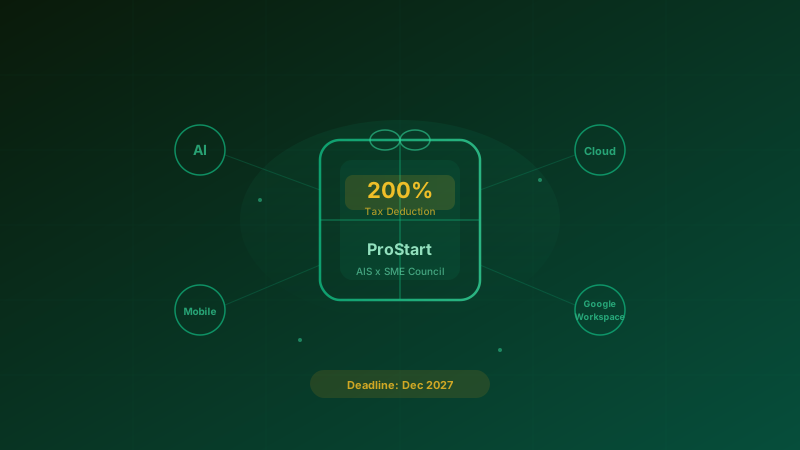
200% Tax Deduction for SMEs (Through Dec 31, 2027)
- SMEs with registered capital of no more than THB 5 million and revenue not exceeding THB 30 million/year
- Eligible for a 200% tax deduction on digital spending, up to THB 300,000
- Covers cloud services, software, and digital transformation expenses
Source: LexNova Partners, BizWings
BOI Investment Promotion
- Data centers, cloud computing, and AI infrastructure are classified as strategic investment promotion sectors
- Benefits include 8 years of corporate income tax exemption and import duty exemption
Source: Alvarez & Marsal, BOI
depa Digital Voucher
- d-voucher: access to digital tools for 6 months for 15,000 SMEs via the Tang Rat app
- d-transform: support grants of up to THB 200,000 for 600 SMEs
Source: depa
Gartner Magic Quadrant 2025 — All Three Are Leaders
One important fact: in the Gartner Magic Quadrant for Strategic Cloud Platform Services 2025, AWS, Azure, and GCP are all in the Leader quadrant.
- AWS has remained a Leader for 15 consecutive years
- Azure ranks highly in Completeness of Vision
- GCP stands out for the strength of its IaaS/PaaS portfolio
What Gartner is effectively telling us is this: all three are credible top-tier options. The real difference is fit for your specific use case, not overall quality.
Source: AWS Blog, Google Cloud, Microsoft Azure Blog — Gartner MQ 2025 announcements
Summary Comparison Table
| Dimension |
AWS |
Azure |
GCP |
| On-demand pricing |
Mid-range |
Mid-range |
Slightly lower |
| Discount model |
Upfront commitment |
Commitment + Hybrid Benefit |
Automatic |
| Thailand Region |
Live (Jan 2025) |
Live (Jan 2026) |
Under construction |
| Free Tier |
Broadest (60+ services) |
Most Always Free services (65+) |
Highest starting credit ($300) |
| Startup Credits |
Up to $300K (AI) |
Up to $100K |
Up to $350K (AI) |
| Service count |
Largest (200+) |
Broad + Microsoft ecosystem |
Focused on Data/AI/K8s |
| Gartner MQ 2025 |
Leader (15 years) |
Leader |
Leader |
| Thailand talent pool |
Largest |
Medium |
Growing |
How to Decide — A Decision Matrix for Thai SMEs
Instead of choosing based on "which one is best," try using this Decision Matrix:
Step 1: Start With Your Existing Stack
- Already using Microsoft 365? → Azure has an integration advantage
- Already using Google Workspace? → GCP may integrate more naturally
- Not tied to any major vendor? → You can compare more freely
Step 2: Look at Your Core Workload
- General web app / API? → All three do this well; compare mainly on price and operations
- Data analytics / ML? → Compare managed services in this area specifically
- Windows workload / .NET? → Calculate Hybrid Benefit before deciding
Step 3: Look at Your Team
- What does your team already know? → Choose based on team capability, not market hype
- No internal IT team? → Choose based on the partner who will support and maintain it
Step 4: Look Ahead
- Planning to scale mainly in Thailand? → A Thailand region matters
- Planning to expand across ASEAN? → Check region availability in your target countries
- Planning to invest heavily in AI/ML? → Compare AI services in detail
Step 5: Test Before You Commit
- Use each provider’s Free Tier to test your real workload
- Measure actual cost with each provider’s pricing calculator, not just the list price on the website
- Test real latency from the Thailand region
What Happens If You Choose the Wrong One — And How to Avoid It
Choosing a cloud platform is not like buying something you can swap out easily. Once you’ve deployed, the switching cost becomes very high — in time, money, and risk.
Risks of Choosing Poorly
- Costs spiral out of control — wrong discount model or over-provisioned resources
- Vendor lock-in — deep dependence on proprietary managed services makes migration difficult
- Talent mismatch — your team struggles with a platform they’re not familiar with
- Weak performance — poor region choice leads to higher latency
- Compliance issues — data is stored outside the country when regulations require it to remain in Thailand
How to Reduce the Risk
- Design a cloud-agnostic architecture where practical — use containers (Docker/K8s), standard databases (PostgreSQL), and standard APIs instead of heavily proprietary services
- Start small, measure, then scale — don’t commit to a 3-year plan on day one
- Set cloud spend as a % of revenue — for SMEs, an industry benchmark is around 3–8% of revenue
- Review costs monthly — use each provider’s cost management tools, which are free across all three
Conclusion — There Is No "Best," Only "Best Fit"
AWS, Azure, and GCP are all Leaders in the Gartner Magic Quadrant. Together, they have invested more than $7 billion in Thailand, and all three either have — or are building — data center infrastructure in Thailand.
The differences are more practical than absolute:
- AWS → largest ecosystem, broadest service catalog, biggest talent pool in Thailand
- Azure → the best fit if you already use the Microsoft stack; Hybrid Benefit can reduce costs dramatically
- GCP → especially strong in Data/AI/K8s, with automatic discounts and no upfront commitment required
So the right question is not "Which cloud is best?"
It is: "Which cloud best fits our workloads, team, budget, and business roadmap?"
And if you’re still unsure — test all three using their free tiers and let real usage data make the decision for you.
Need Help Evaluating the Options?
If your team is considering a move to the cloud or wants to compare real costs across providers based on your actual business workloads, the Enersys team has experience designing and deploying cloud systems for organizations in Thailand.
We help you determine which cloud is the best fit for your context — not push a specific provider.
Talk to the Enersys team
References
- Amazon Press Release — AWS Launches Infrastructure Region in Thailand (January 2025)
- Google Cloud Blog — Bangkok Region Launch (January 2026)
- Microsoft Source Asia — Thailand $1B+ Investment (March 2026)
- CNBC — Amazon Q4 FY2025 Earnings: AWS Revenue $35.58B
- CNBC — Alphabet Q4 2025 Earnings: Google Cloud Revenue $17.66B
- Microsoft Investor Relations — FY26 Q1 Intelligent Cloud: $30.9B Revenue
- AWS Blog — Leader in 2025 Gartner Magic Quadrant for 15 Consecutive Years
- Lexology — Thailand "Go Cloud First" Policy (October 2025)
- LexNova Partners — Thailand 200% Tax Deduction for SME Digital Spending
- Sedai — AWS EC2 vs Azure vs GCP Compute Pricing Comparison 2026
- Gart Solutions — Comparing AWS, GCP, Azure Startup Credit Programs
- depa — SME Digital Coupon Program