The Short Version
On April 8, 2026, Anthropic launched Claude Managed Agents as a public beta, available to all Anthropic API accounts.
This is not just another feature release. It is a fundamental shift in how AI agents get built.
Before Managed Agents, building a production-grade AI agent meant:
- Hiring ML engineers to build from scratch
- Designing your own infrastructure
- Managing security, sandboxing, and credential isolation yourself
- Spending months before anything reached production
After Managed Agents? You define your agent, specify tools and guardrails, deploy on Anthropic's platform — weeks, not months.
But there are caveats. Read on.
Why This Is the "AWS Lambda Moment" for AI Agents
Cast your mind back to 2014, when AWS launched Lambda — the first time developers could run code without managing servers at all. Just write a function, let AWS handle the rest.
The impact was enormous: costs dropped, time-to-market shrank, and three-person startups could scale like enterprises.
Claude Managed Agents is the Lambda moment for AI agents.
Instead of provisioning servers, managing containers, and building orchestration layers from scratch, you simply define what the agent should do, what tools it has, and what rules it follows. Anthropic handles the rest.
Businesses that once needed million-baht investments in ML ops teams can now start with $0.08 per session-hour plus standard API token costs.
The Architecture That Changes Everything
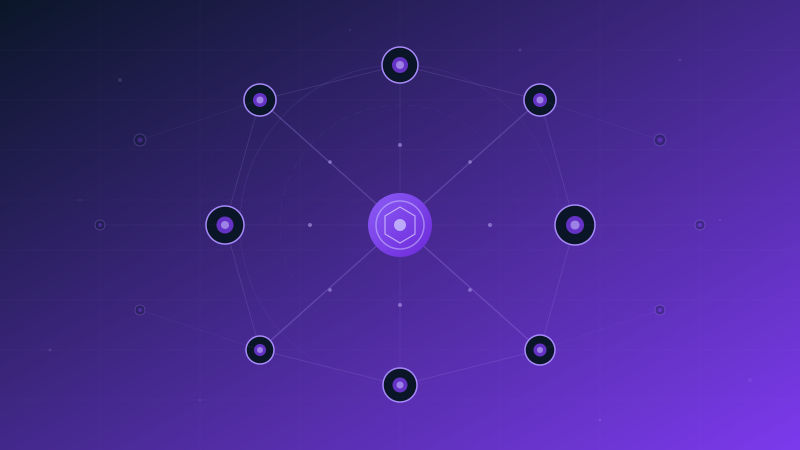
What makes Managed Agents fundamentally different from typical AI agent frameworks is its three-part decoupled architecture:
1. Brain — The Thinking Layer
Claude model plus a control harness. Makes decisions about what to do next, which tool to use, how to respond.
2. Hands — The Execution Layer
Sandboxed containers plus tools — reading files, writing files, searching the web, running commands. Everything runs in a secure, isolated environment.
3. Session — The Durable Memory
A persistent event log that records everything that happens in a session. If something breaks mid-task, the agent can pick up exactly where it left off.
The key insight: all three components can fail independently. If a sandbox crashes, just spin up a new one — the session and context survive. If the model hiccups, retry without starting from scratch.
For anyone who has designed enterprise systems, this is fault tolerance baked into the core, not bolted on afterward.
The Numbers You Need to Know
Forget the marketing pitch — look at the data:
Speed
- Time-to-first-token dropped ~60% at median and over 90% at p95 by eliminating mandatory container provisioning delays
- Development time reduced from "months to weeks"
Effectiveness
- Internal testing showed agents built on Managed Agents deliver a ~10-point uplift in task success versus prompt-only setups
Cost
- Standard Claude API token rates + $0.08 per session-hour
- No additional infrastructure costs. No container fees. No orchestration overhead.
Security
- Credentials never exist in sandboxes where agent-generated code runs
- Auth tokens stored in external vaults, accessed through dedicated proxies only
These numbers come from Anthropic's engineering blog and multiple independent tech publications — not a sales deck.
Who Is Already Using It?
This is not theoretical. Global organizations are already building on the platform:
- Notion — the workspace tool with hundreds of millions of users
- Rakuten — Japan's e-commerce giant
- Asana — enterprise project management platform
That companies of this scale chose Managed Agents tells you two things:
- The security bar is high enough for large enterprises
- It is more cost-effective than building in-house, even for companies with hundreds of engineers
Built-In Tooling
Managed Agents ships with foundational tools that cover most common tasks:
- File management: read, write, edit, and search files within the system
- Command execution: run operations in a secure terminal environment
- Web access: fetch data from the internet in real-time
- Text search: find specific information across large file sets quickly
Everything runs inside sandboxed containers — the agent can operate freely within its sandbox but cannot directly access external systems.
The platform also includes research preview features such as sub-agent spawning for complex tasks and automatic prompt refinement that improves agent instructions iteratively.
Impact on Thai Businesses — 5 Things to Prepare For
1. AI Agents Are No Longer Reserved for Big Enterprises
At $0.08 per session-hour, SMEs with monthly IT budgets in the tens of thousands of baht can run real AI agents.
Consider: an agent handling customer emails, managing purchase orders, or reviewing documents. Running 8 hours a day, the session cost is roughly $0.64 per day (~22 THB) plus token costs.
Compare that to hiring even one ML engineer to build the same system. The gap is enormous.
2. Security Architecture That PDPA Demands
What makes Managed Agents especially relevant for Thai businesses is the security architecture.
Credentials never exist in the sandbox where agent code runs. Auth tokens sit in separate vaults, accessed only through dedicated proxies.
For businesses that must comply with PDPA, this is the right design pattern: separate sensitive data from the code execution environment.
Managed Agents is not automatically PDPA-compliant, but its foundational architecture aligns with data privacy principles from the ground up.
3. Development Time Drops from Months to Weeks
Before Managed Agents, building a production AI agent meant:
- Designing architecture
- Building sandbox environments
- Setting up credential management
- Creating orchestration layers
- Testing and monitoring
- Deploying and maintaining
Each step took weeks. Combined, it took months.
Now the platform handles most of this. Development teams focus only on "what should the agent do" and "what are its rules".
4. Fault Tolerance That Enterprise Workflows Require
The Brain/Hands/Session architecture that fails independently is not just a technical detail — it is about production-grade reliability.
Imagine: an agent processing a purchase order for a client. If the sandbox crashes mid-task — in a traditional system, you might have to restart everything. With Managed Agents, the session persists. Spin up a new sandbox and continue.
For workflows involving money, documents, or compliance, this kind of fault tolerance is not a nice-to-have. It is a must-have.
5. Developer Tooling That Fits Existing Workflows
Managed Agents includes a CLI tool for terminal access, version-controlled configuration, and versioned agent definitions.
For development teams already comfortable with DevOps workflows, this is an AI agent platform that fits into existing processes — not a new paradigm that demands a complete workflow overhaul.
But Do Not Get Carried Away — What Still Requires Humans
Despite the massive reduction in infrastructure complexity, there are things the platform cannot do:
Designing the Right Agent
Ready infrastructure does not mean the agent will work correctly. You still need people who genuinely understand your business processes, workflows, and edge cases.
A poorly designed agent on great infrastructure = making mistakes faster.
Defining Appropriate Guardrails
Knowing what the agent can do, what it cannot, when it should escalate to a human, when it should stop — this requires domain expertise, not technical skill.
Integrating with Existing Systems
Most Thai businesses already run ERP, CRM, accounting, and HR systems. A good AI agent needs to connect with these seamlessly — not operate as an isolated island.
Measuring and Improving
The ~10-point uplift that Anthropic measured came from iteration — build, measure, improve, repeat. You need a team that understands both AI capabilities and business metrics.
What Should You Do Right Now?
Four recommendations for executives who have read this far:
1. Identify Use Cases That Fit AI Agents
Not every task needs an agent — some are fine with simple automation.
But tasks that suit agents are: multi-step decisions, multiple tools, and uncertainty.
Examples: purchase orders with variable conditions, customer inquiries that require searching across multiple systems, compliance document reviews with complex rule sets.
2. Get Your Business Processes Ready
A good agent needs clear "rules." If your business processes exist only in people's heads and are not documented anywhere, an agent cannot work with them.
Start writing SOPs, decision trees, and escalation rules now. They will become invaluable assets when you are ready to deploy agents.
3. Assess Your Data Privacy Readiness
Before deploying AI agents on real work, ensure that:
- Data sent to agents is handled in compliance with PDPA
- Proper consent exists for data processing
- Audit trails are in place and verifiable
Managed Agents includes a durable event log that records every action — but you need to design how to use that log in compliance with the law.
4. Find a Partner Who Understands Both AI and Business Process
This is not easy to do alone. You need a team that:
- Understands AI infrastructure deeply enough to design agents correctly
- Understands business processes well enough to define proper guardrails
- Understands ERP/CRM systems well enough to integrate agents into existing workflows
- Understands PDPA well enough to design safe data flows
How Enersys Sees This
Let us be clear: Enersys is a Software House specializing in Odoo ERP, AI, and Data Privacy (PDPA). We see Managed Agents through a different lens than most tech analyses.
We are not excited about this technology because it is new. We are excited because it removes barriers that previously kept our clients from deploying AI agents seriously.
- Our approach has been clear from the start: every AI project we deliver is designed so the infrastructure layer can be swapped without rewriting business logic. When Managed Agents is ready, we switch immediately.
- For Odoo clients: we help build structured workflows from day one. Clear business processes in Odoo become the knowledge base that agents can work with right away.
- For PDPA work: the architecture that separates credentials from the execution environment matches the principles we have been using to design data privacy systems all along. This is validation that our approach is correct.
- For process design: the fact that agents need clear "rules" reinforces that investing in process design from the beginning pays dividends. Clients who have done process mapping with us will deploy agents faster than anyone else.
We see Managed Agents as a tool, not an answer. The real answer lies in designing the right agent for your specific business.
Summary
Claude Managed Agents transforms the AI agent equation from "months-long custom project" to "ready-to-use infrastructure":
- Brain/Hands/Session architecture with fault tolerance baked in from the core
- Massive speed improvements — 60-90% reduction in time-to-first-token, development from months to weeks
- Pricing that SMEs can afford — $0.08 per session-hour, no infrastructure investment needed
- Security done right from the design stage — credentials separated from execution, aligned with PDPA principles
- But humans still matter — domain expertise, process design, integration, and guardrails remain essential
This news is not a call to rush out and sign up for an API today. It is a call to prepare so you are ready when the time comes to deploy.
If you want to explore how AI agents could fit into your business — connecting with Odoo, CRM, or existing workflows — the Enersys team is ready to talk.
Sources
This article analyzes the impact of Claude Managed Agents on Thai businesses, written by the Enersys team. All figures and facts are sourced from the references listed above.